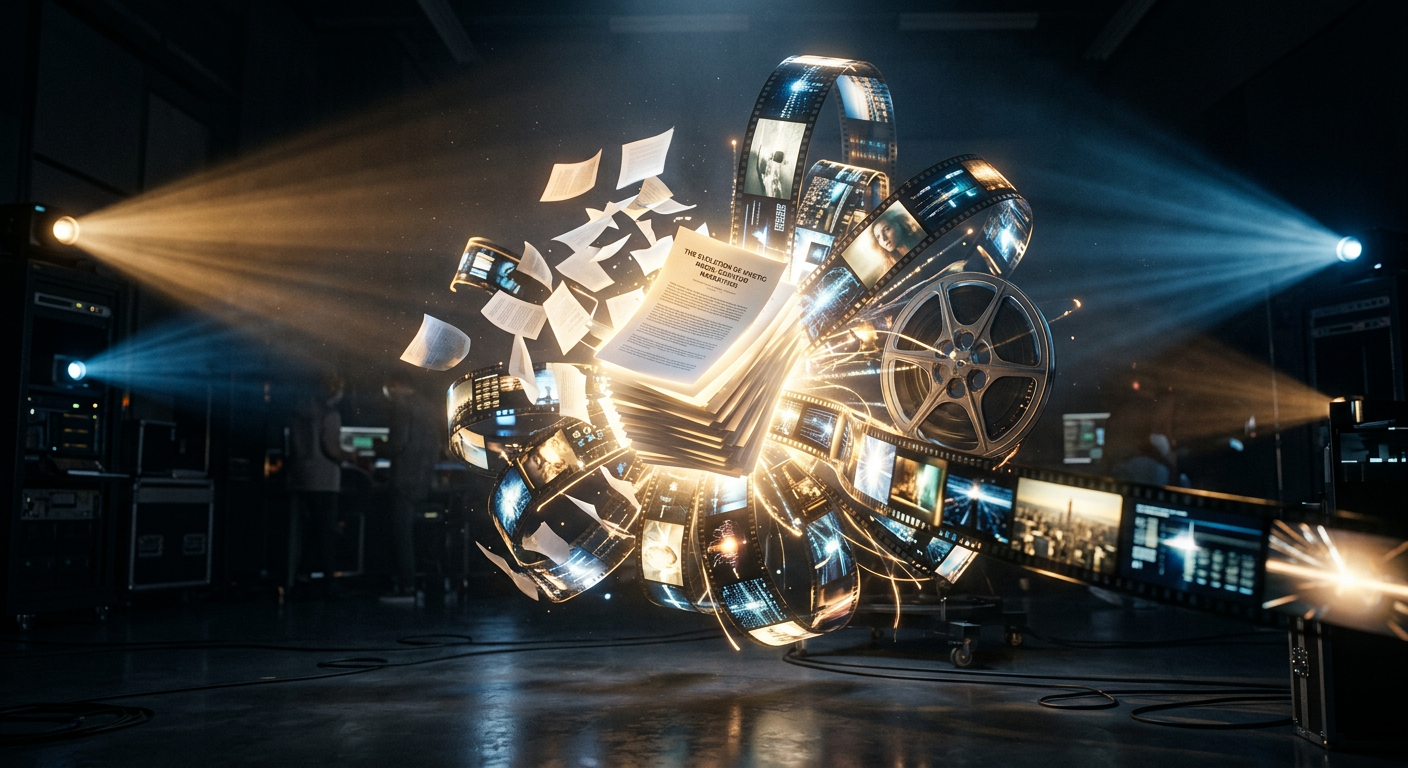
NotebookLM Cinematic turns research docs into produced explainer videos, changing the economics of internal knowledge communication
NotebookLM Cinematic and the Death of the “Nobody Read My Doc” Problem
Google quietly dropped something last week that I think is being badly misread by most of the people reacting to it.
NotebookLM Cinematic takes the audio podcast generator that already made content creators nervous and pushes it a full step further. You drop in research documents, PDFs, notes, whatever you have sitting in a folder, and it outputs a produced cinematic explainer video. Not a rough slide transition. Not a text-to-speech animation. A real video.
The immediate reaction on social media was predictable. Min Choi posted a thread on March 5th with the headline “Video editors are cooked” and eight examples of the output (https://x.com/minchoi/status/2029597201102410120). That framing got the engagement, but it also completely missed the more interesting story.
🎬 The Real Problem This Solves
Knowledge communication inside organizations is broken in a very specific, very expensive way.
An engineer finishes building a new system. They need to explain it to a non-technical stakeholder, or onboard a new teammate, or document a decision for future reference. The options available to them right now are: write a document that will probably go unread, schedule a thirty-minute meeting to explain something that should take two minutes, or build a slide deck that consumes two hours they do not have.
Every one of those paths has enormous friction. So most of the time, the knowledge just… stays in someone’s head. Or gets explained in a Slack thread that disappears into search.
NotebookLM Cinematic cuts that friction to nearly zero. You already have the docs. You feed them in. You get a produced video that a non-technical stakeholder can actually sit through.
Why This Changes Team Economics
The cost structure of video production has always been what kept it out of internal knowledge work. A produced explainer video for a new product feature might run thousands of dollars and take a week of coordination with a contractor or a design team. That math never made sense for a quarterly architecture review or a runbook update.
When the marginal cost of a produced video drops to cents and minutes, the calculation flips entirely. Suddenly video is the right format for things that would never have justified the investment before.
This is the same shift we saw with interior design rendering tools this week. Floor plan to 4K 3D rendering used to cost around $100,000 and take months. Now it takes minutes. When that kind of compression hits a workflow, the economics of who can afford to use that workflow change completely.
🧠 Where I Think This Actually Goes
The audio podcast feature in NotebookLM was already useful for processing dense research into something consumable while commuting. Cinematic makes that same value proposition work for audiences who would never hit play on a plain audio file.
I keep thinking about the specific use case of executive communication. Right now, getting a C-suite audience to absorb a technical decision document requires either a well-designed deck or a live meeting. Both take time that nobody has. A two-minute produced video explaining the architectural tradeoff, generated directly from the actual design docs, is a meaningfully better option.
The same logic applies to customer-facing documentation, onboarding materials, compliance training, and post-mortem summaries. Any context where someone currently says “I’ll send you a doc” and both parties know the doc probably won’t get read.
The Friction Reduction Is the Feature
People are framing this as “another AI content tool,” which puts it in the same mental bucket as AI-generated marketing copy or AI thumbnail generators. That is the wrong bucket.
The right frame is: this is an organizational knowledge tool that happens to produce video. The value is not the video itself. The value is that information which currently sits trapped in documents or in people’s heads now has a path to actually reach the people who need it.
Google has been building NotebookLM into something genuinely useful for knowledge workers. Cinematic is the version of that tool that works for audiences who were never going to engage with the text-first version.
The “video editors are cooked” take will generate more clicks. But the more honest take is that a lot of internal documentation processes are about to get replaced, and most organizations are not thinking about that yet.
#NotebookLM #GoogleAI #ProductivityTools #AITools #KnowledgeManagement #EnterpriseAI