Netflix releases VOID, an AI tool that removes objects from video and corrects physics post-removal
Netflix VOID: Object Removal Was the Easy Part
Every few months a video AI tool drops that makes editors collectively exhale. Netflix’s VOID is one of those tools. But it’s not doing what you think it’s doing, or rather, it’s not stopping where most tools stop.
The headline is object removal from video. Point at something, remove it. That capability has existed in various forms for years. Content-aware fill in Premiere, generative inpainting in Runway, rotoscoping workflows that take days of manual labor to accomplish roughly the same thing. The removal itself is a solved-enough problem.
What VOID does differently is what comes after.
The Physics Problem
When you remove an object from video, you create a gap. Not just a visual gap, a physically implausible one. Shadows don’t update. The ambient light that object was casting, bouncing, occluding disappears without the scene adjusting for it. If a person walks out and their shadow was falling across three other objects in the frame, those objects now look wrong. They’re lit as if the person is still there.
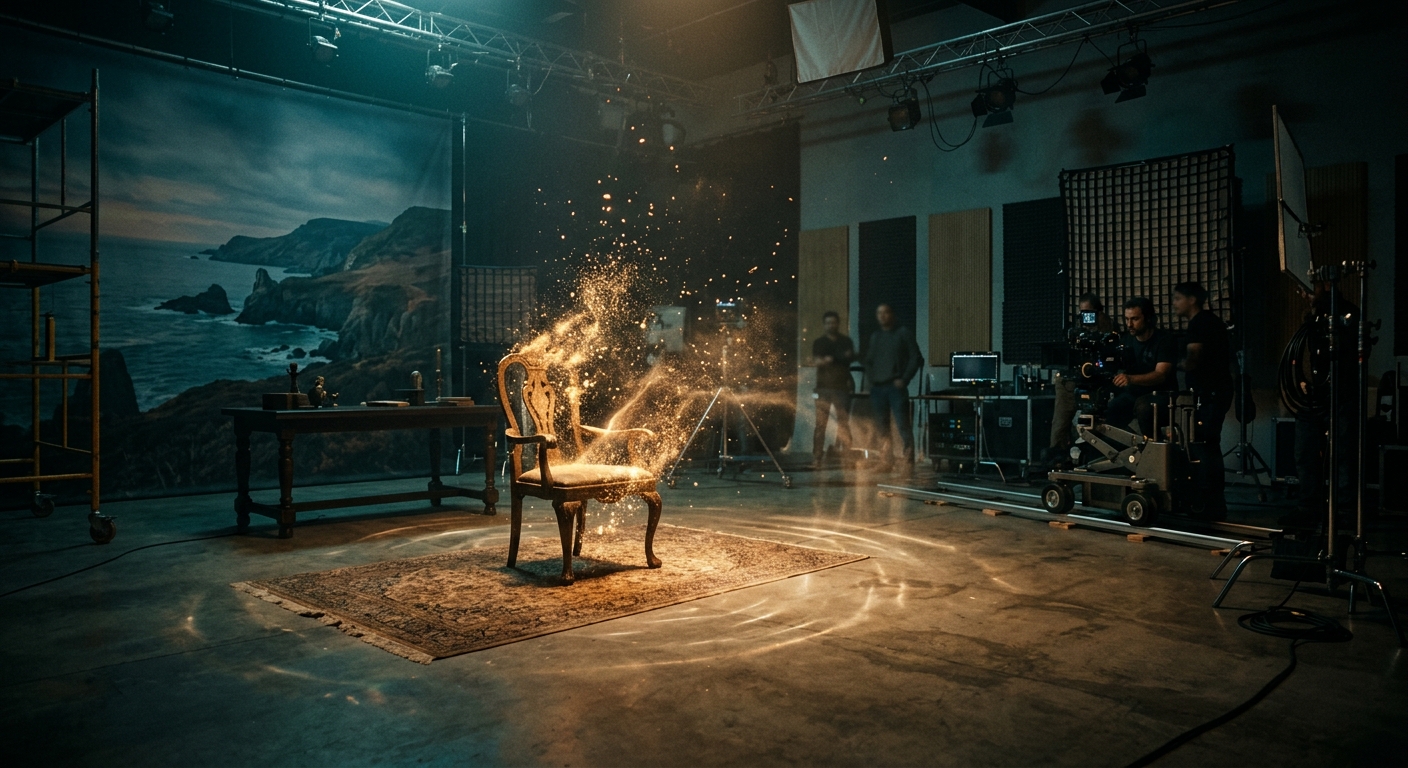
Most tools either ignore this entirely or approximate it badly. VOID corrects the physics post-removal. Shadows shift. Lighting around the removed region updates to match what the scene would actually look like without that object in it. Motion in surrounding elements adjusts.
This is a fundamentally harder problem than removal. Removal is pattern matching. Physics correction requires the model to have internalized some actual understanding of how light behaves in a scene, how shadows are cast relative to light sources, how removing mass from a composition changes everything downstream of it.
Why This Took So Long
The reason post-production editors have been doing this by hand for decades is that it requires contextual reasoning at a level that diffusion-based inpainting models consistently failed at. You can train a model to fill a masked region with plausible texture. Getting that infilled region to interact correctly with the rest of the frame over time, across motion, across changing light conditions, is a different class of problem.
Netflix has a specific advantage here. They have one of the largest libraries of professionally shot, color-graded, physically accurate video content on earth. If you’re training a model to understand how light actually behaves in cinematic scenes, that corpus matters enormously. This isn’t a research team working from YouTube scrapes.
What This Changes in Practice
For anyone who has spent time in post-production, the manual workflow for this is brutal. Rotoscoping a person out of a scene frame by frame, then painting back in believable lighting, can take hours per second of footage depending on the complexity of the shot. VFX houses charge accordingly. It’s one of the line items that balloons independent film budgets.
If VOID performs at the level the demos suggest, you’re looking at a tool that compresses that workflow from hours to minutes for a significant portion of use cases. Not all. Complex compositing with multiple interacting objects, specular highlights, translucency, these are still going to require manual work. But the 80% case, a person walks through a scene and you need them gone, that may be genuinely automated now.
I’d want to run this against actual production footage before calling it production-ready. Demo clips are curated. Real productions are messy. But the direction is clear.
My Take
I’ve watched a lot of “AI removes things from video” announcements. Most of them are demos designed to look impressive in controlled conditions and collapse under real-world testing. VOID is different in one specific way: Netflix actually named the hard part and claimed to have solved it. That’s either a bold accurate claim or an embarrassing one, and they know which. You don’t publish this to the public if your physics correction falls apart on anything other than a clean studio shot.
The deeper implication is that post-production workflows are about to get restructured from the bottom up, not gradually but in discrete jumps as tools like this move from proprietary internal use at a company like Netflix to broader availability. The editors who will stay valuable are the ones who understand when the AI’s physics intuition is wrong, because it will be wrong, just less often than before.
That’s the actual skill now. Not doing the correction manually. Knowing when the correction is broken.
Sources & Further Reading
#Netflix #AIVideo #VideoProduction #MachineLearning #PostProduction #ComputerVision #AITools