Tesla Cybercab enters production — what it means as an AI inference and fleet learning story
Cybercab Is in Production. Here’s Why That’s an AI Story, Not a Car Story.
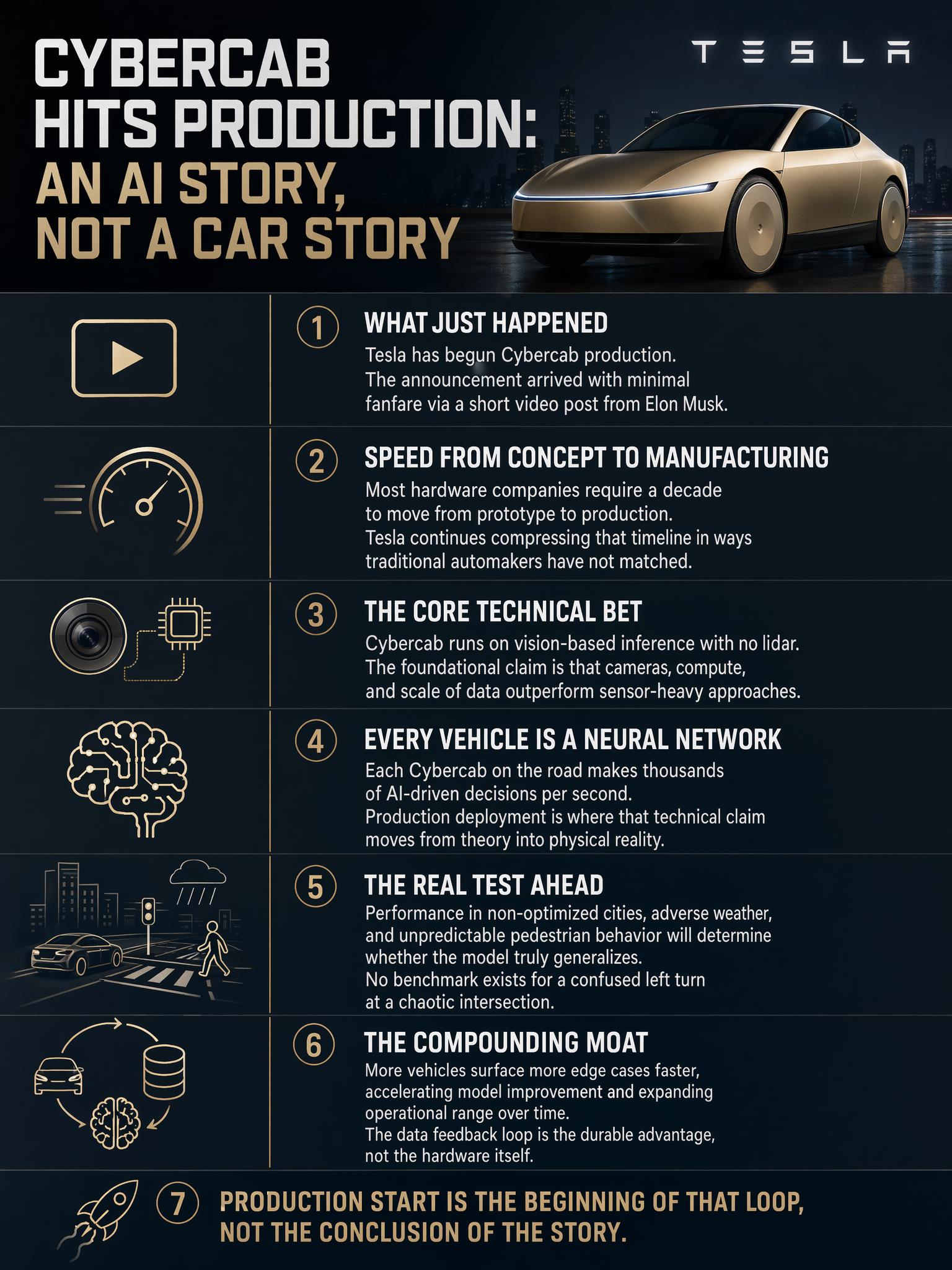
Elon posted it Friday morning. No press release, no event, no staged reveal. Just a short video and four words: “Cybercab has started production.” That’s it. After years of concept renders and prototype teases, the thing is actually being built.
I’ve been watching this project since the original reveal, and I’ll be honest, the speed still surprises me. Most hardware companies take the better part of a decade to close the gap between concept and manufacturing line. Tesla keeps compressing that timeline in ways that make the traditional auto industry look like it’s operating on geological time.
But here’s my actual take as someone who works in AI every day: this is not a car story.
The Inference Problem on Wheels
Every Cybercab rolling off that line is a real-time inference engine. The vehicle makes thousands of perception and decision calls per second, purely from camera inputs. No lidar. Tesla made that bet years ago, and the Cybercab doubles down on it completely. The argument was always that cameras plus sufficient compute plus enough training data would outperform sensor-heavy approaches, because cameras are cheap, scalable, and approximate what human vision actually does.
That bet is now in production hardware.
The compute sitting inside each unit has to handle object detection, path planning, edge-case reasoning, and fail-safe logic all at once, at latency margins where “slow” means dangerous. That’s not a research problem anymore. That’s an engineering problem that’s been solved well enough to ship.
The Fleet Learning Angle Nobody Talks About Enough
Here’s what I think gets undersold in every Cybercab conversation: the feedback loop.
Each vehicle isn’t just running inference. It’s generating labeled real-world data at scale. Every novel edge case, every near-miss scenario, every weird intersection geometry gets flagged and eventually feeds back into training. When you have hundreds of vehicles operating commercially, you’re not just running a robotaxi service. You’re running the world’s most expensive data collection operation, except it also happens to generate revenue while it runs.
Waymo has done this too, but with a hardware cost per vehicle that made fleet scaling genuinely painful. Tesla’s camera-first approach, whatever its tradeoffs in raw sensor fidelity, makes the unit economics of a large fleet much more tractable. More vehicles means more data. More data means better models. Better models get pushed back to the fleet. The loop tightens over time.
This is the part that should make other autonomy players uncomfortable.
Why the “No Lidar” Bet Is More Interesting Now
The vision-only approach took real criticism for years, some of it fair. Lidar gives you precise depth information that cameras have to infer. In low-light, adverse weather, or genuinely ambiguous scenes, that inference can fail in ways that depth sensing doesn’t.
But Tesla’s counterargument was always about scale and learning. If your architecture requires a sensor that costs thousands of dollars per unit, you can’t build the fleet size that generates the training data that makes the model robust. You’re stuck. Vision-only, combined with massive fleet deployment, gives you a path to robustness through data volume that sensor-heavy approaches can’t replicate at the same cost curve.
Whether that bet fully pays off operationally is still an open question. But the fact that production has started means Tesla believes the model quality is now good enough to stake commercial operations on it.
What “Production Started” Actually Signals
A lot of coverage will focus on the robotaxi business model, the regulatory path, and whether this threatens Uber. Those are real questions. But for me, the more interesting signal is what production start means for the underlying AI system.
You don’t ship this unless your inference stack has cleared an internal bar for reliability. You don’t open a commercial service unless your edge case coverage is at a threshold someone was willing to sign off on. That threshold isn’t “perfect,” nothing in deployed ML is, but it’s high enough to run vehicles carrying passengers in real traffic without a safety driver.
That’s a meaningful milestone for vision-based autonomy. Full stop.
The robotaxi wars aren’t really about who builds the nicest car. They’re about who builds the best continuously-learning inference system and deploys it at the scale needed to keep improving. Tesla just moved that competition to a new phase.
Sources
#Tesla #Cybercab #ArtificialIntelligence #MachineLearning #AutonomousVehicles #AIEngineering