Solo operator runs 7-agent Claude pipeline earning $18,800/month selling websites to local businesses via Google Maps scraping and automated outreach
One Guy, One MacBook, $18,800 a Month
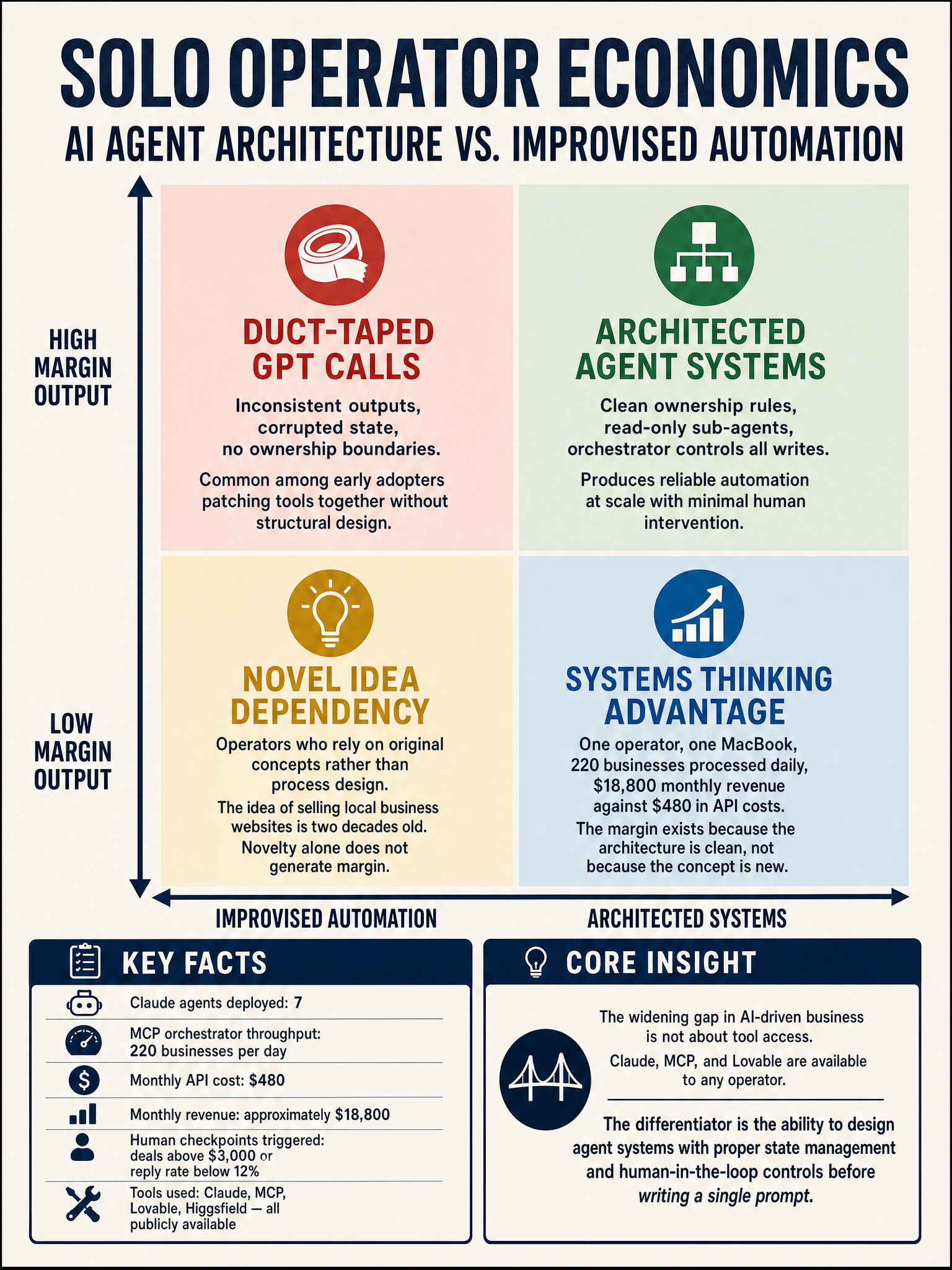
I have seen a lot of “AI agency” pitches in the past two years. Most of them are courses dressed up as case studies. This one is different. A solo operator, no employees, no office, no sales team, is pulling $18,800 a month selling websites to local businesses. His overhead is $480 in API costs and a handful of SaaS subscriptions. The rest is margin. And the whole thing runs on seven Claude agents while he is asleep.
Let me walk through why this is actually worth paying attention to.
The Architecture
The pipeline lives at /Users/dev/maps-agency on a single MacBook. No cloud servers. No backend. Just a local file system, an MCP router, one Anthropic API key, and that same key forwarded to Claude Code on an iPhone.
Seven agents, each with a single job. Scout scans Google Maps across cities like Austin, Denver, and Miami, hunting for businesses with five or more years on the map, fewer than 50 reviews, and either no website or one from 2014. Diagnoser writes a 50-word brief per lead, including tone, hero angle, and a cold message under 70 words. Builder generates a Lovable landing page mockup for the top five leads with the sharpest diagnoses. Filmer pulls screenshots and renders a 10-second vertical video in Higgsfield. Pitcher routes the outreach by niche: email to roofers, SMS to tradesmen, Instagram DMs to salons, LinkedIn to realtors. Checker runs every message through evals to strip AI markers before anything goes out. And Mobile lives on the iPhone, picks up positive replies in real time, and books Zoom calls via Calendly while the owner is on the subway.
Scout processes roughly 220 businesses per day and passes 30 leads to Diagnoser. Pitcher sends 30 personalized messages across four channels with a reply rate around 14%. On a typical Saturday, five positive replies come back and three Zoom calls get booked for Sunday.
The System Prompt Design Is the Real Product
Here is the orchestrator’s opening instruction, quoted directly:
“You are the orchestrator of a solo agency that sells ready-made websites to local businesses. You delegate read-only tasks to 6 sub-agents and own all writes.”
That single constraint, the orchestrator owns all writes, is what prevents race conditions across a shared file system with no in-memory shared state. Each sub-agent reads. Only the orchestrator commits. It is clean concurrency without a database.
The human steps in under exactly two conditions: a deal exceeds $3,000, or the reply rate for a niche drops below 12% in a day. Everything else is autonomous. The system even flagged a $3,400 deal with The Lotus Salon for manual review because it crossed the threshold. The owner tapped approve and joined the call ten minutes later.
3 million tokens a day at roughly $480 a month in API costs. That math works because Claude Sonnet handles the heavy lifting without burning through the budget that a GPT-4-class model would.
What This Actually Means for the Industry
Traditional web design agencies run teams of eight people to handle a similar volume of client acquisition and delivery. This operator serves 47 businesses a month at $400 each. The gap between his cost structure and a traditional agency’s is not incremental. It is structural.
I am not going to pretend the Google Maps scraping angle is without legal gray area, because it is. And cold outreach at scale always risks spam territory depending on jurisdiction and channel. Those are real considerations, not footnotes.
But the underlying architecture is legitimate engineering. The agent boundary design, the file-system-as-state approach, the eval layer before any message fires, the channel routing by niche. These are decisions that reflect actual systems thinking, not just prompt hacking.
Where This Goes
The business model is not defensible forever. As more people copy it, the cold outreach reply rates will compress and local businesses will get noisier inboxes. The 14% reply rate he is seeing now will not hold at scale across the industry.
What is defensible is the operator who builds the fastest iteration loop, the best eval quality, and the deepest niche specialization. The guy who figures out that HVAC contractors in secondary markets respond to a very specific message format will outperform the one blasting generic mockups.
The MacBook is not the moat. The system prompt is not the moat. The judgment about when to intervene and how to tune the evals, that is where the durable edge sits.
Seven agents and one phone number is a business. For now.
Sources & Further Reading
#AIAgents #MCP #ClaudeAI #SoloOperator #AIAutomation #LocalBusiness #IndependentBuilder