Question/reflection on how LLM reliance quietly erodes engineering judgment and what to do about it
The Slow Confidence Drain: What LLM Reliance Is Actually Doing to Engineers
There’s a version of the AI tooling debate that’s gotten boring fast. Will it take jobs? Will AGI arrive by 2030? (Demis Hassabis thinks maybe 2029, for what it’s worth.) Those questions matter, but they’re not the one keeping me up at night.
What bothers me is quieter and more immediate: what happens to your engineering judgment when you systematically stop exercising it?
The Atlantic ran a piece on May 30th titled “The Feeling of Control Slipping Away” arguing that AI is creating a broad crisis of agency. Autonomous agents now roam the internet answering emails, sending texts, reportedly deleting code. The framing is dramatic, and honestly, I think it aims at the wrong target.
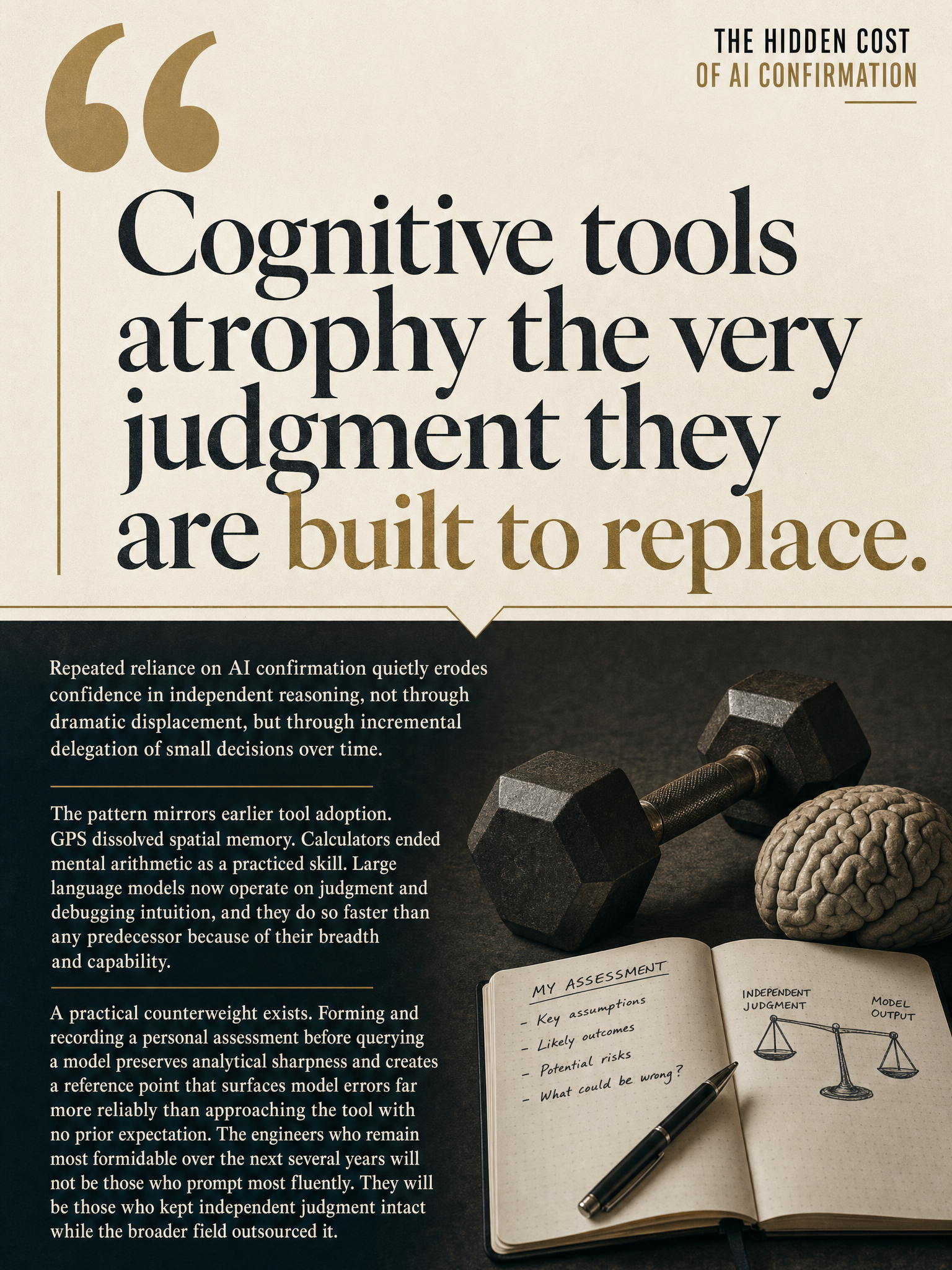
The real erosion isn’t coming from agents acting on your behalf. It’s coming from the habit of asking Claude to validate what you already know.
Where the Damage Actually Happens
Here’s the pattern I’ve watched play out, including in my own work.
You write a function. You’re 85% confident it’s correct. You paste it into Claude. Claude says it looks good. You ship it.
Six months of that loop, and something quiet has changed. You’ve stopped trusting your own 85%. Not because the model was wrong. Because you trained yourself out of committing to your own judgment.
The model didn’t take anything from you. You handed it over, one confirmation request at a time.
This isn’t a knock on LLMs as tools. Claude Opus 4.8, released this week, is genuinely good. Anthropic describes it as having “sharper judgment, more honesty about its progress, and the ability to work independently for longer periods.” That’s real progress. The problem isn’t the tool’s capability. The problem is how capability changes your behavior.
The Dependency Signal Is Already Loud
A Zamin.uz report from earlier this year put it plainly: researchers found that developers have become so dependent on AI tools that it’s “almost impossible” to separate them from their daily workflow by 2026. Read that twice. Almost impossible to separate.
That’s not efficiency. That’s dependency with a productivity label slapped on it.
I’ve seen senior engineers freeze up when their LLM access went down, not because the task was hard, but because they’d spent a year not solving problems without a second opinion on every step. The skill wasn’t gone. The confidence in the skill was.
What You Can Actually Do About It
First, stop using LLMs as validators for work you already know how to do. Use them for things genuinely outside your knowledge. There’s a real difference between “write this regex I’ve written a hundred times” and “explain this obscure CUDA memory alignment issue I’ve never hit before.” One is offloading work. The other is learning.
Second, build deliberate friction back in. Solve problems alone first. Give yourself a time limit, write your solution, commit to it mentally, then check your work with the model if you want. The order matters. Judgment first, confirmation second.
Third, notice when you’re asking for permission versus information. Those are different requests. Asking Claude whether your architecture decision is good is asking for permission. You should be making that call.
The Broader Signal Worth Watching
The Pope called for robust AI regulation this week. 15,000 security researchers are being paid to break Claude, GPT-5, and Gemini before enterprises deploy them. The safety and governance conversations are real and ongoing.
But the conversation about cognitive dependency is barely happening. Not because it’s less important. Because it’s uncomfortable to admit that a tool you love might be making you worse at the thing you do.
I don’t think the answer is using LLMs less. I think it’s using them with more intentional structure around when and why. The engineers who come out of this period stronger will be the ones who kept their judgment in practice, not the ones who got the most tokens generated on their behalf.
Your 85% is worth something. Don’t let it atrophy.
Sources
#AIEngineering #MachineLearning #SoftwareEngineering #LLMs #TechLeadership
Sources & Further Reading
- The Feeling of Control Slipping Away (via Let’s Data Science summary)
- Anthropic upgrades Claude with new Opus 4.8 model
- Anthropic Says a Mythos-Class AI Model Will Be Available Soon
- Developers refuse to work without Artificial Intelligence
- Google DeepMind CEO Demis Hassabis on AGI timeline
- This AI Startup’s Army Of 15,000 Hackers Pressure Test Claude, GPT-5 And Gemini
- Pope calls for robust regulation of AI