OpenAI launches Codex Sites (URL-shareable apps from natural language) and role-specific work plugins across sales, analytics, and design
OpenAI Isn’t Building a Better Code Editor Anymore
Something shifted this week in how OpenAI is positioning Codex, and I think a lot of people in the developer community missed it because they were watching the wrong thing.
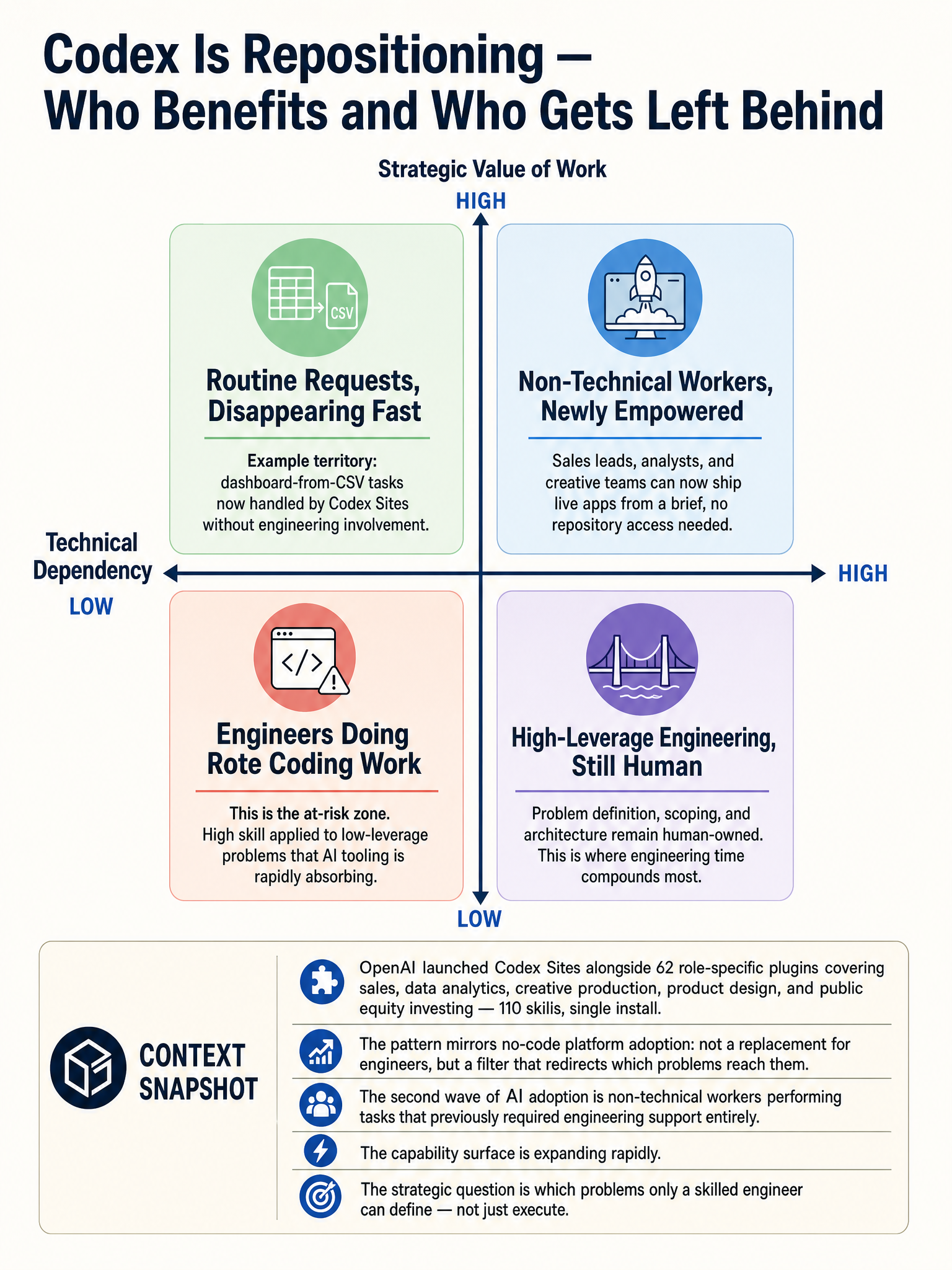
The headline features look incremental on the surface. Codex Sites lets you turn an idea into a shareable web app via URL, no code required. Five new role-specific plugin bundles dropped for sales, data analytics, creative production, product design, and public equity investing. Single install, 62 apps, 110 skills. Business and Enterprise plans get first access before broader rollout.
But the packaging tells you more than the features do.
What OpenAI Is Actually Doing
This is a deliberate repositioning. Codex started as a code completion model. Then it became an agentic coding tool. Now OpenAI is wrapping it in the language of departments, job titles, and workflows that have nothing to do with writing software.
The sales plugin tweet from OpenAI reads: “Prep faster. Sell smarter.” The data analytics one says: “Translate data into answers.” These are not messages aimed at engineers. They are messages aimed at sales managers, analysts, and creative directors who have never opened a terminal in their lives.
“No coding required” is not a disclaimer. It is the product strategy.
The Codex Sites Angle Is Bigger Than It Sounds
The Sites feature is where this gets genuinely interesting to me. Taking someone’s work, ideas, and plans and turning them into an interactive web app their team can explore and share via URL is a different value proposition than “write code faster.”
This is closer to what Notion, Airtable, and Webflow have been building toward, except now it collapses the entire build step. You describe what you want. You get a URL. That is a meaningful compression of effort for non-technical workers who have been stuck waiting on engineering backlogs for years.
I have some skepticism about how polished the output actually is at this stage. Shareable prototypes and production-grade apps are not the same thing, and OpenAI has a track record of announcing capabilities before the rough edges are fully smoothed down. But the direction is correct.
Why the Plugin Structure Matters
62 apps and 110 skills bundled into role-specific packages is not an accident. It mirrors how enterprise software gets bought and deployed. You don’t sell a sprawling toolset to a company, you sell a solution for a team. A “sales plugin” maps to a budget owner. An “analytics plugin” maps to a data team. That is how SaaS companies have sold for two decades.
OpenAI is learning how to sell to businesses, and it shows.
The simultaneous announcement that OpenAI frontier models and Codex are now generally available on AWS through Amazon Bedrock also matters here. Enterprise buyers already have AWS procurement workflows, compliance frameworks, and security governance in place. Plugging into that reduces the friction that has slowed adoption in larger organizations. OpenAI is removing excuses, not just adding features.
What This Means If You Build With or Around Codex
If you are building developer tooling that competes on the “write code faster” angle, this week should prompt a strategy conversation. OpenAI is moving upmarket and outward into business functions that were never part of the original Codex pitch.
If you are on the enterprise software side, the role-specific plugin framing is the part to watch. The question is no longer whether AI will get embedded into department workflows. The question is whose AI gets there first and whether the integrations are deep enough to create switching costs.
For the non-technical worker, this week’s announcements are the most significant in a while. Getting from idea to shareable app without touching code, with your existing sales tools or analytics stack already connected, is a real change in what is possible on a Tuesday afternoon with no engineering help.
I do not think Codex Sites replaces real software development for anything with complexity or longevity. But it does not need to. It just needs to handle the long tail of internal tools, one-off reports, and quick prototypes that eat engineering time without ever making it onto a roadmap.
That tail is enormous.
Sources
#OpenAI #Codex #AIStrategy #EnterpriseAI #NoCode #ProductStrategy