Google DeepMind adds native computer use to Gemini 3.5 Flash for browser, mobile, and desktop agent development
Google DeepMind Gave Agents a Native Screen. Here’s Why That Changes the Architecture.
Google DeepMind quietly dropped something last week that I think is going to matter more than its announcement suggested. Gemini 3.5 Flash now supports native computer use. One tweet, a link, not much fanfare. But the technical implications are worth sitting with.
Why Native Is Different
Most teams building computer-use agents today are assembling a stack from parts. A vision model reads the screen. Some DOM parsing logic extracts structure. A control loop sequences the actions. A few increasingly creative hacks deal with iframes, shadow DOMs, and anything a website does that breaks your assumptions.
It works. Sometimes. Until a site redesigns its nav, or a modal appears at the wrong moment, or the vision model misreads a button label by two pixels.
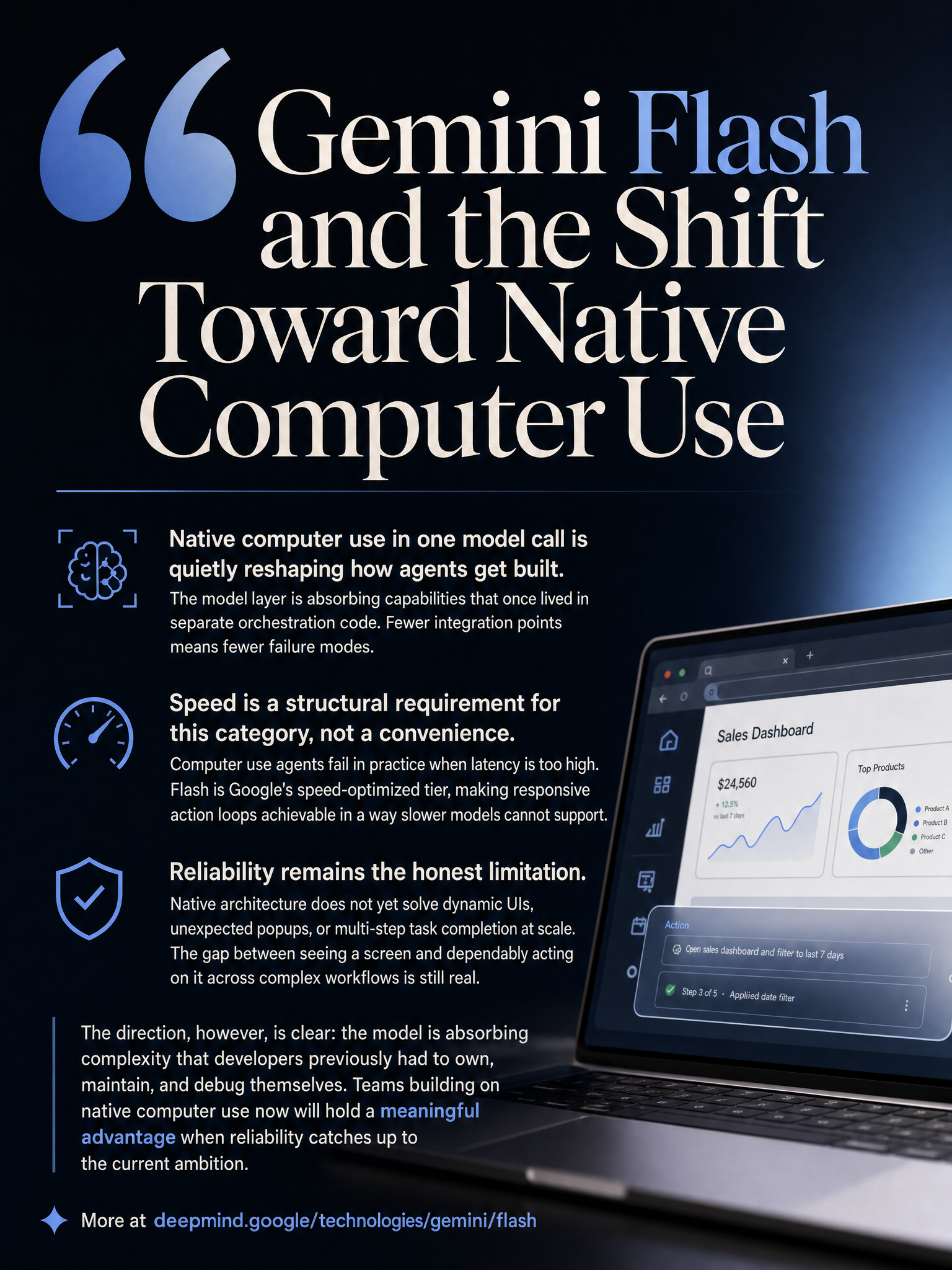
Native computer use means the model is not a component in that pipeline. It is the pipeline. Gemini 3.5 Flash now has a built-in tool that lets it see and act across browser, mobile, and desktop interfaces from a single model call. The model knows it has a screen. It reasons about what it sees as part of the same inference pass that decides what to do next.
That is a fundamentally different integration surface.
The Architecture Shift
When you stitch together separate models and controllers, you get error propagation. A misread from the vision model becomes a wrong action in the controller, which produces a broken state the next vision pass has to interpret. Each handoff is a place where things go wrong.
Collapsing that into a single model call removes most of those handoffs. The reasoning about what to do and the perception of what is on screen happen together. That is not a small improvement in reliability. It is a structural one.
This is the same reason end-to-end trained systems consistently outperform pipeline systems in robotics. When perception and action share gradients during training, the model learns to perceive in ways that are useful for acting. You do not get that from gluing two separately trained models together.
What Developers Actually Get
Concretely, this means you can build a browser agent, a mobile automation agent, or a desktop workflow agent without maintaining separate vision infrastructure. You describe a task, the model sees the current interface state, and it takes action. All through one API call.
For teams that have been waiting for computer use to stabilize before investing in it, this is a meaningful signal. Google DeepMind is betting on native integration as the right abstraction, and Gemini 3.5 Flash is a fast, cost-efficient model to build on top of.
The fact that it covers browser, mobile, and desktop in one capability matters too. You do not have to pick a surface and specialize your stack around it.
Where This Sits in the Broader Race
Anthropic has had computer use in Claude for a while, and it is genuinely good. OpenAI has been building toward agentic interfaces too, with Codex and operator-style agents getting more capable every month. Google DeepMind’s move with Gemini 3.5 Flash is not a surprise, but the native integration approach is a specific architectural opinion worth paying attention to.
The broader direction is clear. Every major lab is converging on agents that can take action in real software environments, not just generate text. The question is which abstraction wins. Modular pipelines offer flexibility. Native integration offers reliability and simplicity. I think reliability wins in production, which means native architectures have an edge as this matures.
What I Am Watching Next
The real test is not benchmarks. It is whether developers building production agents actually get fewer failures at the seams. That is where modular stacks lose time. If native computer use in Gemini 3.5 Flash delivers meaningfully better reliability on realistic agent tasks, not just demos, the architecture question is answered.
I am also watching latency. Flash is supposed to be fast. If the native tool overhead is low enough that it stays fast under agent workloads, that is a real competitive advantage over heavier setups.
The agent era is not coming. It is here and being plumbed in right now. The teams that understand why native integration is architecturally different from pipeline integration will build more reliable products faster than the ones still stitching vision models to control loops with duct tape.
🔧
#AI #AgentDevelopment #Gemini #GoogleDeepMind #MachineLearning #ComputerUse #AIEngineering