Critique: Meta’s failed AI workforce replacement attempt and what it reveals about deployment strategy vs. model capability
Meta Tried to Replace Workers With AI. Here’s What That Actually Reveals.
There’s a story circulating right now that’s being framed as “AI failed at Meta.” That framing is wrong, and the misread is itself the problem worth examining.
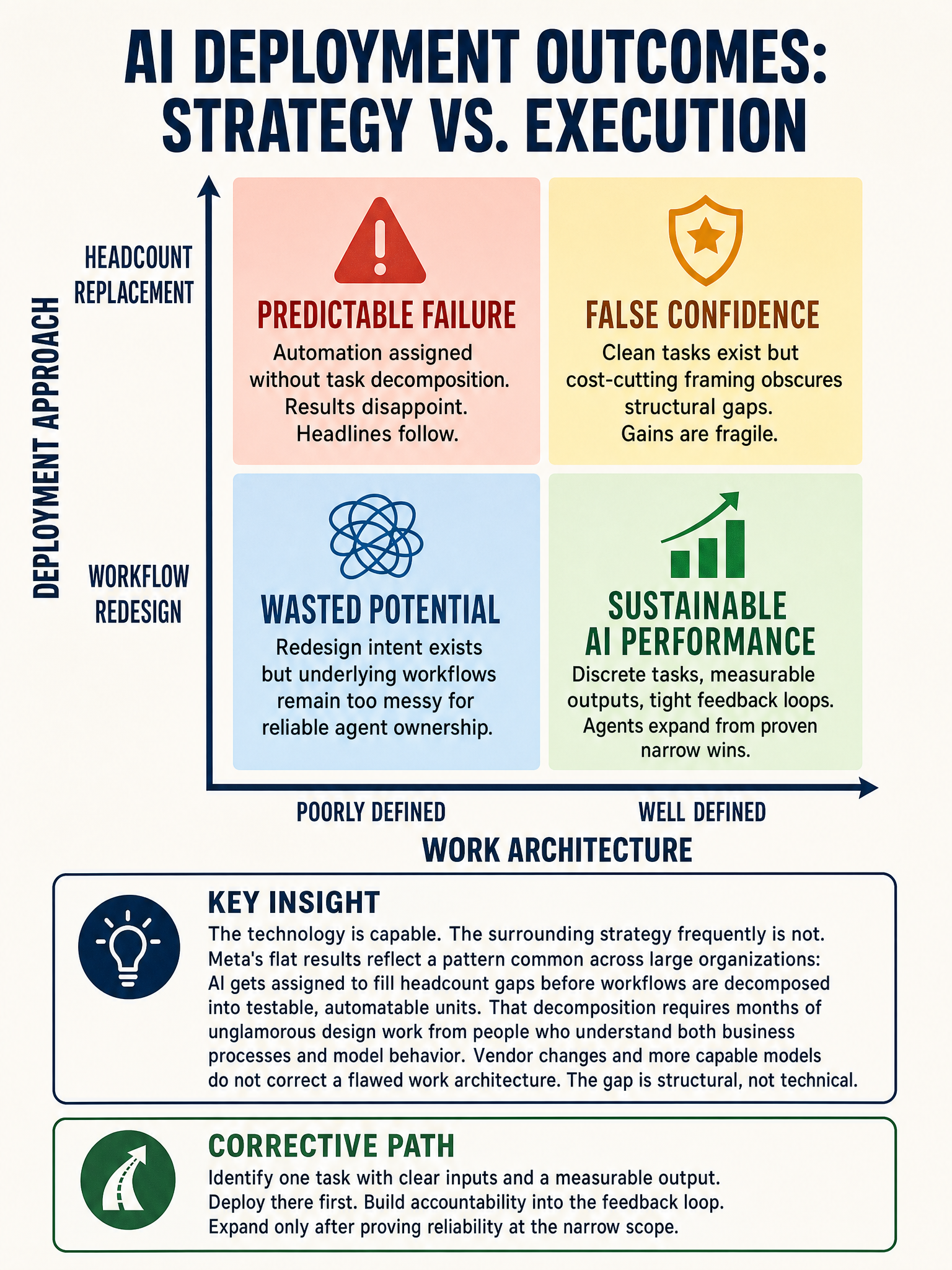
Meta’s attempt to replace portions of its workforce with AI fell flat, according to reporting from Computerworld in August 2026. The company assigned AI to fill headcount gaps without, apparently, doing the harder upstream work that would make that assignment viable. The result was predictable to anyone who has actually deployed agents in production.
This isn’t a story about model capability. It’s a story about deployment strategy.
The Decomposition Problem
Before any AI agent can own a task reliably, that task has to be decomposable. It has to break into discrete, testable, verifiable steps with clear success conditions at each one. Most enterprise work doesn’t look like that. It looks like a human navigating ambiguity, making judgment calls, bouncing between six tools, and patching over broken processes with institutional knowledge nobody ever wrote down.
You can’t hand that to an agent and expect output that satisfies anyone. The agent isn’t the weak link. The workflow is.
What I keep watching happen is this: leadership sets a headcount reduction target, AI gets assigned to fill the gap, and nobody asks whether the underlying processes were ever clean enough to automate. The AI struggles. The results disappoint. The headline writes itself.
The McKinsey State of AI 2026 survey found that organizations using AI across three or more business functions grew from 51 percent to 56 percent year over year. That’s adoption going up. But adoption and successful deployment are not the same number, and I’d wager the gap between them is exactly where stories like Meta’s live.
Capability Is Not the Constraint
This is the part that frustrates me most about how these failures get reported. Anthropic’s models are now reportedly writing up to 80 percent of their own code. Google DeepMind, despite a bruising summer of talent departures including Noam Shazeer and other Gemini co-leads, is still shipping competitive frontier models. OpenAI isn’t standing still. The capability argument is essentially over.
The models can do the work. The question is whether the organizations asking them to do it have done the preparation required. That preparation is hard, unglamorous, and doesn’t make for good board presentations. It involves process archaeology, workflow redesign, and building evaluation pipelines so you actually know when the agent is wrong. Most companies skip it.
Meta, apparently, skipped it.
What Good Deployment Actually Looks Like
The contrast worth paying attention to is in the companies treating AI as a workflow redesign project rather than a headcount substitution math problem.
iManage’s partnership with Google Cloud’s Gemini Enterprise for Legal is a reasonable example of the opposite approach. Legal document workflows have defined inputs, defined outputs, and established quality criteria. You can evaluate the agent. You can catch failure modes. That’s not an accident of the domain. That’s what disciplined scoping looks like.
The companies getting real results from agents right now tend to share one thing: they picked a narrow problem where success was measurable before they wrote a single line of integration code.
The Accountability Gap
Here’s my actual opinion: the Meta situation isn’t primarily an AI story. It’s a management story. Someone approved a strategy that treated model capability as a substitute for deployment rigor, and when it failed, “AI” absorbed the reputational damage instead of the decision-makers who skipped the hard parts.
That pattern will keep repeating until organizations start holding deployment strategy to the same standard as model selection. Picking the right model is maybe 20 percent of the problem. The other 80 percent is everything you do before and after the model touches your workflow.
The models are ready. The question going into the rest of 2026 is whether enterprise strategy will catch up.
Sources
#AIStrategy #EnterpriseAI #MachineLearning #AIDeployment #FutureOfWork
Sources & Further Reading
- Meta’s plans to replace workers with AI fell flat, report says
- The State of AI: Global Survey 2026
- iManage Accelerates Enterprise AI Transformation with Google Cloud’s Gemini Enterprise for Legal
- Google DeepMind Is Losing the AI Talent War It Used to Win Easily
- Chinese open-source AI is starting to win over U.S. businesses