Google DeepMind launches world’s first double-blind cryptographic evaluation of a frontier AI model and what it means for builder model selection decisions
Google DeepMind Just Changed How We Should Think About AI Benchmarks
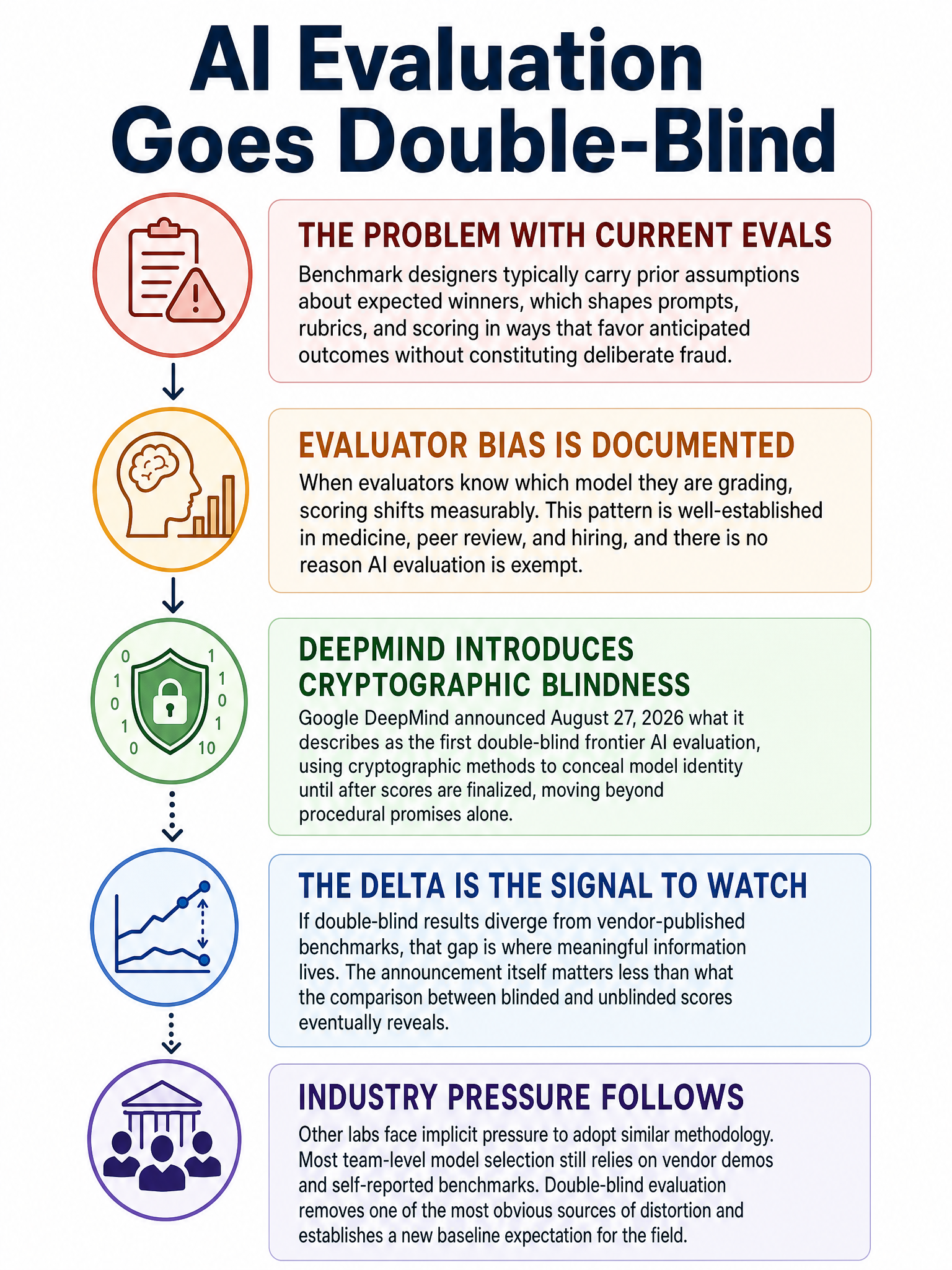
On August 27, 2026, Google DeepMind announced what it describes as the world’s first double-blind evaluation of a proprietary, frontier-class AI model. The pilot uses cryptographic methods to prevent evaluators from knowing which model they’re judging. My first reaction was: good. My second was: why did it take this long?
Every builder who has run internal evals knows the dirty secret hiding in plain sight.
The Benchmark Problem Nobody Talks About
The person designing the benchmark usually has a strong prior about which model should win. That prior shapes the prompt set, the rubric, what counts as “correct,” and which failure modes get weighted heavily. This isn’t fraud. It’s just human nature, and it compounds quietly across the industry.
The result is a years-long accumulation of eval data that flatters expected winners. We’ve been making architecture decisions on top of that.
When you’re choosing between Gemini, Claude, or GPT-class models for a production pipeline, you’re often relying on benchmark numbers that reflect, at least partially, the benchmarker’s assumptions. That’s a problem worth taking seriously.
What DeepMind Actually Built
The cryptographic blinding approach works by stripping identifying signals from model outputs before human evaluators score them. Evaluators can’t infer the model from response style, verbosity patterns, or formatting habits. The pilot is explicitly positioned as a methodology proof-of-concept, not a full model comparison release.
What I find interesting is the timing. DeepMind has had a rough summer on the talent front. Starting in mid-June, the team lost several prominent researchers, including Noam Shazeer, a co-lead on Gemini and one of the original Transformer paper authors. Announcing a credibility-building evaluation methodology right now is smart positioning, whatever the underlying motivation.
Why This Matters for Builders Specifically
If you’re selecting a model for a production system, you’re making a bet. You’re betting that the benchmark numbers you’re reading reflect something real about how the model will perform on your workload.
Double-blind evaluation, if the methodology holds up and gets adopted broadly, changes that calculus. It introduces a layer of measurement integrity that current leaderboards simply don’t have.
The Fortune reporting from the same week is relevant context here. Companies are already moving workloads off Claude to open-source Chinese models for document review, with CTOs arguing that large proprietary models aren’t necessary when you can specialize a strong open foundation. That trend is driven partly by cost, but partly by distrust in whether benchmark performance translates to real task performance.
Better evaluation methodology doesn’t just benefit model labs. It benefits the builders who need to make defensible architecture decisions.
The Financial Stability Board, in a press release from August 31, 2026, flagged risks from frontier AI models as a systemic concern. Regulators are paying attention. One consequence of that attention will be pressure for auditable, reproducible eval practices. DeepMind’s pilot is getting ahead of that curve.
What Still Needs to Happen
Cryptographic blinding solves evaluator identity bias. It doesn’t solve task selection bias, rubric bias, or the problem of benchmarks that measure proxy skills rather than the actual capability you care about. Those are harder problems.
One double-blind pilot from one lab is a data point. The methodology needs to be published in enough detail that other labs can replicate it, and then actually replicate it for models they didn’t build themselves. Cross-lab, third-party double-blind evaluation is the real target.
Until then, the practical advice for builders hasn’t changed much. Run your own evals on your own data before committing to a model for anything that matters. Public benchmarks are a starting point, not a decision. Weight recent third-party testing more than vendor-published numbers.
But the direction DeepMind is pointing is the right one. Measurement integrity is infrastructure. The field has been building on shaky ground, and at least someone is trying to pour a better foundation.
Sources
#AIEngineering #MachineLearning #LLMs #ModelEvaluation #BuildingWithAI