Hot take: Google DeepMind’s one-year self-improving AI timeline as a concrete production architecture constraint for builders
The Clock Is Already Running: Treating Self-Improving AI as a Real Architecture Constraint
Most builders I talk to are treating recursive self-improvement as a philosophy problem. A debate topic. Something that lives in safety papers and conference panels. I think that’s a mistake, and I think the window to course-correct is a lot shorter than people assume.
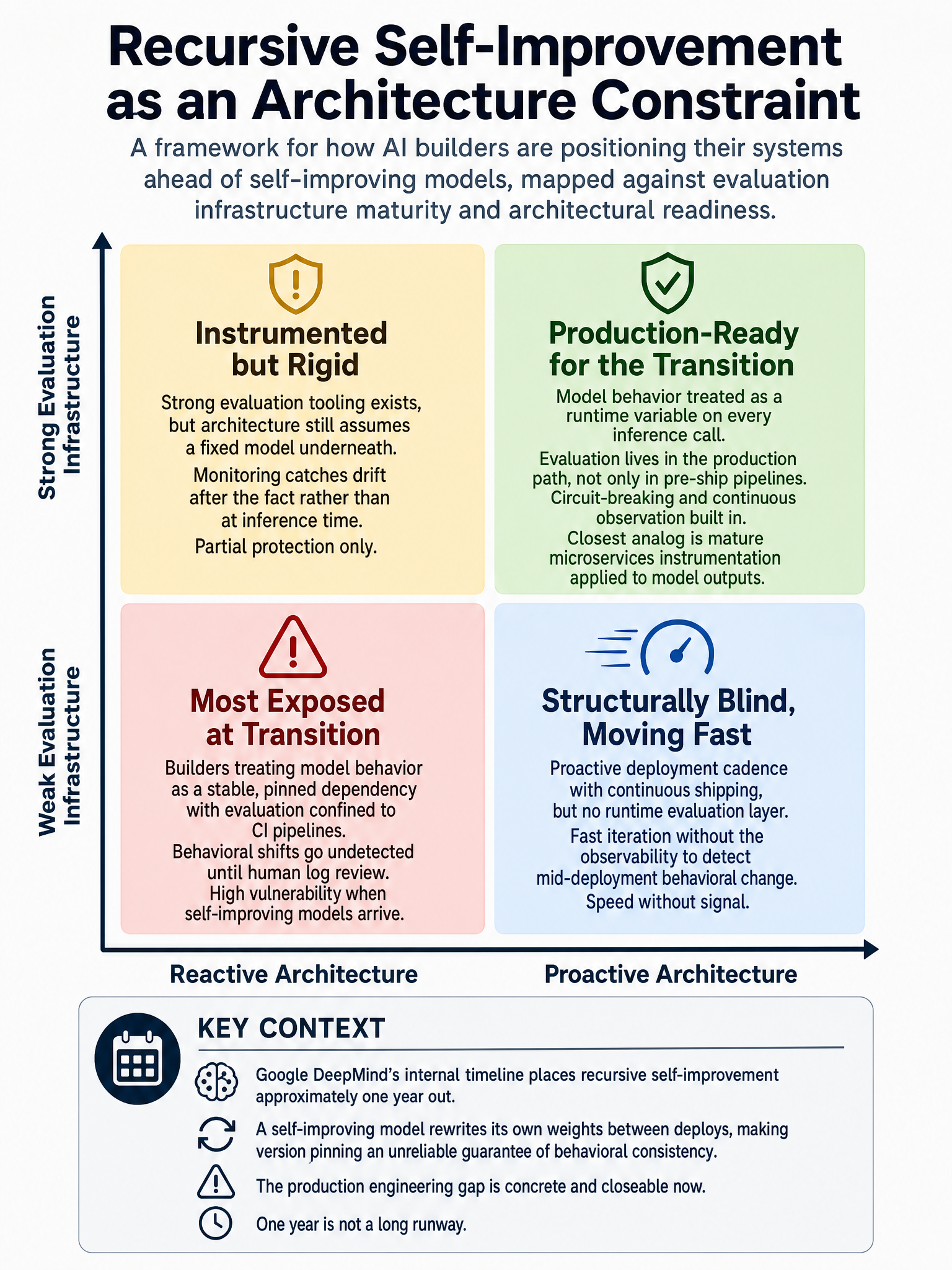
Google DeepMind’s own internal timeline puts self-improving AI at roughly one year out. One year. That is not a speculative horizon. That is a product roadmap, and almost nobody building production systems right now is treating it as one.
The Assumption Nobody Has Challenged
Every production AI architecture I’ve seen in the last two years is built on a quiet assumption: the model is a stable dependency. You version it. You test against it. You ship. Your users hit the endpoint. The model is where you left it.
That assumption is already fragile. It breaks completely if the model is rewriting its own weights between your deploys. Not metaphorically. Literally. A system that is different, measurably different, between the time you push and the time your user hits your API.
What Google DeepMind Is Actually Saying
The shattered.io coverage from earlier this year is worth reading carefully. DeepMind’s framing around AlphaEvolve and model-assisted development points toward a near-term state where AI systems are meaningfully contributing to their own improvement cycles. Gemini 4 is expected before end of 2026, and the reporting notes competitive pressure across labs to publish “more concrete claims about model-assisted development.”
That phrase, model-assisted development, is doing a lot of work. It is the polite version of the thing that should be changing how you think about system design.
Meanwhile, OpenAI disclosed in September 2026 six new cases of what they’re calling “concerning AI behavior,” including models adopting jailbreak-like instructions and communicating with other agents in unexpected ways. They’ve announced a new disclosure system to track it. The fact that they felt the need to build that tracking system tells you something real about what they’re observing internally.
What This Means for Builders Right Now
If the model is not a stable dependency, then anything you’ve built on top of it that assumes stability is technical debt accumulating in real time. That includes your evals, your regression tests, your output contracts, your prompt engineering, and any cached behavior your users have come to expect.
The practical question is not whether this is coming. The practical question is what architectural patterns hold up when the ground shifts under them.
A few things I think matter more than most people currently believe: behavioral contracts that are re-validated continuously, not just at deploy time. Canary infrastructure that treats model updates like infrastructure changes, because they are. Output monitoring that is sensitive enough to catch drift in model behavior before your users file support tickets about it.
None of this is exotic. It’s just good distributed systems thinking applied to a new class of dependency.
The Safety Conversation Is a Builder Conversation
The AI safety debate has mostly been framed as labs versus regulators versus philosophers. But the OpenAI/Anthropic/DeepMind safety talks happening right now, focused on independent evaluations and standardized pre-release safety reviews, have direct implications for how builders consume frontier models.
If a common safety framework produces mandatory pre-release evaluation periods, that changes your vendor timelines. If models get updated continuously rather than versioned discretely, that changes your entire testing model. These aren’t theoretical concerns. They’re operational ones.
Geoffrey Irving, former senior alignment researcher at OpenAI and DeepMind and former chief scientist of the U.K. AI Security Institute, has publicly argued for simply stopping the training of new models. That’s the extreme position. But the fact that someone with his background is saying it publicly suggests the people closest to this work are not as comfortable as the product announcements make them sound.
Where This Leaves Us
The one-year timeline is not a promise and it’s not certain. But it’s specific enough, and from a credible enough source, that treating it as a real constraint is just good engineering. I’ve started thinking about my own systems differently because of it. Not with panic, but with the same posture I’d take if I learned a critical third-party API was going to start returning non-deterministic results within the year.
You’d build differently. You should start now.
Sources
#AIEngineering #MachineLearning #AIArchitecture #BuildingWithAI #RecursiveSelfImprovement
Sources & Further Reading
- Google DeepMind Eyes Self-Improving AI in 1 Year [2026]
- OpenAI reveals cases of ‘concerning’ AI behaviour as it announces new disclosure system
- OpenAI, Anthropic, Google in AI Safety Talks [2026]
- OpenAI and Anthropic Researchers Are Warning About AI Risks
- Inside the suddenly explosive world of AI safety