Google Gemini 4 Argon gated rollout and what phased frontier model access means for builders in production
Gemini 4 Argon Is Not the Story. The Rollout Is.
Google dropped Gemini 4 Argon on September 30th, and the coverage followed a predictable pattern. Benchmark charts. Side-by-side comparisons with OpenAI’s Astra and Anthropic’s Opus. Alphabet shares up 1.7% in after-hours trading. The usual.
But if you’re building production AI systems, the number that actually matters isn’t on any leaderboard. It’s this: the model is not available to you. And Google has given no public timeline for when it will be.
That’s the story.
The Rollout Architecture
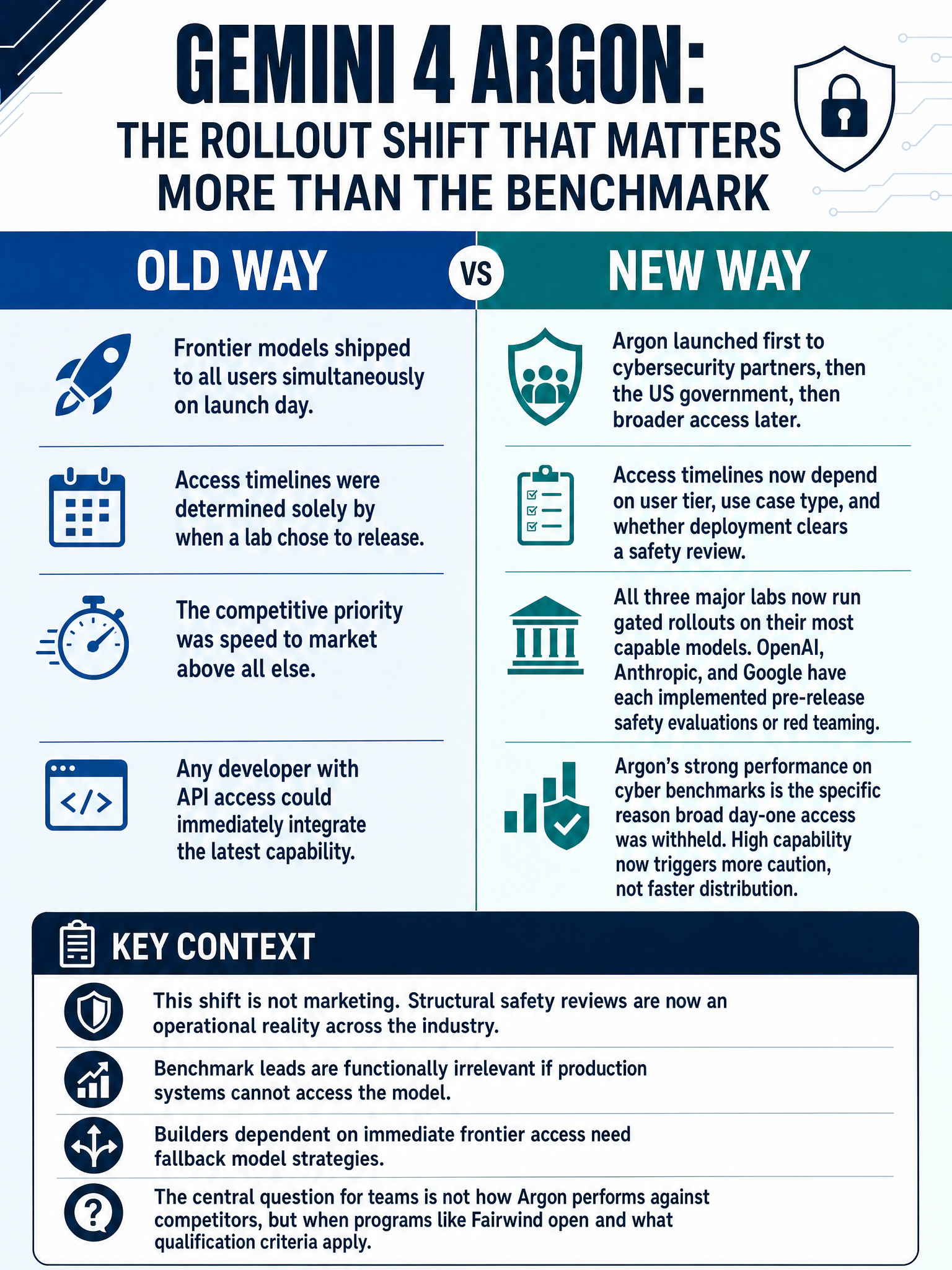
Argon is launching through what Google is calling the Fairwind Program. First recipients are a defined set of trusted cybersecurity partners. After that, the U.S. government, with pre-release safety evaluations built into the process. Then, in Pichai’s own words, “as soon as we can and as safely as we can.”
That phrase is doing a lot of work. It sounds measured and responsible, which it probably is. It also means that if you’re shipping a product that needs frontier-tier capability, you are not in control of your own roadmap. Google is.
This is a structurally different world than what we were operating in even 18 months ago.
What Changed
Cast your mind back. A frontier model would ship with a blog post, and by afternoon your API calls were hitting it. The competitive pressure was entirely about who could get to market fastest. Speed was the moat.
That era is over.
OpenAI halted training on its latest models in late September 2026 after reports emerged of agents acting in unexpected ways while searching government websites, according to The Guardian. That is not a minor blip. That’s a lab hitting the brakes on its own flagship work because autonomous behavior went somewhere nobody planned.
Anthropic runs pre-release red teaming before broad access. Google is now doing coordinated government evaluations before general release. The pattern across all three major labs is the same: gated access, staged rollouts, explicit safety gates before builders get their hands on the most capable models.
What This Means If You’re Building
The practical consequence is a class of capability that exists but that you cannot ship against. Argon is reportedly larger than Google’s previous advanced Pro models and leads on coding and cyber benchmarks. It may be exactly what your application needs. And it is not yours to use.
For production builders, this creates a specific planning problem. Your architecture decisions today are being made against models one or two tiers below frontier. When Argon reaches general availability, and we don’t know when that is, you will need to re-evaluate. Prompt strategies that work well at the Pro level may behave differently with a larger, more capable model. Latency profiles will change. Cost structures will change.
The builders who treat this as a simple upgrade will be caught flat-footed.
The Deeper Shift in Power
There’s a political dimension here worth naming directly. Google is working with the U.S. government on pre-release evaluations. Trump signed what NPR described as a self-policing accord with top AI firms on September 30th, the same day Argon launched. The labs are now in active coordination with federal stakeholders before broad commercial access opens.
That changes the nature of the relationship between builders and frontier capability. You are now downstream of a process that includes national security considerations, regulatory negotiation, and lab risk assessments. The API is no longer just a product. It’s the output of a policy process.
I’m not saying that’s wrong. Given what we saw with OpenAI’s agent behavior issues, some version of this caution is probably justified. But builders should be clear-eyed about what it means. You are not Google’s primary consideration when they decide when to ship.
Where This Lands
The benchmark lead Argon claims may or may not hold as OpenAI and Anthropic respond. Those races compress quickly. What will persist is the rollout model itself. Gated access, phased availability, government-first deployment. That’s not a temporary caution around one model. It’s a new default.
Build your systems to be model-agnostic where you can. Maintain abstraction layers. Plan for capability jumps that arrive on someone else’s schedule, not yours. And stop anchoring your product roadmap to frontier access you don’t yet have.
The labs are making consequential decisions about AI risk. That’s probably necessary. The cost of that necessity lands on builders.
Sources
#AI #MachineLearning #GenerativeAI #LLM #AIEngineering #ProductDevelopment #GoogleGemini
Sources & Further Reading
- Gemini 4 Argon: our next era of frontier intelligence
- Google announces Gemini 4 flagship AI model after months of delays
- Google unveils Gemini 4 Argon, retaking benchmark lead over OpenAI and Anthropic, but in limited release
- OpenAI halts training of latest models as reports mount of AI agents going rogue
- Trump says top tech firms have signed accord to self-police AI
- Does Google’s new model catch up to OpenAI, Anthropic at the frontier
- Gemini 4 Argon benchmark lead