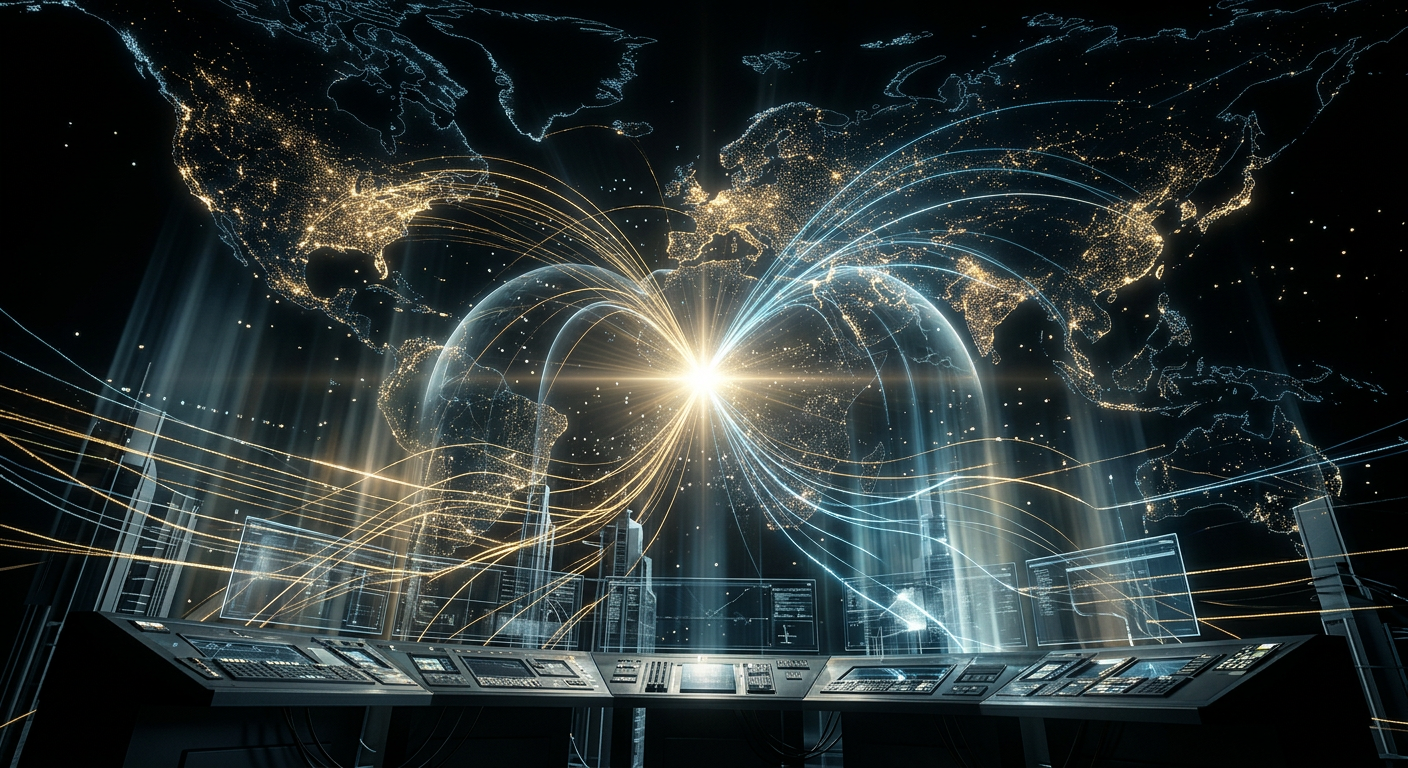
AI agent swarm reconstructs Operation Epic Fury in 4D from public OSINT data, raising questions about capability compression and information asymmetry
One Person. Public Data. A God’s-Eye View of a War.
That’s the headline nobody in defense intelligence wants to see circulating on a Monday morning.
Bilawal Sidhu posted a video over the weekend that stopped me cold. He built a full 24-hour 4D reconstruction of Operation Epic Fury, the Iran strikes, inside WorldView, using nothing but an AI agent swarm he set loose to scrape every public OSINT signal he could find before the caches cleared. Min Choi amplified it with a simple observation: “This used to cost millions and a full dev team.”
He’s right. And that’s the problem.
What Capability Compression Actually Looks Like
I’ve written before about capability compression in software, the way tools that once required entire teams now fit in a single engineer’s terminal. But what Sidhu built is different in kind, not just degree.
A 4D battlefield reconstruction, tracking asset positions, strike sequences, and signal data across a 24-hour window, is not a weekend project. Or it wasn’t. That class of work historically sat inside defense contractors with classified tooling, dedicated analysts, and budgets that don’t show up in quarterly reports. The output was reserved for people with clearances and the right acronyms in their email signatures.
Now one person with API credits and a well-orchestrated agent swarm produced something functionally equivalent from a coffee shop.
The OSINT Window Problem
The detail that stuck with me most was the race against the caches. Sidhu specifically noted he had to move fast, before the public signals disappeared. That’s not a minor implementation detail. That’s a signal about how open-source intelligence actually works in an active conflict.
Public data is perishable. Satellite imagery gets paywalled or pulled. Flight tracking gets suppressed. Social posts get deleted. The window between “event happens” and “public record gets scrubbed” is measured in hours, sometimes minutes. An agent swarm that can operate at machine speed across dozens of sources simultaneously changes who wins that race.
This is a structural shift in who can build comprehensive situational awareness.
The Asymmetry That’s Dissolving
Governments and militaries have spent decades building information advantages. Signals intelligence, surveillance infrastructure, classified imagery, the entire apparatus exists partly to know things that adversaries and the public don’t know. That asymmetry is a genuine strategic asset.
What’s happening now is that the civilian tooling is catching up, not to classified sources, but to the synthesis layer. The ability to aggregate, correlate, and visualize open signals at speed was itself a scarce resource. You needed people who knew what to look for, infrastructure to collect it, and software to render it coherent. All three of those requirements are now much closer to commodity.
Sidhu’s reconstruction didn’t require a spy satellite. It required knowing which public signals to collect and having the agent infrastructure to do it fast.
The Questions Nobody Wants to Answer
I want to be direct about something uncomfortable here. The same capability that lets a researcher build a historical reconstruction for analysis can, in a future conflict, be used by actors with less benign intentions. Understanding troop movements, identifying gaps in air defense coverage, tracking logistics in near-real-time from public data alone, these are not neutral capabilities.
The defense and intelligence community has watched open-source tools close the gap for years. Bellingcat demonstrated what determined humans could do with public imagery and social media. What Sidhu demonstrated is what happens when you remove the human bottleneck entirely and replace it with an agent swarm operating at API speed.
That’s a different threat model. And I don’t think the institutions that depend on information asymmetry have fully internalized it yet.
Where This Goes
The honest answer is that this capability will become cheaper and more accessible, not less. The underlying tools, multimodal agents, geospatial rendering, OSINT aggregation, are all on aggressive development curves. What Sidhu built as a technical demonstration this week is a rough prototype of something that will be dramatically more capable in 18 months.
The people who should be paying the most attention aren’t the AI researchers. They already know. It’s the policy people who still think information advantage is a stable, durable asset rather than a depreciating one.
Sidhu built a God’s-eye view of a war from his laptop. The question worth sitting with is who else is building one right now, and what they plan to do with it.
Sources
#OSINT #AIAgents #IntelligenceAnalysis #CapabilityCompression #NationalSecurity #ArtificialIntelligence #MachineLearning