
NVIDIA DLSS 5: When AI Enhancement Becomes Art Direction Override
I’ve shipped games. I’ve spent entire afternoons obsessing over the curve of a character’s eyelid, the way light catches the edge of a lip, the exact desaturation that makes a stylized world feel intentional rather than unfinished. Those choices aren’t accidents. They’re craft. So when NVIDIA announced DLSS 5 at GTC 2026 — real-time AI neural rendering, Jensen Huang calling it “the GPT moment for graphics” — I had feelings. Complicated ones.
Let me try to sort through them honestly.
The Technical Achievement Is Real
I’ve lived through every major rendering inflection point. Programmable shaders changed everything. Real-time raytracing felt impossible until it wasn’t. Path tracing kept inching closer to ground truth. Each time, the industry went through the same cycle: disbelief, then adaptation, then “I can’t imagine working without this.”
DLSS 5 feels like another one of those moments, and I don’t say that lightly.
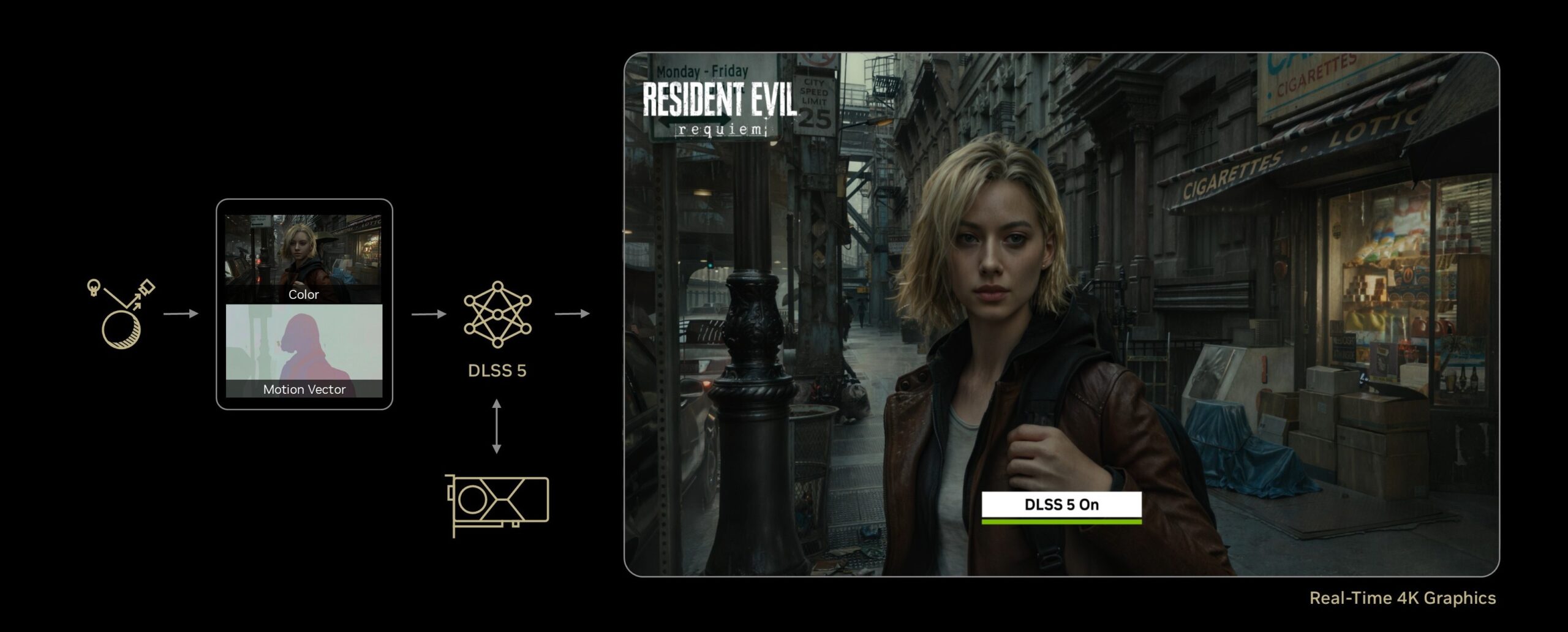
The system takes frame color and motion vectors as input, then runs an AI model trained to understand scene semantics — it knows the difference between a character’s hair, their skin, fabric physics. From that, it’s generating photoreal lighting and materials in real time on RTX 50 series hardware. DLSS 4.5 was already generating 23 out of every 24 pixels in a frame. DLSS 5 is pushing further into territory that, for my entire career, belonged exclusively to offline rendering farms. The Hollywood-quality-in-real-time grail has been hanging there for thirty years. I’m not going to pretend this isn’t a serious technical achievement just because the rollout is messy.
That said — the demo required two RTX 5090 GPUs. At $2,000 each. So let’s stay grounded about who this is for right now.
The “Slop Filter” Criticism Deserves a Real Answer
The backlash from developers and fans was immediate and, in some corners, pretty savage. “Slop filter.” “Garbage AI filter.” New Blood’s Dave Oshry put it plainly: “Pure Slopium.” The Resident Evil Requiem situation crystallized the concern — Grace’s face was visibly altered, eyes and lips shifted enough that people noticed and called it “yassification.” That’s not a minor complaint. That’s a character whose design someone fought for getting quietly overwritten by a post-process pass.
I’ve been in that room. I know what it feels like to spend weeks nailing a character’s face — the specific stylization that says this is our game, this is our world. Stylized art direction is not a technical limitation that needs correcting. It’s a conscious creative decision, made by artists who know exactly what they’re doing. The worry isn’t that DLSS 5 exists. The worry is that it treats those decisions as problems to solve.
Tom’s Hardware’s hands-on was measured about it — “results can be impressive, but there’s work to do.” PCMag called it “still a work in progress.” That’s honest. NVIDIA says developers have artistic control: intensity sliders, color grading, masking settings to protect specific elements. I want to believe that’s sufficient. But “we gave you a slider” is not the same as “we preserved your intent.”
Where Enhancement Ends and Alteration Begins
That’s the line I keep coming back to. DLSS at its best is invisible — it makes your game run better while looking like your game. The moment a player looks at a character’s face and sees something the developer didn’t put there, you’ve crossed from enhancement into alteration. And in an industry where DLSS is already in 750+ games, the scale of that potential drift is significant.
I genuinely believe NVIDIA wants to get this right. The engineering ambition here is extraordinary, and the people building this aren’t careless. But game development is a discipline full of intentional decisions that look like mistakes to an outside system — the flattened speculars in a cel-shaded world, the deliberately muted skin tones in a horror game, the eyes drawn slightly too large on purpose. An AI trained on photoreal references may not know the difference between a flaw and a choice.
DLSS 5 ships fall 2026. There’s time to get this right, and I’m watching closely.
So I’ll ask the question I keep turning over: Where do you draw the line between a rendering enhancement and an artistic override — and who gets to draw it?
#GameDev #NVIDIA #DLSS5 #AI #GraphicsEngineering #RealTimeRendering #UnrealEngine