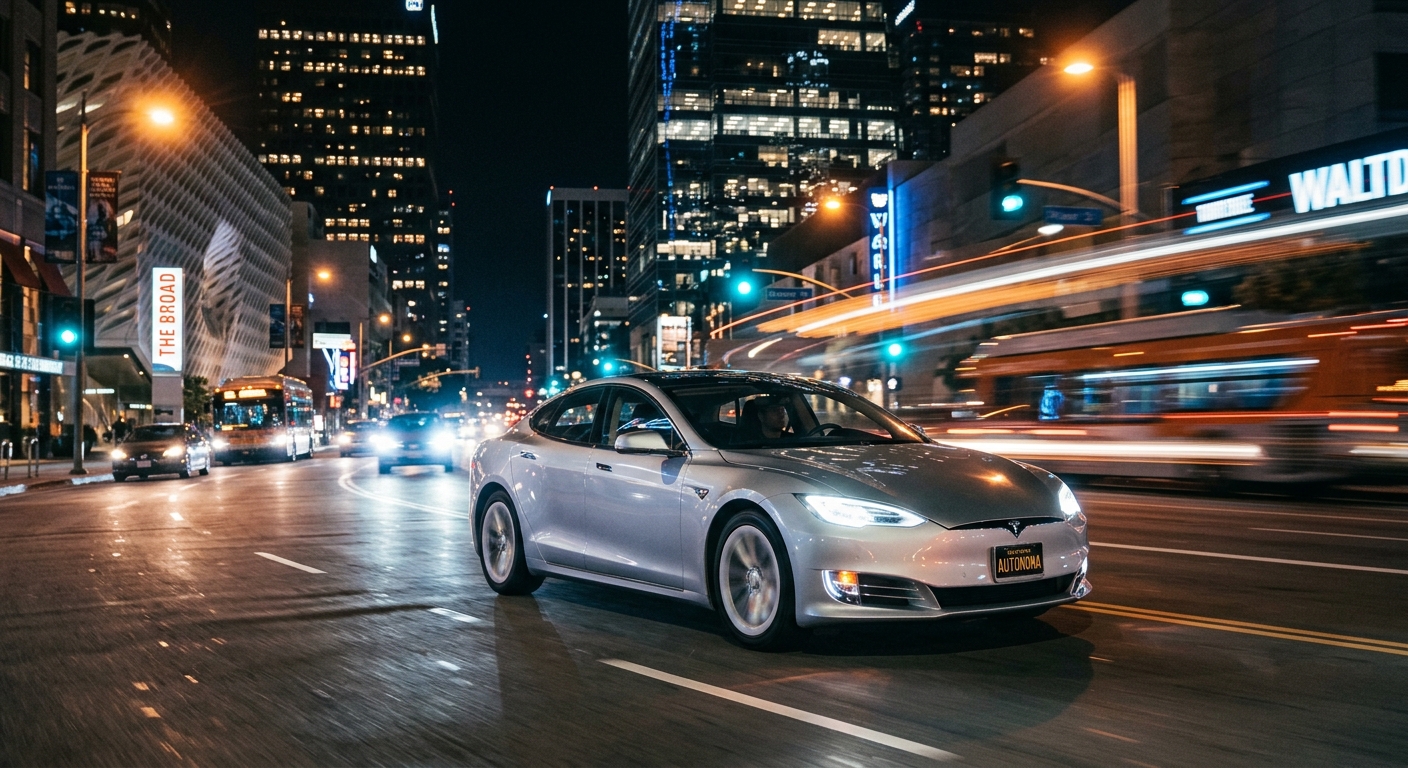
Tesla posts video of car driving itself through LA with no human input, signaling a shift in real-world autonomous AI capability
Tesla’s Self-Driving Video Is About More Than Self-Driving Cars
On April 9th, Elon Musk posted a short clip to X with a simple caption: “Tesla driving itself around LA.” No staged demo environment. No closed course. No safety driver with hands hovering over the wheel. Just a Tesla navigating Los Angeles city streets without any human input.
https://x.com/elonmusk/status/2042348111809691858
I’ve been watching autonomous vehicle progress for years. I’ve seen the hype cycles, the Waymo rollouts, the Cruise stumbles, the endless “five years away” predictions. This video feels different. Not because of the car. Because of what the car is actually doing.
Why LA Specifically Matters
Anyone who has driven in Los Angeles knows it is not a friendly test environment. It is dense, chaotic, and full of the exact edge cases that break autonomous systems: cyclists filtering through stopped traffic, pedestrians jaywalking mid-block, aggressive lane changes with no signal, and construction zones that appear overnight.
This was not a highway cruise-control demo. This was urban navigation at the hardest difficulty setting. And the system handled it without intervention.
That is a meaningful benchmark.
The Real Story Is the AI Stack Underneath
Here is what most of the reaction I’ve seen is missing. This video is not really about self-driving cars. It is about the maturity of the underlying AI architecture.
Tesla’s Full Self-Driving stack runs vision-based perception models, real-time decision layers, and on-device inference at highway speeds, all without LIDAR. That last part matters. Most of the autonomous vehicle industry leaned heavily on LIDAR as a crutch. Tesla bet on cameras plus neural nets, and for years that looked like stubbornness. This video makes it look like foresight.
The same class of perception and inference capability that lets a car navigate a left turn through a busy LA intersection is also what’s needed for real-world robotics, autonomous logistics, and industrial AI systems. The car is the demo. The underlying capability is the product.
What This Means for the Industry
Waymo has been operating commercially in San Francisco and Phoenix with strong safety records, but it uses a sensor suite that costs significantly more per vehicle and requires extensive pre-mapping of each city. Tesla’s approach, if it generalizes, scales in a way Waymo’s currently does not.
That is not a knock on Waymo. Their approach is rigorous and their safety data is real. But scale economics matter enormously when you are talking about deploying millions of vehicles rather than thousands.
If Tesla can reproduce this consistently, the pressure on every other player in the space becomes intense.
The Verification Problem
I want to be honest about one thing: a single posted video is not proof of a solved problem. We do not know how many takes it required. We do not know what routes were pre-selected or what conditions were avoided. Tesla has a long history of compelling demos that preceded reliable consumer availability by years.
Full Self-Driving has been “almost ready” for a long time. The gap between “impressive video” and “I will let my car drive my kids to school without me” is still real.
That said, I do not think skepticism should slide into dismissal. The technical complexity of what is shown is not faked. The system is doing something genuinely hard. The question is consistency and generalization, and only fleet data over time will answer that.
Where This Is Actually Heading
The honest forward-looking take is this: autonomous driving is no longer a question of “if” but of “how messy is the transition.” Regulatory frameworks are lagging. Insurance models are not ready. And public trust is fragile after every high-profile incident.
But the capability is here, or nearly here. That changes what every city planner, insurance actuary, and fleet operator should be thinking about right now.
The car driving itself through LA is the easy part to see. The harder thing to see is what gets rebuilt around it.
Sources
#Tesla #AutonomousVehicles #ArtificialIntelligence #MachineLearning #FSD #AIEngineering