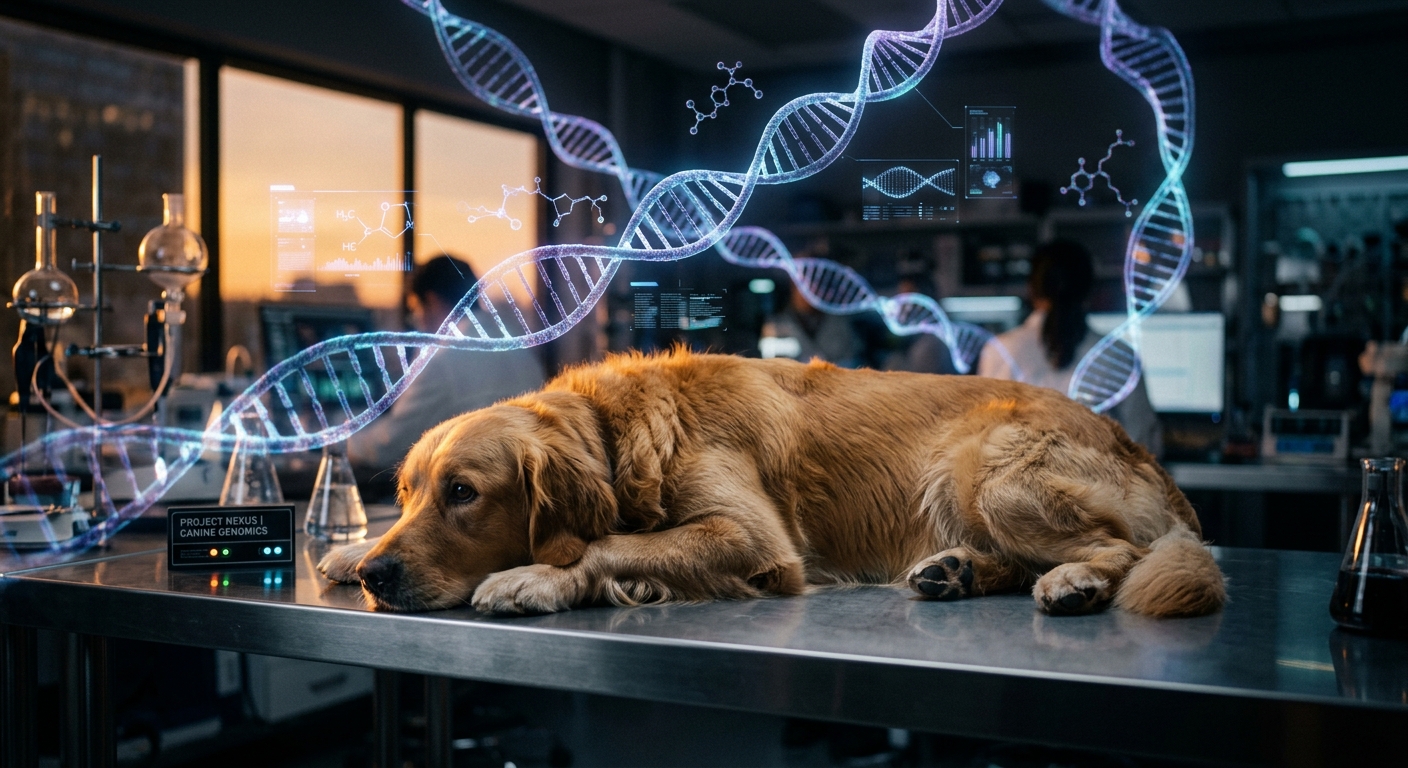
Man uses AI (ChatGPT, Gemini, Grok) to help design personalized mRNA cancer vaccine for his dog Rosie
One Person. One Dog. One mRNA Vaccine.
I’ve been sitting with this story for a day and I can’t stop thinking about it.
Paul Conyngham’s dog Rosie was diagnosed with cancer after her symptoms were missed for roughly 11 months. By the time anyone caught it, the cancer had progressed badly. Paul went through the standard playbook: chemo, immunotherapy, multiple surgeries. It wasn’t enough.
So he did something most people would have considered impossible without a biology PhD, a lab budget, and a team of researchers behind them.
He built her a personalized mRNA cancer vaccine.
Not metaphorically. Not with a startup and $10 million in Series A funding. As a single determined person using ChatGPT, Gemini, and Grok alongside real genomics labs, real vets, real sequencing equipment, and ethics approvals. Months of work. Real science. Real results.
Some of Rosie’s tumors began shrinking.
What He Actually Did
The technical depth here matters. Paul didn’t just ask ChatGPT “how do I cure cancer.” He sequenced Rosie’s normal DNA, tumor DNA, and tumor RNA to identify what was actually driving her specific cancer. The AI helped him design the analysis pipeline, troubleshoot bioinformatics tools, interpret results, and narrow down the field to the most relevant neoantigen targets.
Earlier approaches hit dead ends. Ligand discovery and compound matching ran into legal barriers, timing constraints, and approval walls. So the approach shifted: identify the tumor-specific neoantigens, design a custom mRNA construct around them, then manufacture and administer it.
The wet lab work, tissue processing, vaccine manufacturing, and treatment administration all happened with actual scientists and actual equipment. The AI didn’t pipette anything.
But it gave Paul the cognitive leverage to direct the whole process.
The Phrase That Keeps Landing
Min Choi put it well in his summary of the story: AI gave one determined person the leverage to operate more like a research team than an individual.
That framing is more precise than the usual “AI is a tool” platitude. Tools are passive. Leverage changes what you can actually reach. A single person with AI-assisted bioinformatics can now ask questions that, five years ago, required a funded lab and several months of grad student hours just to set up the query correctly.
The final protocol wasn’t just the vaccine either. It was multimodal: targeted therapy, immune support, and careful timing and sequencing of treatment. Paul had to understand enough oncology to make those calls. The AI accelerated that learning and kept it grounded.
What This Is Not
I want to be careful here, because this story is easy to misread.
This is not a case of AI replacing scientists. The labs, vets, and researchers were doing irreplaceable work. This is not a template anyone should copy without expert oversight. Canine oncology involves regulatory and biological complexity that doesn’t yield to enthusiasm alone.
And Rosie’s outcome, while genuinely promising, is one data point. Tumors shrinking is not the same as a cure.
What this is: a proof of concept for a new kind of human capability. One person, with the right tools and relentless effort, operating at a level of scientific sophistication that used to require institutional infrastructure.
Why I Think This Matters Beyond the Story Itself
We spend a lot of energy debating whether AI will take jobs or whether it’s overhyped. Both conversations miss the more interesting question: what becomes possible for individuals who use it aggressively and thoughtfully?
Paul didn’t have a biology background. He learned cancer genomics well enough to direct a sequencing and vaccine design workflow because AI compressed months of prerequisite knowledge into something navigable. That’s a different kind of capability shift than “AI writes my emails faster.”
The ceiling for what one motivated person can attempt just moved. Significantly.
Rosie’s story is worth reading in full. Paul documented the whole thing at https://x.com/paul_conyngham/status/2036940410363535823 and it’s one of the more honest accounts of what this kind of AI-assisted science actually looks like: messy, iterative, full of dead ends, and ultimately real.
This is what the technology is for.
Sources
#AIinHealthcare #mRNA #MachineLearning #CancerResearch #ArtificialIntelligence