Google DeepMind opens Co-Scientist multi-agent hypothesis generation to individual researchers via Gemini for Science
The Lone Researcher Just Got a Lab
Most announcements from major AI labs land with a thud of hype and then quietly fade. This one is different. Google DeepMind just opened Co-Scientist to individual researchers through a new initiative called Gemini for Science, and I think the scientific community is sleeping on what this actually means.
Let me be direct about what Co-Scientist is, because the marketing language tends to blur it.
What Co-Scientist Actually Does
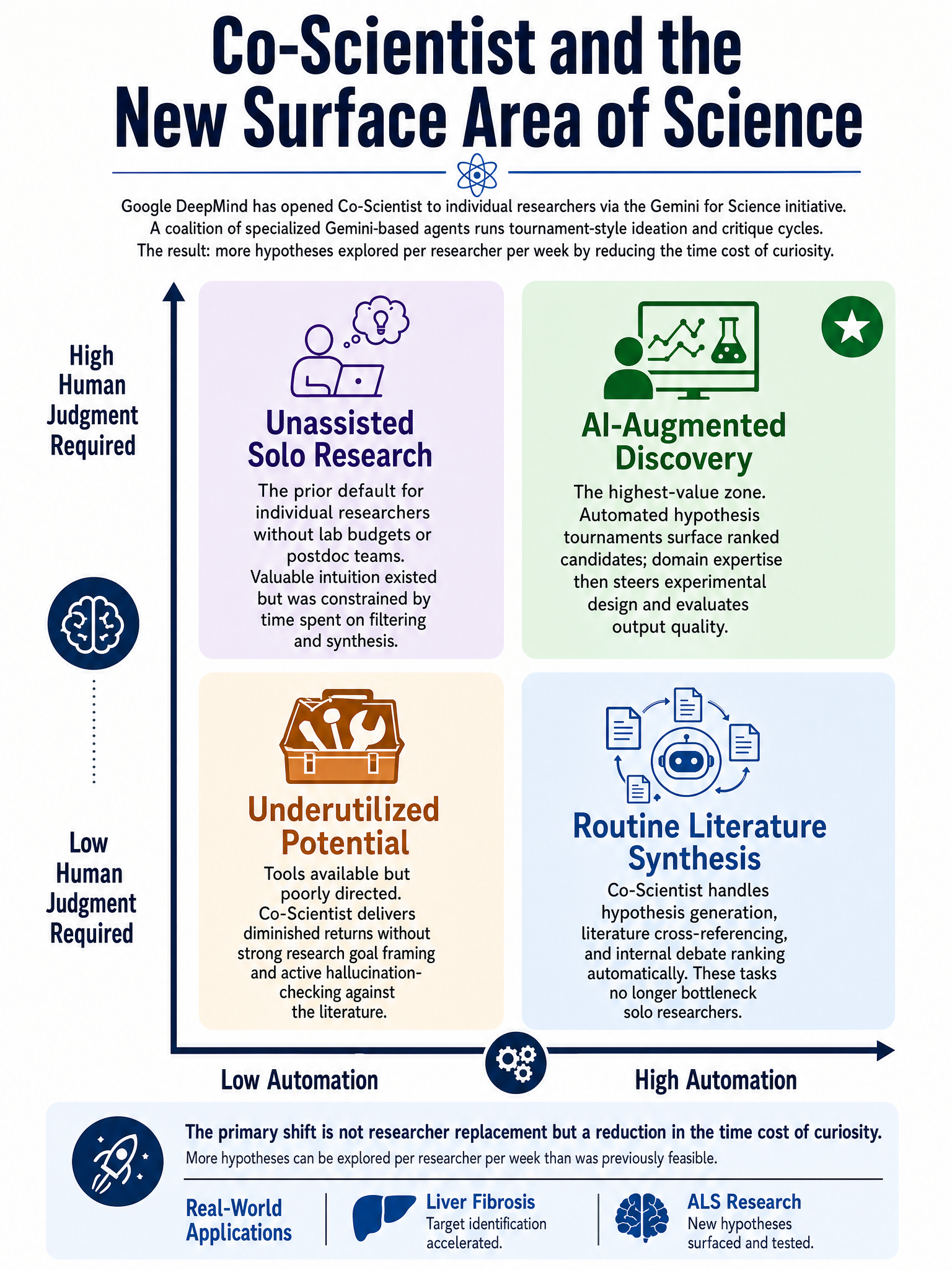
This is not a chatbot you ask science questions. Co-Scientist is a multi-agent system built on Gemini where specialized agents generate hypotheses, then debate them against each other in what DeepMind calls a “tournament of ideas.” The system ranks the hypotheses that survive that internal debate, verifies claims against scientific literature, uses web search, and iterates. It can produce thousands of hypotheses from a single research problem, then cull them down to the ones most worth pursuing.
That last part matters. Volume without quality filter is useless. The tournament structure is the thing.
What It Has Already Done
DeepMind didn’t release this cold. Over the past year they ran Co-Scientist with scientific partners on real problems. It helped identify new targets for liver fibrosis. It uncovered fresh approaches to ALS research. It digested decades of literature in domains where keeping up with the pace of publication is itself a full-time job.
Those are not toy demos. Liver fibrosis and ALS are genuinely hard problems with limited treatment options. The fact that the system surfaced novel research directions in both areas, directions that working scientists found worth examining, is a real data point.
The Access Shift Is the Story
Here is where I have a strong opinion. The transition from institutional access to individual researcher access is not just a distribution change. It is a structural shift in who gets to do ambitious science.
A postdoc at a well-funded R1 university has resources. A researcher at a smaller institution, or an independent scientist, or someone in a country where research infrastructure is thin, historically does not. The bottleneck was never raw intelligence. It was access to time, compute, and the sheer labor of literature synthesis.
Co-Scientist dents all three of those constraints simultaneously. One person with a focused research question can now run a hypothesis generation process that would have required a team. I find that genuinely interesting, not because AI is magic, but because the marginal cost of that process just dropped toward zero for anyone with access to the tool.
Where I Would Pump the Brakes
I am not going to pretend this is without friction. Hypothesis generation is the beginning of science, not the end. Wet lab validation, clinical trials, peer review, the full chain of verification still requires human expertise and institutional infrastructure. A system that produces thousands of hypotheses is only as useful as the researcher’s ability to evaluate which ones are worth chasing.
There is also the question of what happens when everyone has the same tool generating hypotheses from the same literature. Diversity of approach is one of science’s real defenses against getting stuck. If Co-Scientist pushes the field toward a narrower set of “tournament-winning” ideas, that is worth watching carefully.
The Gemini for Science initiative frames this as exploring the future of AI-powered scientific discovery, which is appropriately modest. This is an experiment, not a solved problem.
🔬
The thing I keep coming back to is the solo researcher use case. Science has always rewarded people who could do more with less. Now the gap between a well-resourced lab and a single motivated researcher just got a little smaller. Whether that produces breakthrough results or a flood of half-baked hypotheses depends entirely on the people using it.
My bet is both, and the signal will be worth sorting through.
Sources
#AIresearch #GoogleDeepMind #GeminiForScience #ScientificDiscovery #MachineLearning