Google DeepMind releases DiffusionGemma, an open experimental model that generates full text blocks simultaneously instead of token-by-token, claiming up to 4x faster output on GPUs
DiffusionGemma and the End of Left-to-Right Thinking
Google DeepMind dropped something this week that I think is getting undersold in the noise of the usual model release cycle. DiffusionGemma is an open experimental model, and the architecture underneath it is genuinely different from everything else currently in production. Not different in a marketing sense. Different in a way that changes how generation actually works.
Why the Architecture Matters
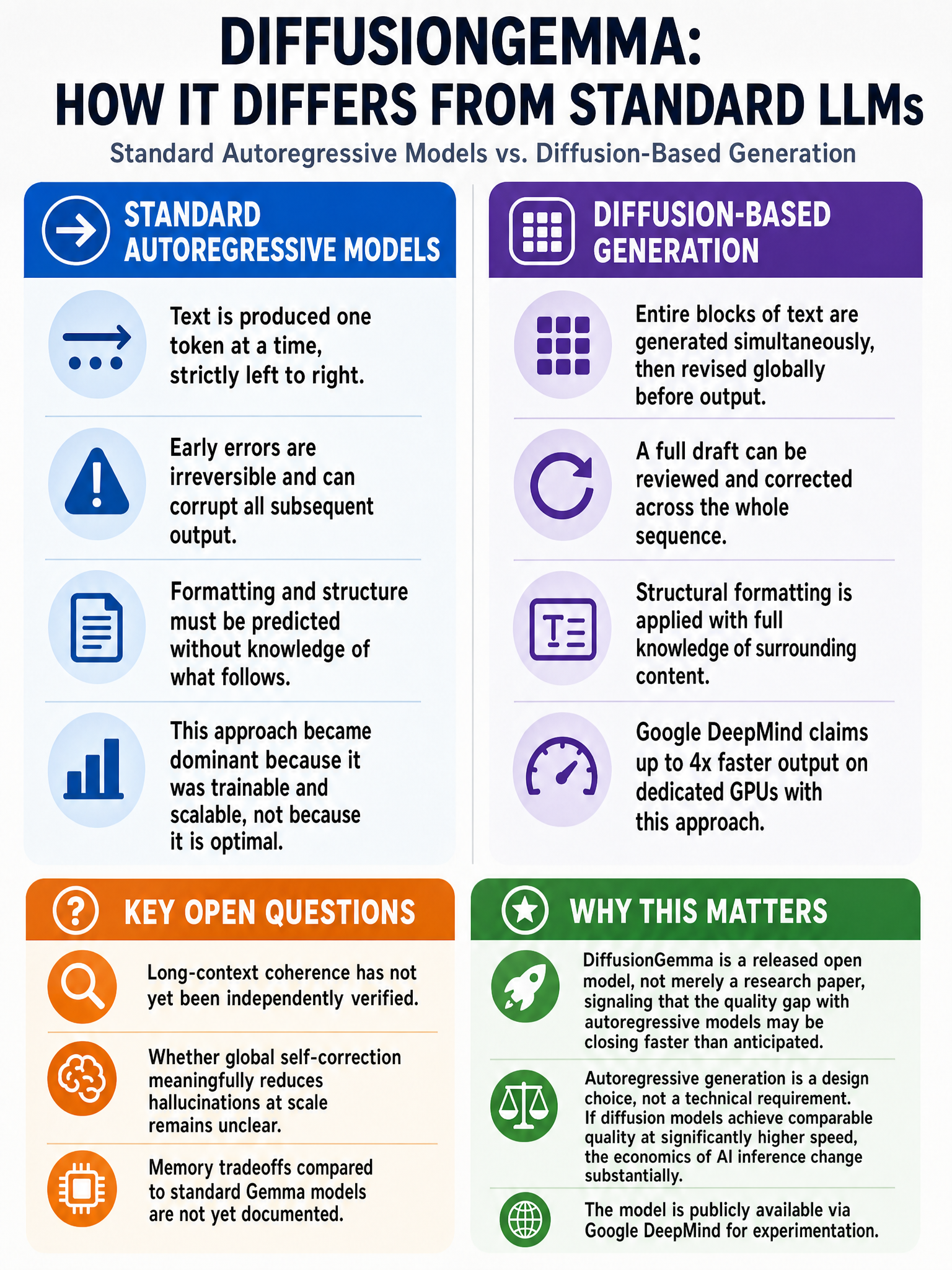
Every major LLM you’re using today, GPT, Claude, Llama, Gemini, generates text autoregressively. One token at a time, left to right, no going back. The model commits to “The” and then builds on top of that commitment for every token that follows. If that early choice was wrong, or just suboptimal, it ripples forward through the whole output.
DiffusionGemma does something different. It generates entire blocks of text simultaneously, then applies a self-correction pass across the whole block before producing output. Google DeepMind’s announcement describes it as the model being able to “self-correct and format complex markdown in real time” precisely because it has a view of the full draft before anything is finalized.
That is a fundamentally different editing process. Closer to how a human writer actually works: rough draft, then revision, not dictation.
The 4x Number
Google is claiming up to 4x faster output on dedicated GPUs. That number is going to get a lot of attention, and it should. Inference speed is one of the real bottlenecks in production AI deployments right now, and a 4x improvement on GPU hardware would change the economics of a lot of applications.
The qualifier matters though: “dedicated GPUs.” We don’t yet have comprehensive independent benchmarks across mixed hardware environments or edge cases with long context. The claim is from DeepMind’s own release. I’m not dismissing it, but I’m watching for third-party replication before treating it as gospel.
What Parallel Generation Actually Changes
Here’s the part I find more interesting than the speed claim. With autoregressive generation, quality is path-dependent. The model has no mechanism to reconsider a token once it’s placed. Diffusion-based generation breaks that constraint.
Think about what that means for structured outputs. Code blocks, markdown tables, JSON, anything with strict formatting requirements. Autoregressive models frequently fumble these because a formatting error early in the block propagates. A model that can look at its own draft and revise globally has a structural advantage on exactly these tasks. DeepMind specifically calls out markdown formatting as a benefit in their announcement, which suggests they’ve seen this play out in practice.
Whether that advantage holds at scale against the best autoregressive models, we’ll find out. But the theoretical argument is solid.
Open and Experimental
Two words in the release worth holding onto: open and experimental. DiffusionGemma is available to build with, which means the research community will get access quickly. The “experimental” label is honest. This isn’t a claim that diffusion has beaten autoregressive generation. It’s a claim that the architecture is viable and worth serious attention.
That openness matters. Diffusion-based text generation has been a research area for a few years, but it’s been mostly academic. Having Google DeepMind ship something people can actually run and test accelerates the feedback loop considerably.
Where This Goes
I’m not ready to say autoregressive generation is going away. The existing ecosystem, fine-tuning infrastructure, tooling, deployment patterns, is built entirely around it. Disrupting that takes more than one experimental release.
But I’ve been watching parallel and diffusion-based text generation for a while, and this feels like a real inflection point. If the 4x speed number survives independent testing, and if the quality story on structured outputs holds up, the architecture conversation gets a lot louder very quickly.
The model is out. People will run it. We’ll know more soon, and that’s the right way to settle this.
Sources & Further Reading
#MachineLearning #GenerativeAI #GoogleDeepMind #AIResearch #LLMs