Google Gemini 3.5 Live Translate launch: streaming speech-to-speech translation across 70+ languages with prosody preservation, available via API
Gemini 3.5 Live Translate Is Harder Than It Looks
Most people will read the announcement, nod approvingly, and move on. “Cool translation feature.” That’s the wrong read. What Google shipped this week with Gemini 3.5 Live Translate is one of the more technically demanding problems in applied audio ML, and the fact that it works well enough to ship via API puts it in a different category than anything we’ve seen at this scale.
Let me explain why.
The Hard Part Nobody Is Talking About
Speech-to-speech translation sounds like a pipeline problem. Take audio in, transcribe it, translate the text, synthesize new audio out. That’s how most systems have worked for years, and it’s exactly why they feel robotic. Every stage in that pipeline adds latency. By the time output reaches the listener, the conversation has already moved on.
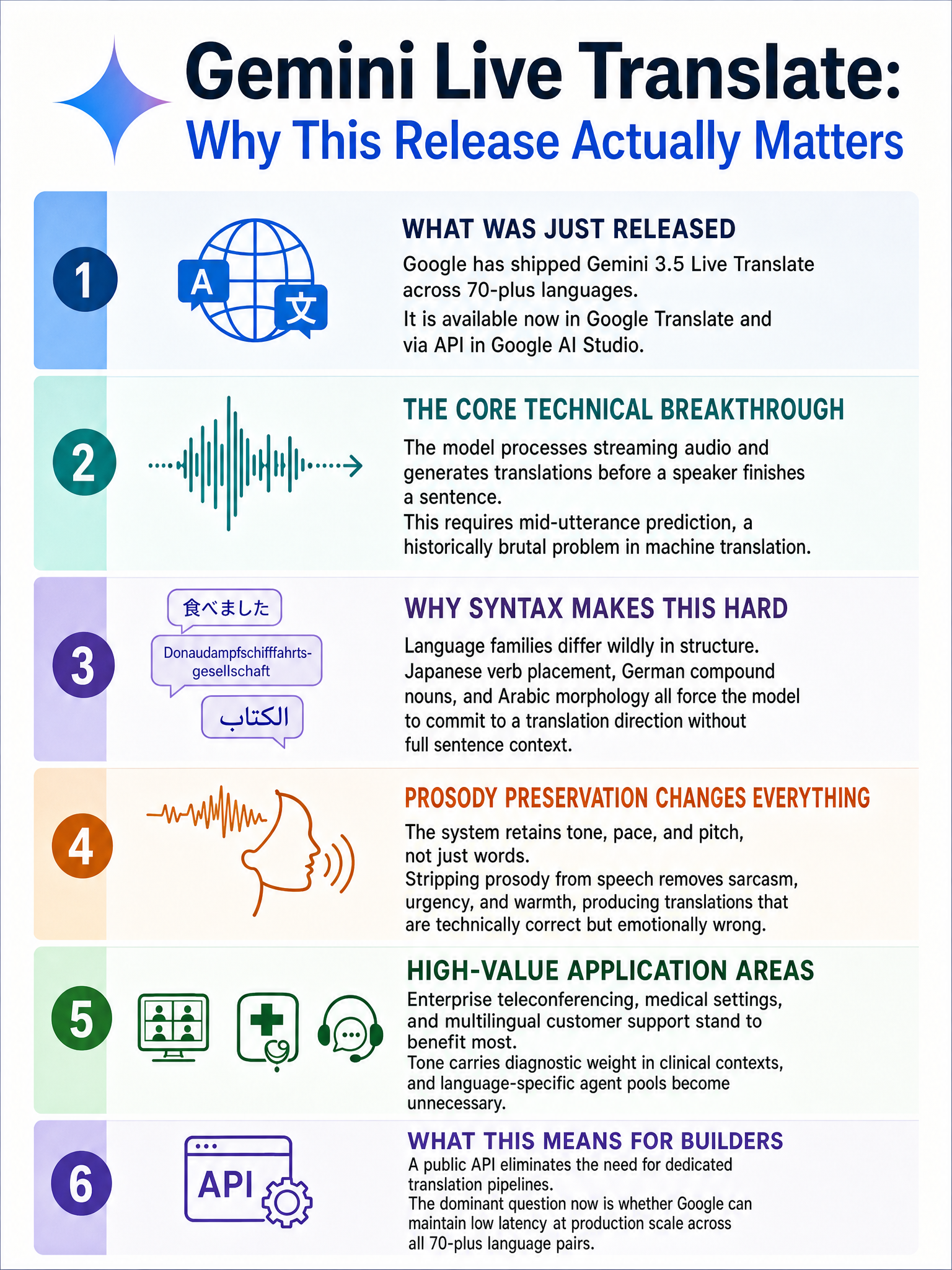
What Gemini 3.5 Live Translate does is different. According to Google’s announcement, it starts translating as soon as you start talking and streams translations while still listening to what you say next. That means the model is making forward predictions about where an utterance is going before it ends. Any machine translation researcher will tell you that’s genuinely hard. Word order differs radically across languages. German and Japanese both stack meaning at the end of sentences. Committing to a translation mid-utterance means committing to a structural interpretation you haven’t confirmed yet.
The model gets that wrong, and the output sounds like it was assembled from spare parts.
Prosody Is the Real Benchmark
The translation accuracy is table stakes at this point. The part I keep coming back to is tone, pace, and pitch preservation. Google describes this explicitly: the model keeps these acoustic properties intact across the translation, not just the words themselves.
This matters more than it sounds. A speaker being sarcastic, or excited, or cautious, carries that signal in how they speak, not just what they say. Strip that out and replace it with flat synthesis, and you’ve lost the actual communication. You’ve produced a transcript with audio attached.
Prosody transfer across languages is hard because different languages encode emotion differently at the phonetic level. A rising intonation that signals a question in English doesn’t map cleanly to Japanese pitch accent patterns. Getting this right requires the model to understand pragmatics, not just phonemes.
What 70+ Languages Actually Means
The 70-language figure is worth interrogating. Support across that many languages is not uniform. You can expect that Spanish, French, German, Mandarin, and Japanese are polished. The tail of that list almost certainly includes languages with less training data and weaker prosody modeling.
That’s not a criticism so much as a calibration. Google has shipped this in preview via API through Google AI Studio, which means developers can start stress-testing it on the languages that matter to their applications. That feedback loop is how the tail gets better.
For most real-world use cases, 70 languages covers the vast majority of global internet users. The number is meaningfully large.
Why This API Matters
The fact that this is available via API is the distribution story. Real-time translation is not a new problem, but access to a streaming audio model with prosody preservation at API scale is new. The use cases that become possible here range from live customer support across language barriers to accessibility tools for deaf or hard-of-hearing users communicating across languages, to educational platforms where conversation practice with native-speaker prosody actually models real speech.
Google says developers can try it in preview via the API in Google AI Studio. That preview status means rough edges exist. I’d expect latency to vary under load, and I’d expect some languages to perform inconsistently. But the architecture is there.
The question I’d be asking as a builder right now is what problems I’ve shelved because real-time translation was too unreliable or too latency-sensitive to build around. Some of those problems just became worth revisiting.
Where This Lands
Google has a history of shipping impressive demos that take years to become reliable products. This might follow that pattern. But the underlying technical claims here, streaming output while listening, prosody preservation across 70+ languages, are specific and testable. When a company makes claims that specific, they’re either confident in the numbers or they’re asking to be publicly embarrassed.
I’m not ready to call this solved. But I think it’s a real step forward on a problem that has been stuck for a while. Start testing it on the languages your users actually speak.
Sources & Further Reading
#AI #MachineLearning #NLP #SpeechRecognition #Google #Gemini #BuildingWithAI