Meta releases Brain2Qwerty v2: real-time non-invasive brain-to-text decoder with open-source training code published alongside Nature paper
Brain2Qwerty v2 Is the Quiet BCI Announcement Everyone Missed
While the AI world spent the week dissecting GPT-5.6 naming conventions and token-per-second benchmarks, Meta dropped something that I think will matter far more in ten years. Brain2Qwerty v2. Real-time brain-to-text decoding. No implants. Open-sourced. Published in Nature. And almost nobody is talking about it.
Let me fix that.
What It Actually Does
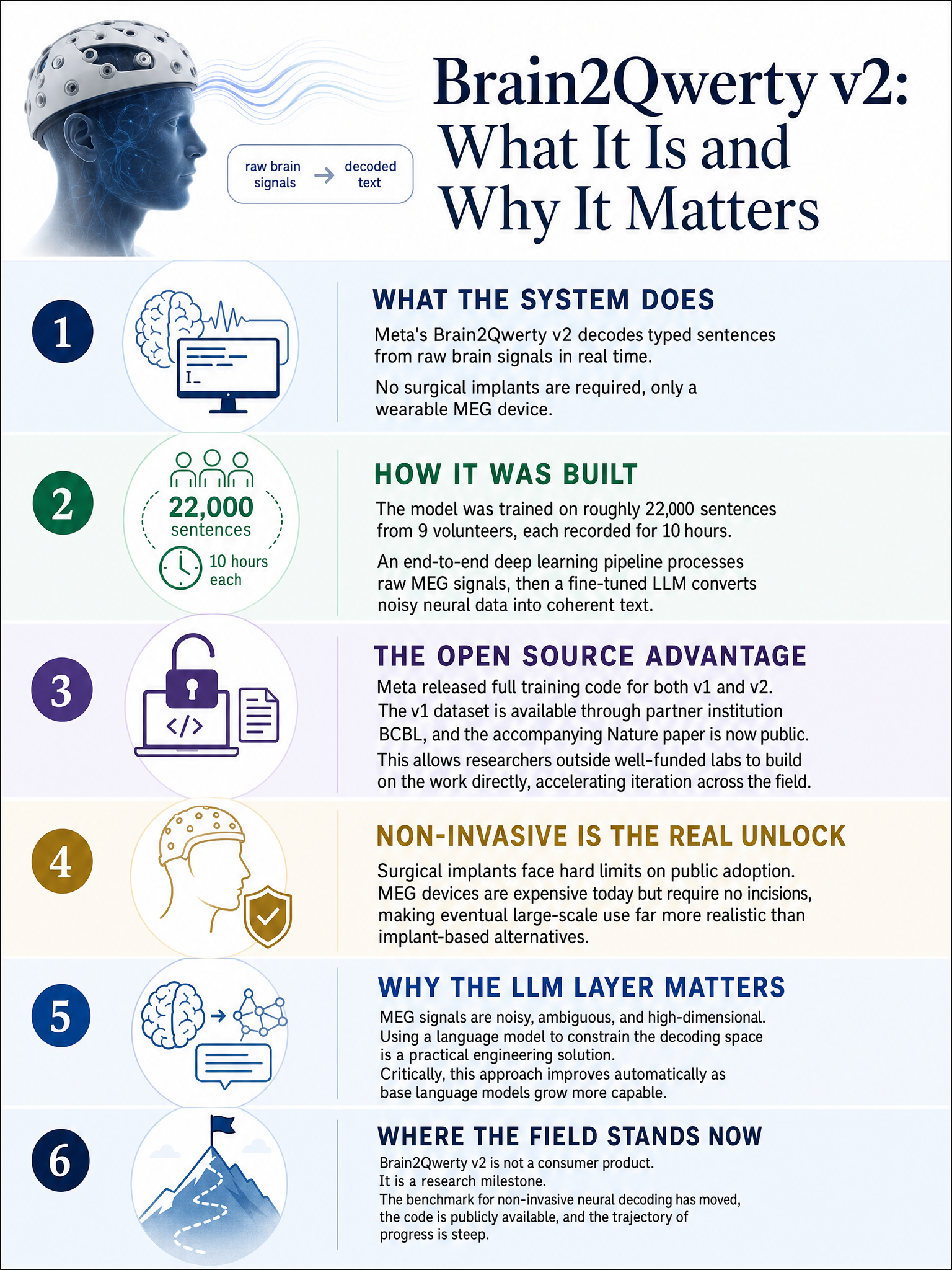
The system reads raw MEG signals from someone typing, and decodes them into text. In real time. MEG is magnetoencephalography, a non-invasive headset that picks up the magnetic fields your neurons produce. You wear it, you type, and the model reads your brain activity to reconstruct what you typed.
Meta trained v2 on roughly 22,000 sentences across 9 volunteers, each contributing about 10 hours of recording. The pipeline runs end-to-end deep learning on the raw MEG signal, then fine-tunes a large language model on top to bridge the gap between noisy neural data and coherent text. That two-stage design is smart. The deep learning backbone handles the signal chaos; the LLM handles the linguistic coherence. Neither alone would get you there.
Why Open-Sourcing Is the Real News
Most BCI research sits behind closed hardware and proprietary pipelines. You see a paper, you see impressive numbers, and you have no path to reproduce or build on it without buying into a specific vendor ecosystem.
Meta published full training code for both v1 and v2. Their partner BCBL is releasing the v1 dataset. The Nature paper dropped alongside the code release. That is a genuinely different posture from how this space usually operates, and it matters because BCI progress has been bottlenecked by data and reproducibility, not just model architecture.
When you open-source the training pipeline and release the dataset, you let the broader research community stress-test your claims, find failure modes, and build extensions. That is how fields actually move.
🧠 The Non-Invasive Part Deserves More Credit
Neuralink gets the headlines because surgical implants are dramatic. But the clinical path for an implant-based BCI is brutal. You need neurosurgeons, you need regulatory clearance for every new indication, and you need patients willing to have electrodes placed in their brain tissue.
MEG removes all of that friction. The tradeoff is signal quality. MEG is noisier and spatially coarser than an implanted electrode array. The fact that Meta is getting real-time sentence decoding from MEG signals, with an end-to-end learned pipeline rather than hand-engineered feature extraction, suggests the gap between invasive and non-invasive performance is closing faster than most people expected.
That is the actual story here.
What This Isn’t
I want to be careful not to oversell it. The system was trained on people who were actively typing, which means it is decoding motor intent correlated with physical keystrokes, not pure imagined speech. That is a more constrained problem than fully imagined thought. The 9-person dataset is small. Individual variation in MEG signals is significant, and generalization across people remains a hard problem.
But none of those caveats make this unimportant. They make it a first serious open step rather than a finished product, which is exactly what it should be at this stage.
Where This Goes
The combination of a Nature-published methodology, open training code, and a released dataset means other labs can now build on this directly. That changes the timeline. BCI research has been slow partly because each group had to rebuild foundational infrastructure from scratch.
Meta calling this a “milestone” in their non-invasive brain-to-text research implies v3 is already in the works. If the scaling behavior on MEG signals follows anything like what we have seen in NLP, more data and better architectures will push performance substantially further.
The assistive technology applications alone are worth taking seriously. ALS patients, people with locked-in syndrome, anyone who has lost the ability to produce speech. A non-invasive, software-improvable system that decodes typed sentences from brain signals is not science fiction anymore.
I think we will look back at this week’s release as the moment non-invasive BCI went from academic curiosity to engineering problem. Those are very different things.
#BrainComputerInterface #MetaAI #Neuroscience #MachineLearning #OpenSource