Anthropic Claude Mythos 5 partial government clearance restored for US critical infrastructure organizations
The AI Clearance Divide Is Becoming Policy
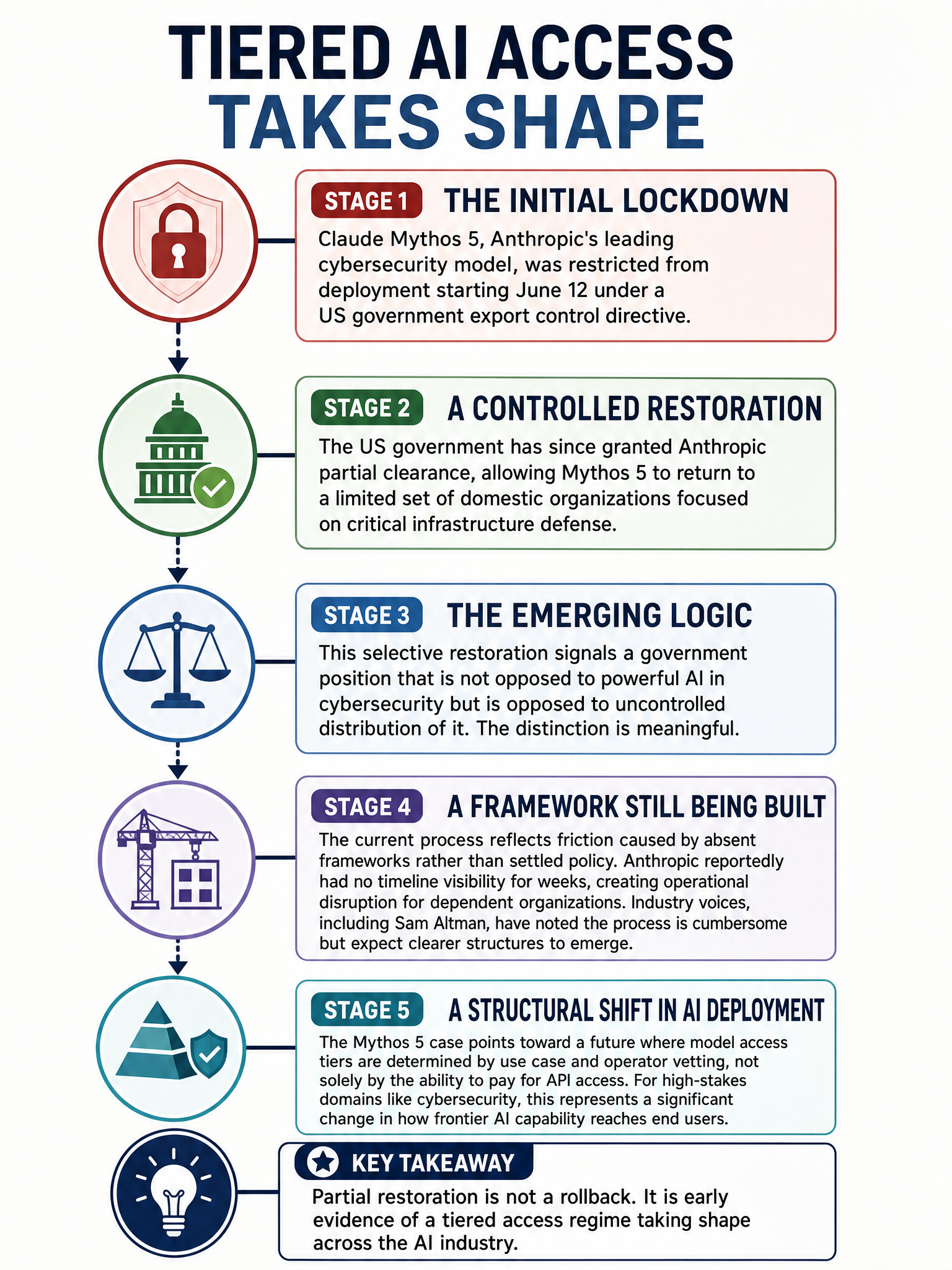
Something quiet but significant happened this week. Anthropic announced that the US government has notified them that Claude Mythos 5, their strongest cybersecurity model, can be redeployed to a specific set of US organizations working on critical infrastructure defense. This follows a lockdown that began June 12. Not a full public return. A controlled, narrow one.
Read that carefully, because the framing matters a lot.
What “Partial Clearance” Actually Signals
The government didn’t say Mythos 5 is safe. It said Mythos 5 is safe for this group, under these conditions. That is a fundamentally different statement, and it tells you exactly where federal thinking on frontier AI is settling right now.
We are watching, in real time, the construction of a tiered access architecture for capable AI. The logic is not “block it.” The logic is “control who touches it and in what context.” Infrastructure defenders apparently clear that bar. Random API consumers do not, at least not yet.
I think this is the right instinct even if the execution is going to be messy.
OpenAI Is Walking the Same Road
Anthropic is not alone in this. OpenAI launched GPT-5.6 Sol this week, described as their most capable model yet for cybersecurity, with top performance on Terminal-Bench 2.1 for complex command-line workflows. Sol is also starting in limited preview, and OpenAI was explicit: “at the request of the U.S. government, we’re starting with a small group of trusted partners in Codex and the API.”
Sam Altman was candid about his own discomfort. He wrote: “I just don’t like the idea of the government picking the customers.” But he added that he found the government “very reasonable and trying to get to a good place,” and that he expects to arrive at a better framework.
That tension, between believing in broad access and accepting gated rollout, is going to define the next 18 months of frontier AI deployment in the US.
Why Cybersecurity Models Specifically
This is not happening with coding assistants or writing tools. It is happening with models that can do real work on vulnerability research and exploitation. OpenAI said Sol “shifts the performance-efficiency frontier for long-horizon security tasks.” Mythos 5 is framed the same way, a cybersecurity specialist, not a general model.
The attack surface for misuse is obvious. A model that meaningfully accelerates exploit development, in the wrong hands, is a different category of risk than a model that helps you write better SQL. The government appears to understand this distinction. So do the labs, which is presumably why neither pushed back hard enough to walk away.
The Framework Being Built Is Imperfect but Real
Here is my actual take: I am not thrilled about government agencies functioning as capability gatekeepers for private AI products. The potential for that power to be exercised poorly, slowly, or selectively is real and worth watching closely.
But I am also not naive about what these models can do. OpenAI spent weeks on human red teaming and over 700,000 A100-equivalent GPU hours of automated testing before Sol’s release. Anthropic spent weeks in direct coordination with the government post-June 12. These are not companies ignoring risk, they are companies that built something powerful enough to trigger a federal response and are now figuring out the rules alongside regulators.
The alternative, no coordination and full open access, has its own failure modes.
What I want to see is the framework become transparent and fast. Controlled access that takes months to expand helps no one, including the defenders Mythos 5 is supposedly there to protect.
Where This Goes
The clearance for critical infrastructure organizations is a data point, not an endpoint. Anthropic’s original announcement noted that Fable 5, their other locked model, still does not have restored access. That case is presumably still being evaluated.
We are going to see more of this. More models, more negotiations, more tiered access schemes that make sense in theory and will be frustrating in practice. The question is whether the labs and the government can build something predictable enough that innovation doesn’t stall waiting for approvals.
Altman said the goal is “a predictable framework for future models.” That is the right goal. Whether they get there before the next generation of models makes the current debate obsolete is the real race.
Sources & Further Reading
#ArtificialIntelligence #Cybersecurity #AIPolicy #Anthropic #OpenAI #FrontierAI