Google Gemini 4 announcement creates confusion around 3.5 and 3.6 releases, and what it means for builders choosing models
Google Gemini 4 and the Naming Problem Nobody Wanted to Talk About
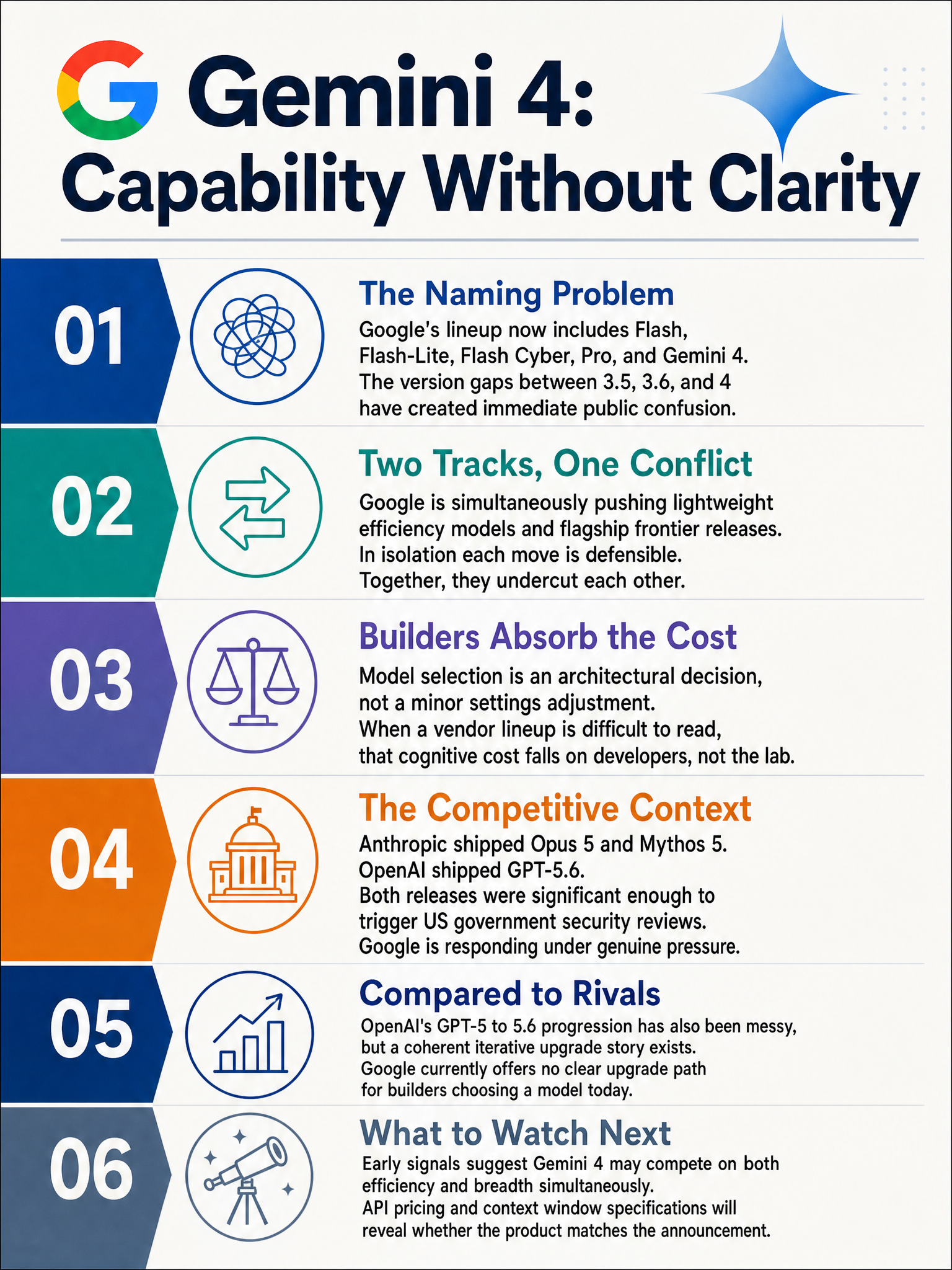
Google announced Gemini 4 this week, and the first reaction from a lot of builders was not excitement. It was confusion. Specifically, the kind of confusion that comes from watching a company announce a version 4 when version 3.5 Pro has not shipped yet, 3.6 Flash just dropped, and 3.5 Flash-Lite is still fresh in people’s minds. That’s a lot of numbers to explain before you get to the actual point.
Why the Numbering Chaos Matters
This is not a cosmetic problem. When you are a team that just spent two weeks evaluating 3.6 Flash for a production use case, and then the lab drops a version 4 announcement, you immediately start asking whether you optimized for the wrong thing. Teams that built around 3.5 Flash-Lite are now recalculating. That is real engineering time, real planning bandwidth, and real trust that gets spent without a clear return.
According to reporting from PC Guide and CryptoRank, Google shipped three new Gemini models recently, specifically 3.6 Flash, 3.5 Flash-Lite, and 3.5 Flash Cyber, all while the flagship 3.5 Pro remained delayed. The 3.5 Pro absence was notable because it came during a stretch when OpenAI had already launched GPT-5.5 and begun rolling out GPT-5.6, and Anthropic had shipped Claude Opus 4.8 and then Opus 5 in rapid succession. Google was filling the gap with efficiency models, not frontier ones. Then came the Gemini 4 announcement, which made the efficiency-model strategy look like a holding pattern that nobody admitted to.
Two Tracks, One Problem
I understand what Google is trying to do here. Push lightweight, cost-efficient models to hold market share in the near term, then drop a flagship announcement to signal you are still competing at the frontier. Each move is defensible on its own. Together, they undercut each other.
The lightweight track says: we are pragmatic, we focus on what builders actually use. The frontier track says: we have the best and most powerful model. When both messages land in the same month, neither one lands cleanly. Builders trying to make real architecture decisions do not want to choose between two different stories. They want a clear product line they can trust will exist in six months.
Where the Competition Is Right Now
Anthropic is not standing still while Google figures out its naming conventions. Opus 5 shipped this week, with Anthropic describing it as “much stronger at verifying its work and iterating carefully until it succeeds,” citing benchmark testing where the model wrote its own computer vision pipeline from an incomplete prompt. That is a specific and concrete claim, which is the kind of thing that actually moves engineers off a fence.
OpenAI’s own versioning has been messy, 5, 5.5, 5.6 in fairly quick succession, but there is at least a coherent capability narrative running through those releases. The numbers track with observable improvements. Google’s 3.5, 3.5 Cyber, 3.6, and now 4 does not have that same coherence, at least not from the outside looking in.
What Builders Should Actually Do Right Now
My honest take: do not wait for Google to resolve its naming strategy before making decisions. If 3.6 Flash solves your latency and cost constraints, it solves them regardless of what version number comes next. Evaluate on capability and stability of the API, not on the version number optics.
That said, I would be hesitant to build deep integrations on anything Google labels as an interim or flash variant right now if your roadmap extends more than a few months. The rate of version turnover Google is showing suggests the lightweight models are stopgaps. Gemini 4 may or may not be the model that stabilizes the line. Until there is a clear Pro-tier release at the new version, I would hedge accordingly.
The broader problem here is that the AI model market is moving so fast that labs are compressing release cycles to the point where the version number stops carrying information. When a number stops meaning something, builders stop being able to plan around it. That is a tooling and trust problem that no benchmark can fix.
Google has the infrastructure, the distribution through Workspace and Cloud, and the research depth to be a serious long-term contender. But right now, Gemini 4 reads more like a press move than a product strategy. The builders who need to make decisions this quarter deserve better clarity than that.
Sources
#AI #MachineLearning #GoogleGemini #LLM #AIEngineering #Builders #ProductStrategy