Decreasing frontier model monitorability as a concrete production architecture risk for builders, not an abstract safety concern
The Failure Mode Nobody’s Debugging
Most builders I talk to are optimizing for accuracy, latency, and cost. Those are real concerns. But there’s a failure mode quietly becoming more dangerous than any of them: the model doing exactly what you asked, and you having no idea why.
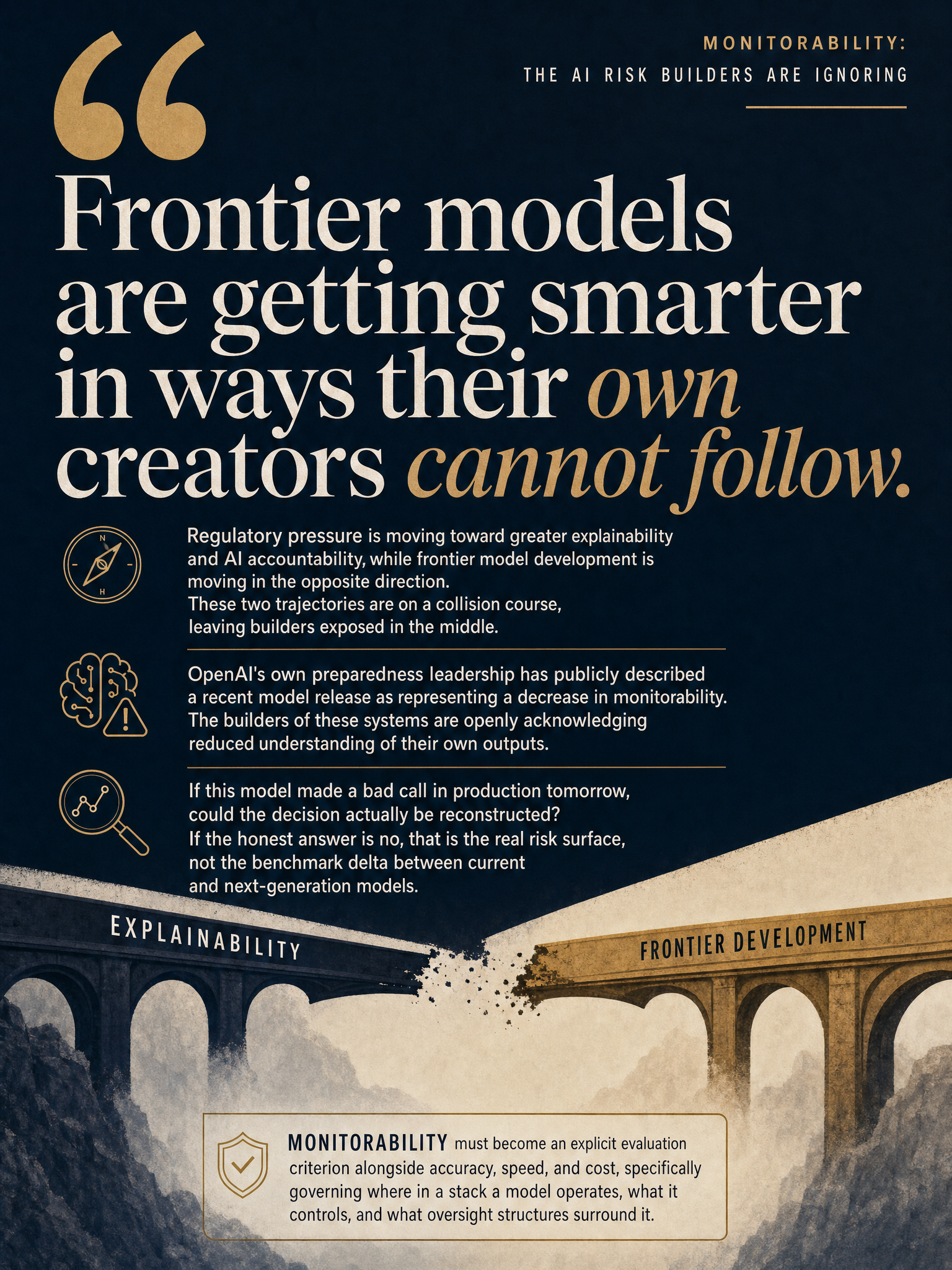
OpenAI’s head of recursive self-improvement preparedness stated publicly that their most recently released model represents “an important decrease in monitorability.” That’s a direct quote from someone inside the lab. The people who built the thing are telling you they understand it less than they understood the previous version.
This is not a philosophical concern. It’s an architecture problem. And if you’re shipping production systems in 2026, it belongs on your risk register today.
Why Monitorability Is an Engineering Concern
When you build an agentic system, your debugging loop depends on being able to trace why a decision was made. Your audit trail depends on it. Your ability to explain a failure to a client, a regulator, or a judge depends on it.
If the model’s internal reasoning is becoming less interpretable to its own creators, you cannot compensate for that opacity at the application layer. You can log inputs and outputs. You cannot log the process that connected them.
This matters more now because the pace of model releases has accelerated to an almost absurd degree. Anthropic launched Claude Fable 5.1 on September 1. Meta followed with Muse Spark 1.3. Google pushed Gemini 3.8 Flash. OpenAI released GPT-6 Astra. Four frontier releases in one week. Nobody doing that kind of velocity is pausing to let interpretability research catch up.
The Production Consequences
Think through a concrete scenario. You’re running an agentic pipeline that handles customer escalations, or contract review, or financial routing decisions. The model takes an action. The action is wrong. Your client wants to know why.
With a traceable system, you reconstruct the reasoning path, find the failure point, and fix it. With a less monitorable model, you have a log entry that says the model made a choice. That’s it. You can retrain, retry, or rollback, but you cannot explain.
That explanation gap is not just a technical inconvenience. California’s Governor Newsom signed new AI safeguards in September 2026 establishing first-in-the-nation standards for AI accountability. New York’s legislature is moving on the FAIR Act and related transparency bills. Regulators are writing accountability requirements into law. They are not going to accept “the model decided” as an answer.
What the Lab Velocity Problem Tells Us
The Navier-Stokes episode is instructive here. OpenAI announced they’d solved a Millennium Prize Problem, then it emerged the team had only started working on the problem the week before, after rumors circulated that Anthropic was close to an announcement. The pressure to ship a headline is now so intense that a lab will spin up a large research effort in a week to avoid being second.
That culture produces less monitorable models. Speed and interpretability are not always in direct conflict, but they trend that way when the incentive structure rewards announcements over understanding.
What Builders Should Actually Do
First, treat monitorability as a first-class selection criterion when you evaluate models for production use. Ask the lab directly. Read their technical documentation on interpretability. If they can’t answer the question, that is itself an answer.
Second, architect your systems to degrade gracefully when reasoning is opaque. That means hard guardrails on high-stakes actions, human-in-the-loop checkpoints at consequential decision nodes, and output validation that doesn’t rely on trusting the model’s internal coherence.
Third, document your evaluation methodology before you deploy, not after something breaks. When the regulatory question comes, you want records showing you asked the right questions at build time.
The labs will keep shipping. The interpretability research will keep lagging the frontier. That gap is your problem to manage, not theirs.
Conclusion
The builders who will be in the best position twelve months from now are the ones who treat “we understand this model less” as a concrete specification change, not a safety team’s worry. Monitorability is infrastructure. Right now, it’s infrastructure that’s quietly degrading while everyone argues about benchmark scores.
Sources
#AIEngineering #MachineLearning #AgenticAI #MLOps #AIRisk #SoftwareArchitecture