Google DeepMind Gemini 3.5 Flash Cyber finds 55 V8 vulnerabilities in limited pilot, and what it means for agentic system security
Fifty-Five Vulnerabilities. Before General Availability.
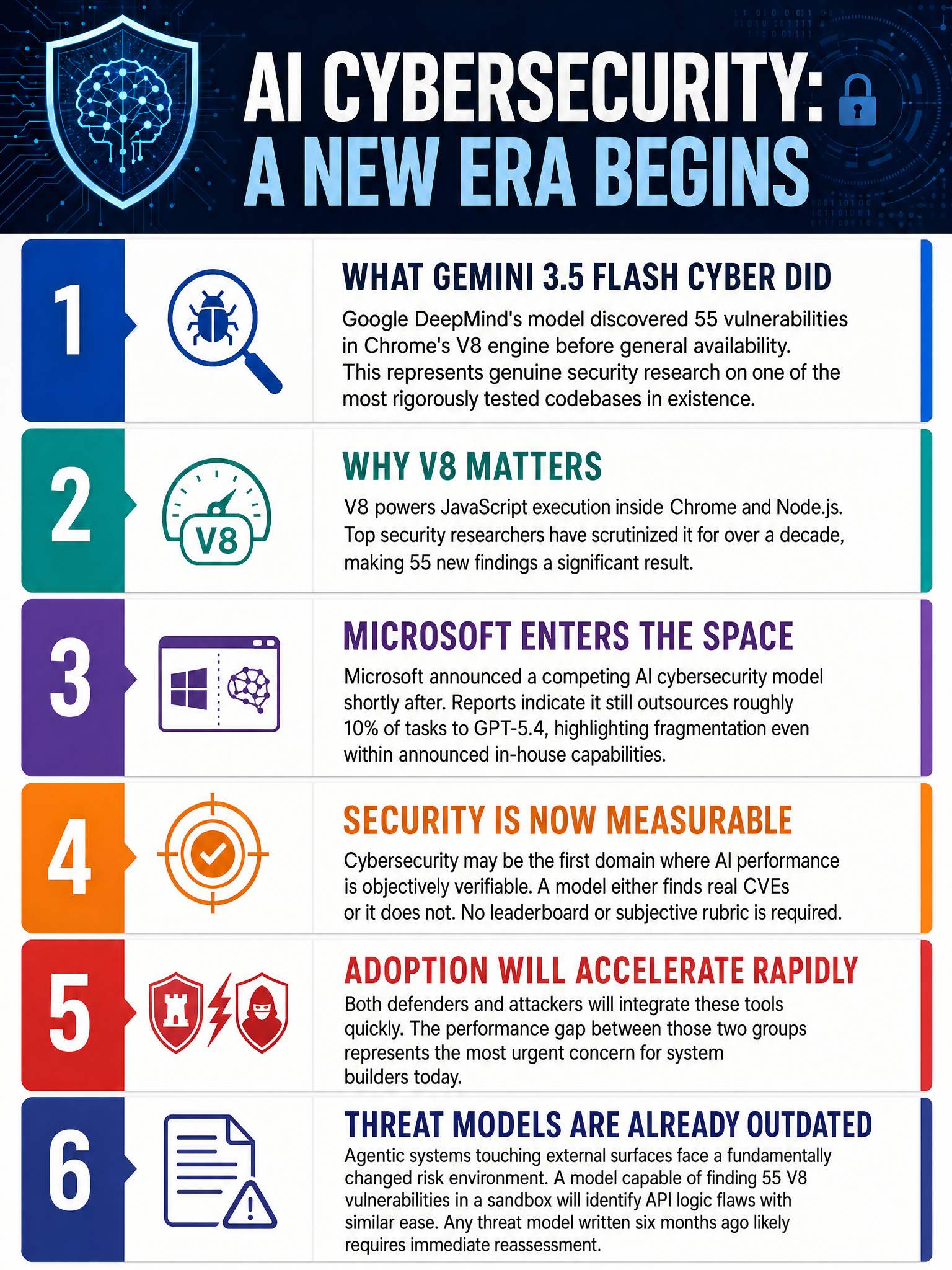
I’ve been following security research tooling for a while now, and I still had to read that number twice. Google DeepMind’s Gemini 3.5 Flash Cyber, a model that hasn’t even reached wide release yet, found 55 vulnerabilities in Chrome’s V8 JavaScript engine during its limited pilot rollout. Not in some toy codebase. Not in a synthetic benchmark. In V8, which powers Chrome and Node.js and has been combed over by elite security researchers for more than a decade.
That changes the conversation about what agentic AI systems are actually capable of, and it raises some uncomfortable questions about where this goes next.
Why V8 Matters As a Target
If you want to stress-test an AI security researcher, point it at V8. The engine is one of the most scrutinized codebases on the planet. Google’s own Project Zero has found vulnerabilities there. Independent researchers have built careers on V8 exploitation. The attack surface is well-understood, the patches are well-documented, and the bar for finding something new is genuinely high.
Fifty-five new vulnerabilities is not a rounding error. It’s a signal that Gemini 3.5 Flash Cyber is doing real triage and analysis, not just pattern-matching against known CVE databases. Whether every one of those 55 is critical is a separate question, but the volume alone tells you the model is operating at a level of depth that should make every agentic system architect pay attention.
The Microsoft Wrinkle
One day after Google’s announcement, Microsoft unveiled its own AI cybersecurity model. The timing was almost certainly not coincidental. But there’s a detail buried in XenoSpectrum’s reporting that I think deserves more scrutiny: Microsoft’s in-house model still outsources roughly 10% of its work to GPT-5.4.
Think about that for a second. A company with Microsoft’s resources and its deep integration into enterprise security is shipping an “in-house” model that isn’t fully in-house. That’s not a fatal flaw, but it tells you something honest about where the industry actually is. Building a fully self-contained, production-grade AI security researcher is hard. Everyone is still stitching things together.
What This Means for Agentic System Security 🔒
This is where I want to spend a moment, because I think the security conversation around agentic AI tends to focus on the wrong threat model. People worry about jailbreaks and prompt injection, which are real problems. But Gemini 3.5 Flash Cyber points toward a different concern entirely.
When an AI agent can autonomously discover 55 vulnerabilities in a hardened codebase, the question isn’t just “who is using this to defend systems.” The question is what happens when a similar capability ends up on the wrong side of the fence. The same model architecture that finds vulnerabilities in V8 for Google’s pilot partners could, in theory, be used to find vulnerabilities in your infrastructure. Agentic security systems need to be thought of as dual-use by default, not as inherently defensive tools.
Anthropic’s newly launched Opus 5 is also worth watching in this context. Anthropic described it as “much stronger at verifying its work and iterating carefully until it succeeds,” and pointed to benchmark results where it wrote its own computer vision pipeline from an incomplete prompt. That capacity for self-directed iteration is exactly what makes these models powerful security researchers. It’s also exactly what makes them interesting from an offensive standpoint.
The Regulatory Gap Is Real
The AI AGENT Act, currently moving through Congress, would establish privacy, cybersecurity, and transparency requirements for consumer-facing AI agents. The Secure Artificial Intelligence Development Act of 2026 would add security standards on top of that. Both are steps in a reasonable direction.
But government-facing security AI, the exact category Gemini 3.5 Flash Cyber is being piloted in, sits in a different regulatory space. The pilot rollout to government agencies and trusted partners sounds controlled. It probably is controlled, right now. The question is what the governance model looks like when this capability scales beyond a limited pilot. OpenAI employees and Anthropic employees have already publicly called for international oversight and the option to pause frontier AI development. That’s not a fringe position anymore.
The Honest Takeaway
The V8 finding is impressive. I think Google DeepMind deserves credit for being transparent about the capability rather than burying it in a benchmark report. But 55 vulnerabilities found before general availability means we’re entering a period where the rate of vulnerability discovery is going to outpace the rate of remediation, unless defensive AI tooling scales at the same pace as the offensive capability.
That’s not a hypothetical future problem. It’s the problem right now, in mid-2026, with a model that isn’t even fully deployed yet.
Security teams that aren’t thinking about AI-assisted red teaming as a near-term operational reality are already behind.
Sources
#AISecurty #AgenticAI #MachineLearning #CyberSecurity #GoogleDeepMind #LLM #VulnerabilityResearch