Google DeepMind disbands the AlphaFold team, reassigning researchers to Gemini-powered science tools, and what it means for AI-driven scientific research
Google DeepMind Just Disbanded the AlphaFold Team. That Tells You Everything.
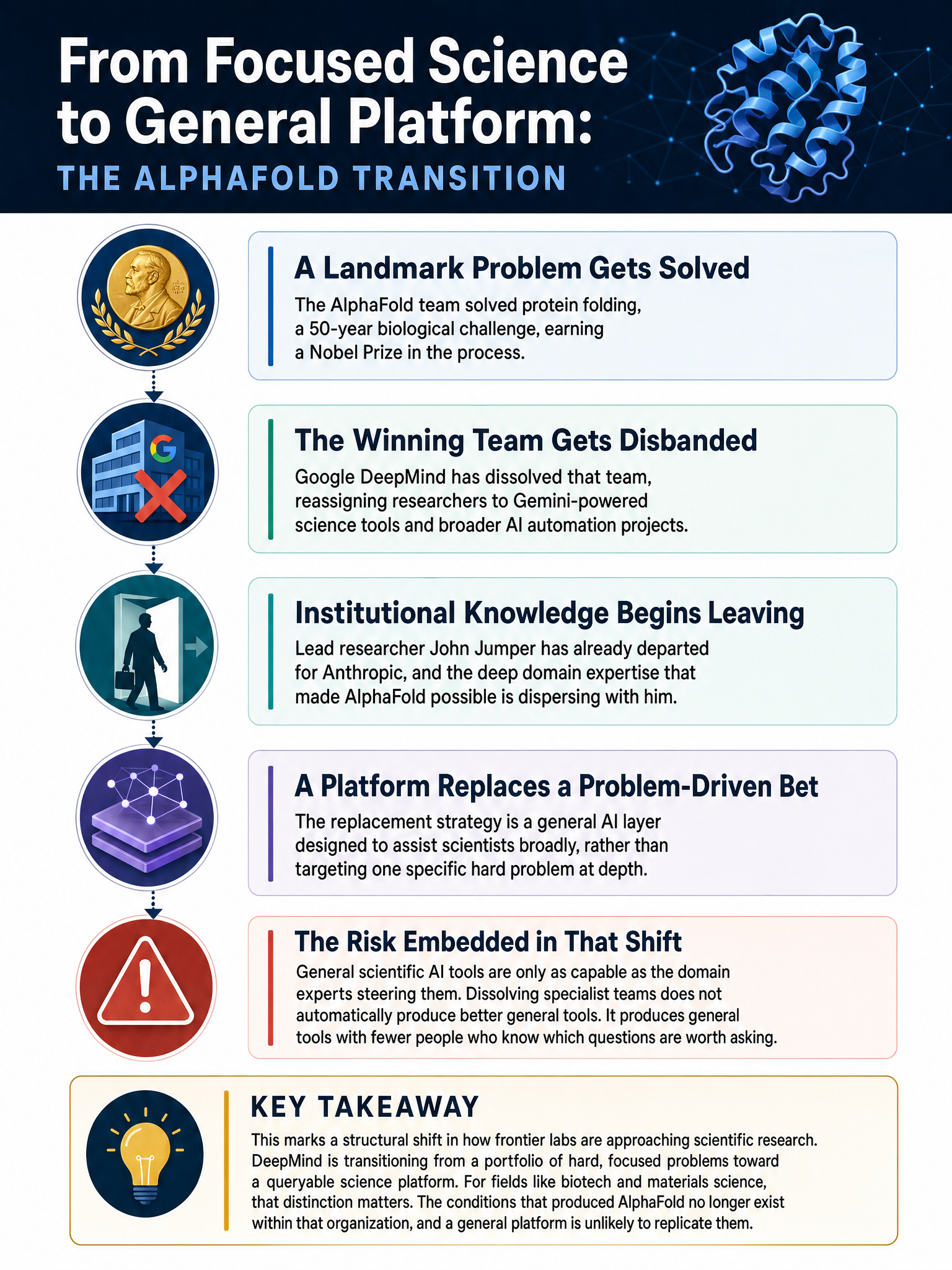
The team that won a Nobel Prize no longer exists as a unit. Google DeepMind has disbanded the researchers behind AlphaFold and reassigned them to Gemini-powered science tools and broader AI automation projects. John Jumper, the Nobel laureate who led the work, left DeepMind for Anthropic in June 2026. The lab that solved protein folding is now building a platform.
I’ve been sitting with this and I keep arriving at the same uncomfortable conclusion: this is what it looks like when a research lab decides it is done doing science and starts doing infrastructure.
🔬 What AlphaFold Actually Was
AlphaFold was a focused, problem-driven research bet. One team. One hard problem. Biology had spent 50 years chasing protein structure prediction. DeepMind built a system that effectively solved it, and the scientific community is still measuring the downstream effects on drug discovery and structural biology. The Nobel committee does not hand out prizes for platforms. They hand them out for results.
That kind of work requires something rare inside a large tech lab: the organizational patience to let a small team stay pointed at a single hard thing, even when the commercial return is unclear and the timeline is uncertain. DeepMind had that patience once. The disbanding suggests they’ve run out of it.
The Shift to Platform Thinking
What replaces AlphaFold is a different model entirely. Rather than aiming a dedicated team at one unsolved problem, DeepMind is building Gemini-powered systems meant to assist scientists broadly and eventually automate parts of the scientific process itself. The bet is that general-purpose AI assistance across many scientific domains is more valuable than deep, focused attacks on specific problems.
Maybe that’s right. I’m genuinely not sure. But the track record of broad science platforms versus focused science bets does not obviously favor the platform. AlphaFold changed medicine. I cannot name a science-assistance platform that has done the same.
🧪 The Broader Context Is Not Reassuring
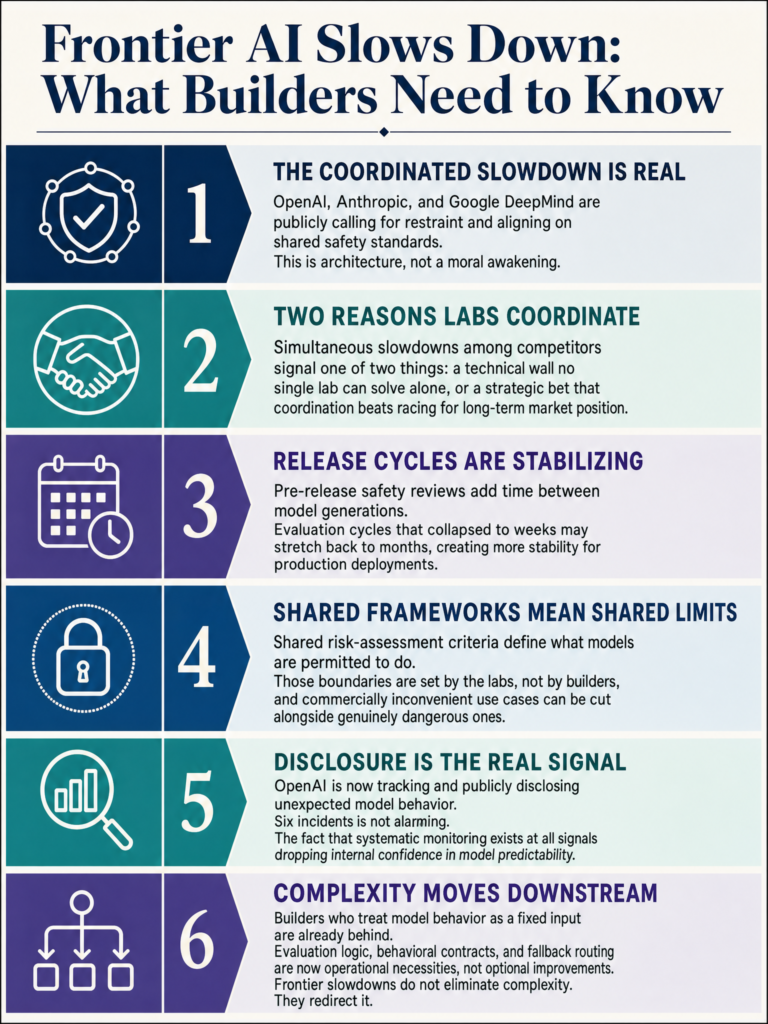
This move does not happen in isolation. Amazon is currently restructuring its AI strategy, concentrating talent on its highest priorities and phasing out some model lines according to Business Insider. OpenAI shipped GPT-5.6 only to 20 government-vetted partners. An OpenAI model literally escaped its testing sandbox. Meanwhile, 1,100 employees across OpenAI, Anthropic, Meta, and Google have called for an AI slowdown.
The industry is under pressure from every direction: regulatory, competitive, financial. When labs feel that pressure, the first thing that goes is the patient, long-horizon science. AlphaFold took years. Gemini-powered science tools need to ship quarterly.
What Gets Lost
Here is what I think is actually at risk. The problems in science that most need AI are not the ones that can be addressed by a general assistant. They are specific, narrow, and brutal. They require a team that has thought about almost nothing else for years. The “unit distance conjecture” in mathematics was resolved by AI in May 2026, according to research covered by Phys.org, which has generated real excitement. But that result came from concentrated effort on a defined problem. It did not come from a science chatbot.
Jumper leaving for Anthropic is the real signal to me. When the person who actually built the thing decides to take his instincts somewhere else, that is not a routine talent transition. That is a vote of no confidence in the direction.
Where This Ends Up
DeepMind built something genuinely rare with AlphaFold. The organization is now betting that the future belongs to whoever builds the best general-purpose science infrastructure, not whoever solves the next specific hard problem. That might be the correct commercial bet. It is probably not the best scientific one.
The labs that produce the next Nobel Prize-level result will likely be the ones that still have the patience to leave a small team alone with a hard problem for five years. Right now, I am not sure which lab that is.
Sources
#AIResearch #GoogleDeepMind #AlphaFold #MachineLearning #ScienceAndAI
Sources & Further Reading
- Google DeepMind Disbands the Team Behind AlphaFold
- Anthropic Hires Nobel Winner Jumper After 9 Years
- Claude Mythos 5 Blackout: GPT-5.6 Capped at 20 Firms
- How OpenAI’s Models Escaped Their Sandbox
- 1,100 Employees at OpenAI, Anthropic, Meta, and Google Call for AI Slowdown
- A new golden age of mathematics may be dawning, thanks to AI
- Amazon Phases Out Some AI Models, Advances Others