Prediction and analysis: why AI has been net job-creating so far, and whether ‘so far’ is doing heavy lifting in Altman’s claim
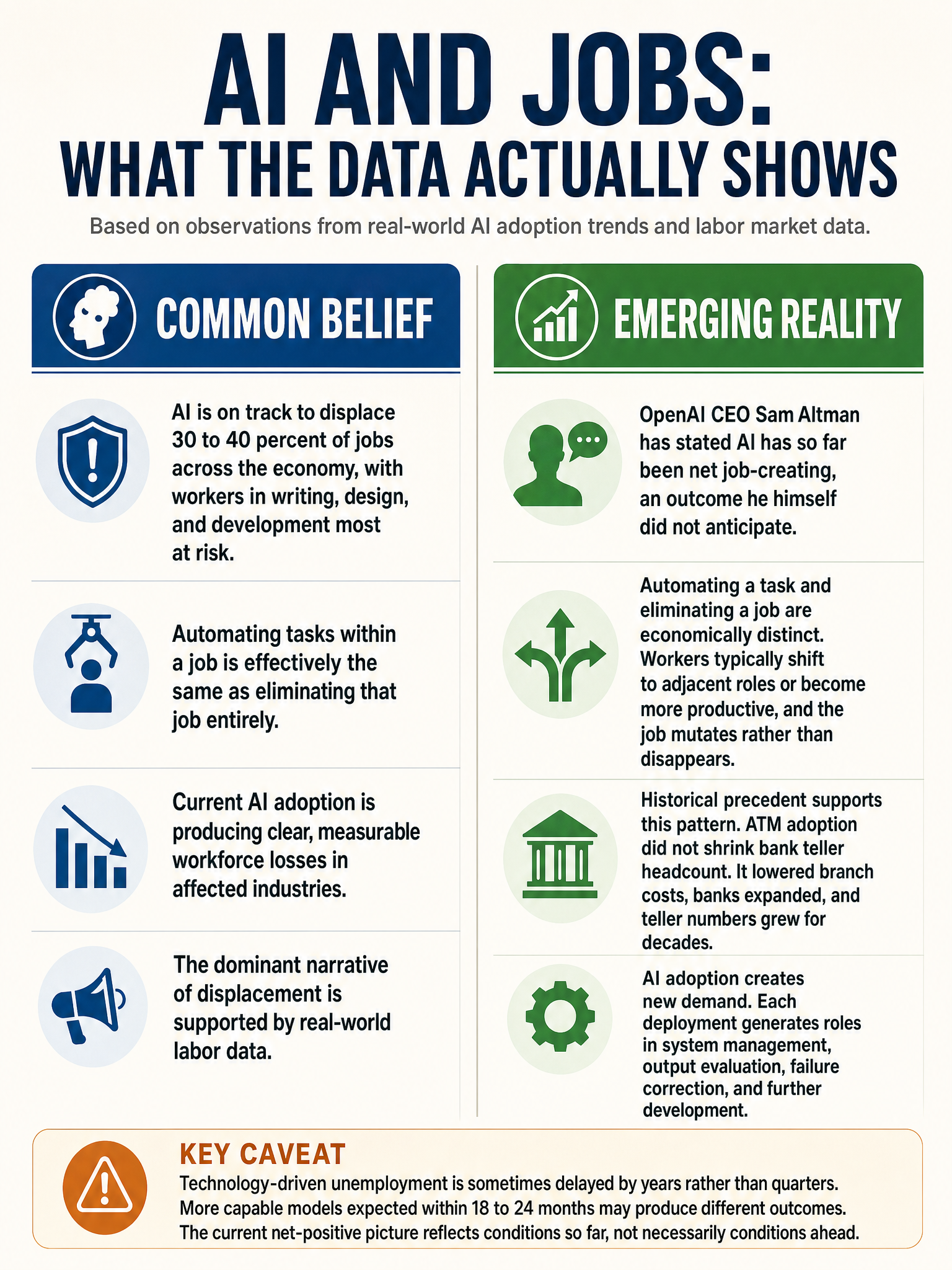
Sam Altman posted something this week that I keep coming back to. “So far at least, I’m pretty sure AI has been net job-creating. This was not what I expected.”
Read that again. The CEO of OpenAI. The person with more direct visibility into AI adoption curves than almost any human on the planet. And he’s surprised.
That surprise deserves more than a quick nod.
Why The Displacement Story Never Quite Arrived
For the past three years, the prevailing narrative has been collapse. Economists at Goldman Sachs put 300 million jobs at risk from automation. Dario Amodei talks about AI potentially doing the work of “an entire mid-level employee.” McKinsey modeled 30 to 40 percent of tasks across knowledge work as automatable with current generation models.
Writers panicked. Developers panicked. Designers panicked.
And yet the BLS data kept not cooperating. U.S. unemployment sat at 4.1 percent as of mid-2025. Tech layoffs, when they came, were attributed to post-pandemic overcorrection more often than AI substitution. The creative industry shed jobs, but not at the cliff-edge rate the models predicted.
So what is actually happening?
Tasks vs. Jobs: The Distinction That Matters
AI is genuinely poor at replacing jobs wholesale. It is very good at replacing specific tasks within jobs. Those two things are not the same, and conflating them is where most of the displacement predictions went wrong.
A radiologist’s job is not “look at images and spot anomalies.” It is consult, communicate uncertainty, manage liability, coordinate care, and operate within a hospital’s political and administrative reality. AI handles one slice of that. The radiologist is still there, now faster.
A software developer’s job is not “write functions.” It is understand requirements that aren’t fully articulated yet, push back on bad product decisions, debug interactions between systems that have years of undocumented history, and own the outcome when production breaks at 2am. Copilot handles the function. The developer is still there.
When you map actual job descriptions instead of abstract task lists, the automation frontier moves back considerably.
Where The Net-Positive Case Actually Comes From
The job creation happening alongside AI adoption comes from a few real mechanisms.
First, AI genuinely lowers the cost of starting something. A solo founder can now run marketing copy, customer support, and code review with a fraction of the headcount previously required. That creates businesses that would not have existed, which creates jobs downstream that would not have existed.
Second, productivity gains historically expand markets rather than simply shrinking labor demand. When spreadsheets arrived, accountants did not disappear. Demand for financial analysis grew because it got cheaper to do. Something similar is plausible here, though not guaranteed.
Third, the AI industry itself is hiring. OpenAI, Anthropic, Google DeepMind, and Meta AI are collectively running some of the most expensive hiring campaigns in technology history. The infrastructure buildout alone, the data centers, the chip fabs, the energy contracts, is generating blue-collar employment at scale.
The Heavy Lifting In “So Far”
Here is where I push back a little on Altman’s framing, even while I think his observation is probably accurate.
“So far” is doing enormous work in that sentence.
Current AI systems are good at augmenting high-skilled knowledge workers. They are not yet good at replacing them. But the trajectory of GPT-5.6, which OpenAI released this week and which now scores 80.0 on the Artificial Analysis Coding Agent Index, outperforming Claude Fable 5 by 2.8 points while costing roughly one-third less, points toward a different kind of capability.
ChatGPT Work, also announced this week, explicitly targets “entire workflows with a single request.” That is a different product category than a writing assistant or a code autocomplete. That is a system designed to reduce headcount on specific job functions.
The job-creating phase may be real. It may also be the early phase of a technology whose displacement effects arrive later and faster than the augmentation effects that preceded them. Historical precedent, the ATM and bank teller example being the most cited, suggests the transition period can last a decade before the net effect flips.
Altman’s surprise is honest and worth respecting. But the honest follow-on is that we are probably not at the end of this particular data series.
The Part Nobody Wants To Say Out Loud
If AI is net job-creating right now, it is partly because the people deploying it are still figuring out how to deploy it. Organizational inertia is a real force. Companies are buying AI tools and then not restructuring around them, because restructuring is hard and politically painful.
That inertia won’t last forever. As tooling matures and the business case for fewer FTEs gets clearer to CFOs, the picture changes. The question is not whether displacement comes. The question is whether new job creation outpaces it fast enough to matter for the people displaced.
I do not think anyone, including Altman, knows the answer to that yet. The honest position is watching the data closely and not letting either the panic narrative or the optimism narrative outrun the actual evidence.
Sources & Further Reading
#AIJobs #FutureOfWork #ArtificialIntelligence #OpenAI #MachineLearning