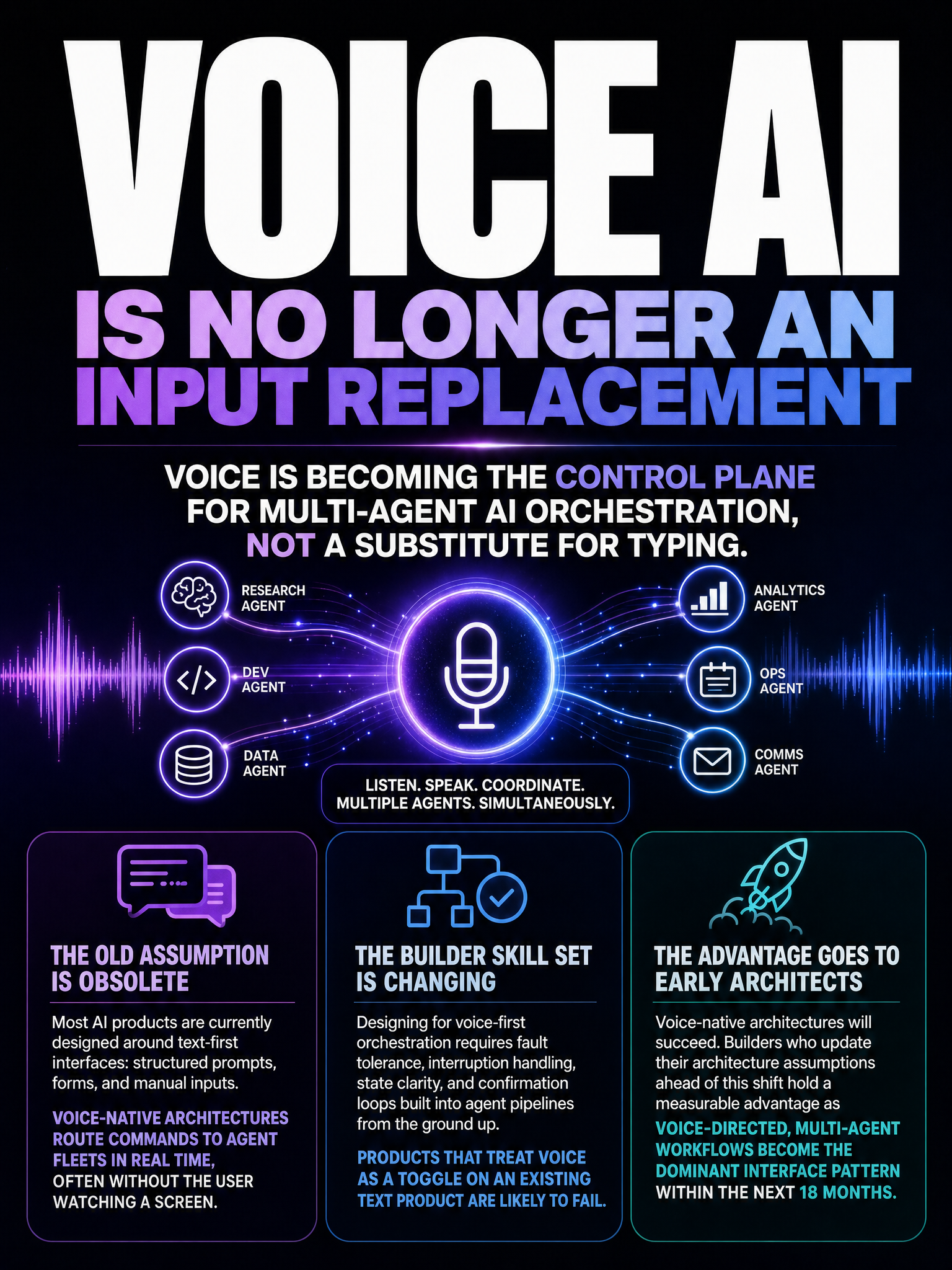
Contrarian take on ChatGPT Voice desktop launch: voice as agent orchestration layer, not just input replacement, and what it means for builders designing AI systems today
Voice Is Not an Input Method Anymore
Most builders I talk to are treating the ChatGPT desktop Voice launch as a convenience feature. Hands-free prompting. Dictation with a smarter autocomplete. That framing is going to cost people who hold it.
OpenAI’s announcement was blunter than that: “Control your computer and direct multiple agents running in ChatGPT Work or Codex, using just your voice.” That’s not a voice wrapper on a chat interface. That’s a new layer in the stack, one that sits above the agents and orchestrates them.
The difference matters enormously for anyone building AI systems today.
Why the Architecture Is Different
GPT-Live, the engine underneath the Voice feature, can speak, listen, and coordinate parallel work simultaneously. That’s a big departure from the traditional voice-to-text pipeline where audio gets transcribed, the transcript hits a model, and a response comes back in sequence. The simultaneity is the point. You’re not pausing execution to issue a command. You’re talking to a running system, redirecting it, adding context, pulling outputs back into a live conversation.
That’s orchestration. It’s what a tech lead does on a team call. Not typing tickets, actually steering work in motion.
And Sam Altman dropped a quiet signal about the scope of this when he wrote that ChatGPT Work is “remarkable” and that “work” undersells it. He described sending a single prompt from his phone, from voice, that kicked off full-stack site generation for a group trip. That’s one spoken sentence producing multi-step, multi-agent output. The voice layer wasn’t just input. It was a control plane.
What Builders Are Missing
The assumption most people are designing around is that voice is an accessibility feature or a mobile-first convenience. You use voice when you can’t type. That’s how Siri was positioned. That’s how most enterprise voice tools get scoped.
But OpenAI is building toward a model where voice is the coordination interface and everything else, the agents, the code runners, the data connectors, are subordinate to it. Voice becomes the thing that holds context across a parallel workload and decides what gets attention next.
If you’re designing an AI system right now and you’re thinking about voice as an afterthought, a modality you’ll add later, you’re probably designing the wrong thing. The interface layer shapes what’s possible downstream. Always has.
The Real Inflection Point Here
OpenAI also launched something called OpenAI Presence this week, described as a way for enterprises to “deploy trusted voice and chat agents across customer and internal workflows.” Agents that can “answer questions, use company systems, take approved actions, and escalate to people when needed.”
Read that last phrase again. Escalate to people when needed. That’s not a chatbot with a voice feature. That’s an autonomous workflow with human oversight checkpoints baked in, and voice is presumably how humans interact with those checkpoints in real time.
This is the architecture of ambient computing. The system runs. You talk to it when it needs direction or when you need to redirect it. The keyboard interaction model, where you initiate every action, is being replaced by an interrupt-driven model, where the agent runs and you supervise.
What This Means If You’re Building Now
Three things I’d be thinking hard about right now.
First, if you’re building any kind of agent pipeline, design for real-time steering from the start. Not just input at the top and output at the end. Your architecture should have hook points where a voice layer can redirect execution mid-run.
Second, the latency requirements for voice-as-orchestration are different from voice-as-input. You’re not waiting for a full response. You’re issuing corrections to a running process. That changes how you think about state management and how you surface partial outputs.
Third, the UX model of “user sends prompt, user waits, user reads result” is already outdated for agentic systems. The interaction pattern is becoming asynchronous and ambient. Build for that now, not in a future sprint.
Where This Goes
I don’t think this means everyone stops typing. But I do think we’re watching the emergence of a new interaction primitive, one where voice holds the supervisory role in multi-agent systems, and text becomes the artifact those agents produce rather than the way humans drive them.
OpenAI is moving fast enough in this direction that builders who treat voice as a UI nicety are going to find themselves redesigning core architecture later. Better to think through the implications now, when the cost of changing direction is still low.
The desktop voice launch is a small feature announcement with a large architectural argument underneath it. That argument is worth taking seriously.
Sources
#AIEngineering #AgentOrchestration #VoiceAI #OpenAI #BuildingWithAI #AIArchitecture