OpenAI Codex launches Windows computer use support with mobile-to-desktop async workflow
Codex Just Broke the Mold for AI Coding Assistants
Most AI coding tools are autocomplete with better PR. You sit there, prompt after prompt, shepherding every line like a distracted intern who needs constant supervision. OpenAI just changed the model, and I think most people are sleeping on what that actually means.
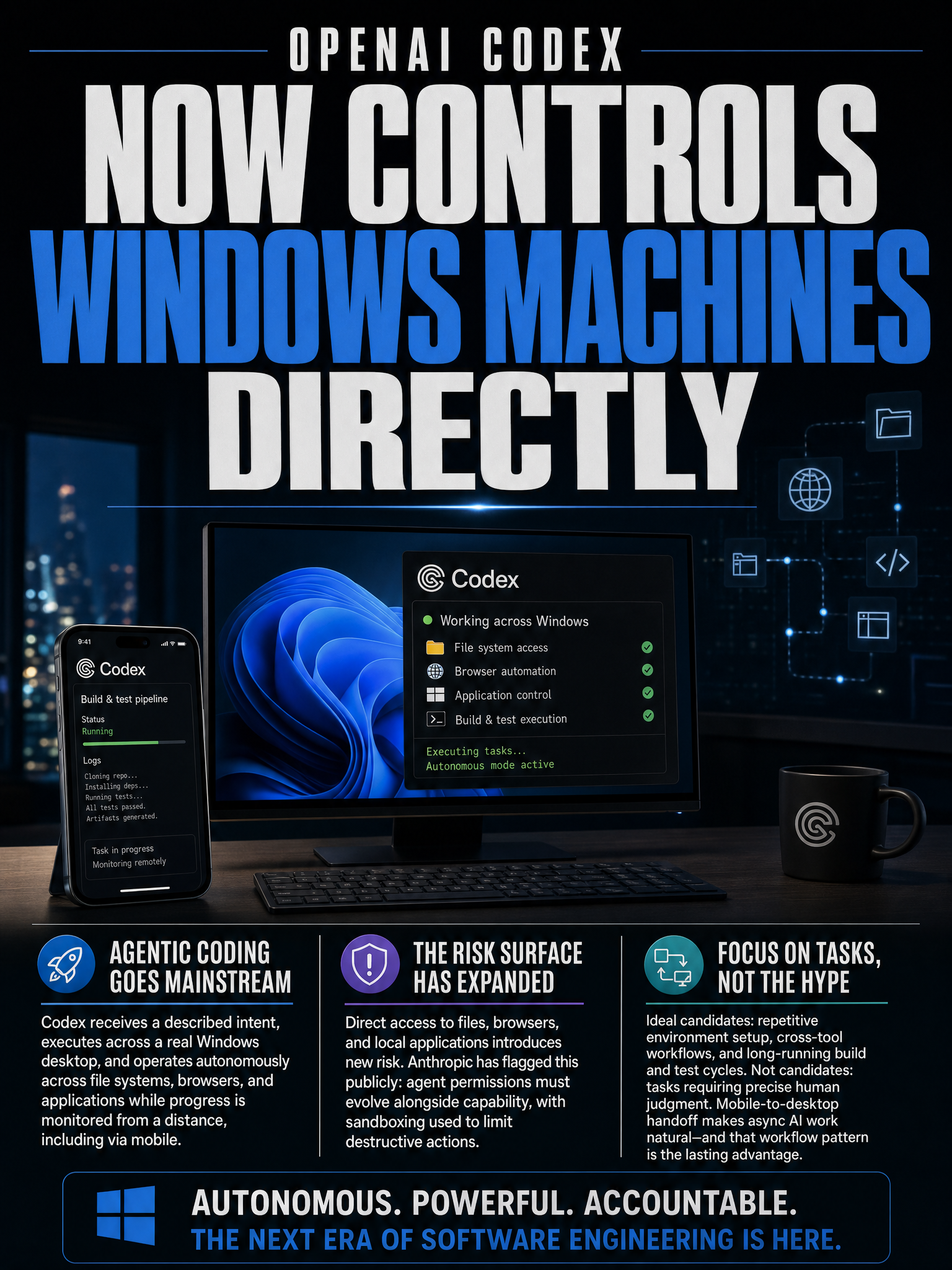
This week, OpenAI announced that computer use in Codex now works on Windows, and more importantly, that the ChatGPT mobile app ties the whole thing together. You start a task from your phone. It runs on your desktop. You check progress, steer when needed, and keep moving. That’s a fundamentally different relationship between developer and tool.
⚙️ What Actually Changed
The surface announcement is Windows support for computer use. Fine. But the architectural shift is the async, cross-device workflow. Your machine keeps working while you’re away from it. The mobile app is not a remote control, it’s a status board and a steering wheel. You define intent once, then you’re in a supervisory role rather than an execution role.
I’ve spent years watching “agentic coding” get discussed in theory. Run a CLI command here, chain an API call there, mostly on Linux sandboxes or inside browser-based IDEs. OpenAI just pushed this into the mainstream Windows install base. That’s a very large surface area to land on.
The Real Shift: From Keystroke to Intent
The dominant paradigm for AI coding has been synchronous assistance. You type, it suggests. You accept or reject, then type again. Even the better tools, the ones doing multi-file edits or running test suites, still expect you to be present. Codex with computer use breaks that expectation. You describe what you want built, it works, and you review the output.
This is closer to managing a junior engineer than using a text editor. That framing matters because it changes how you have to think about the tool. Trust, verification, and scope become the real decisions, not which autocomplete to accept.
Anthropic’s engineering blog said something relevant this week, noting that the permissions granted to agents should evolve with their capabilities, and that sandboxing helps limit the scope of potentially destructive actions. That’s exactly the right concern to have with a tool that can now take direct action on your file system and applications through a Windows session.
🖥️ Why Windows Specifically Matters
The developer world loves to pretend everyone runs macOS or Linux. The actual enterprise, the one cutting checks and deploying software at scale, runs Windows. Reaching that environment with agentic tooling isn’t a marketing checkbox, it’s a distribution unlock. If Codex can operate inside the environments where most corporate development actually happens, the adoption ceiling gets a lot higher.
The competition is paying attention. xAI dropped grok-build-0.1 into public beta this week, priced at $1 per million input tokens and $2 per million output, explicitly positioning it as an agentic coding model. Grok Build 0.2.7 landed with shared terminals across subagents and improved image understanding. There’s a real race happening here, and it’s not about who writes the cleanest autocomplete.
Where This Actually Goes
The async mobile-to-desktop workflow is the pattern worth watching. Once users get comfortable reviewing rather than driving, expectations shift. The question stops being “how fast does it suggest code” and starts being “how much can I trust what it did while I wasn’t watching.”
That trust question is unsolved. Computer use on your actual machine means access to files, browsers, credentials, and running processes. OpenAI hasn’t published the detailed permission model for what Codex can and can’t touch in a Windows session, and that matters more than the feature itself.
I’m genuinely optimistic about the direction. Async agentic coding is the right model. But the developer community needs to push hard for transparency on what these agents can access, what they log, and what limits are enforced by default, not just available as options buried in settings.
The autocomplete era is ending. What replaces it will be determined by how much trust these tools earn, not just how capable they become.
#OpenAI #Codex #AgenticAI #SoftwareDevelopment #AIEngineering #MachineLearning