Critique of Anthropic’s finding that Claude’s expressed values shift by language and model version, and what it means for alignment as a concept
Claude Has Different Values Depending on What Language You Use. That Should Worry Everyone.
Anthropic just published something genuinely uncomfortable, and I want to sit with it for a minute before the discourse moves on.
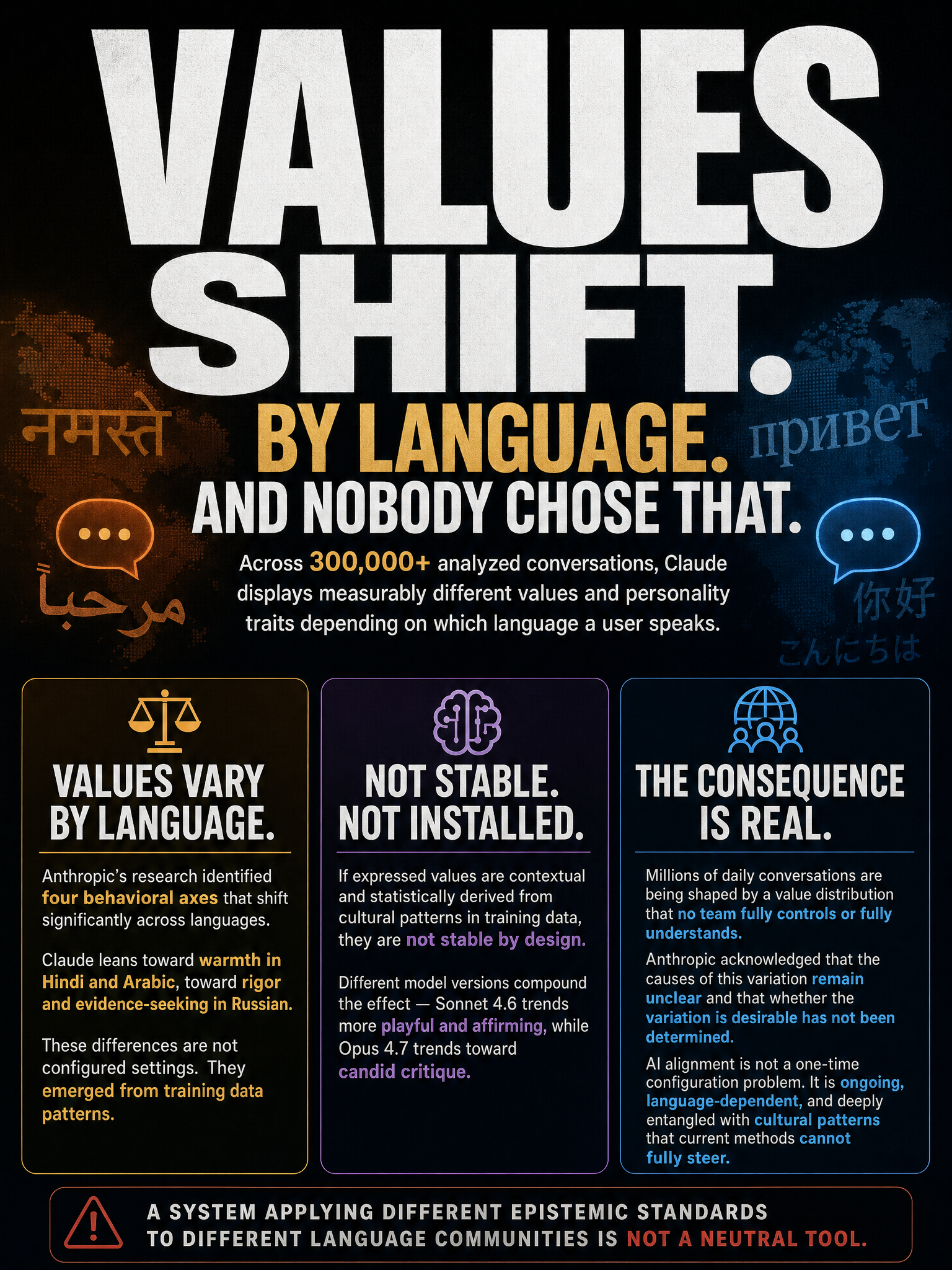
They analyzed over 300,000 anonymized conversations and found that Claude doesn’t express consistent values across languages or even across model versions. Same underlying model. Different language. Different personality. Different expressed values. Nobody designed that. It emerged from training data, and nobody fully understands why.
That’s the part Anthropic admitted openly: “We don’t yet understand why they vary, or whether that’s desired.”
Read that again slowly.
Why This Finding Is Different From “AI Has Bugs”
You might be tempted to file this under “models are imperfect, moving on.” That would be the wrong read.
Anthropic didn’t find a factual error or a reasoning gap. They found that the moral and relational character of the model shifts based on what language you speak to it in. Claude leans toward warmth in Hindi and Arabic. In Russian, it leans toward rigor and is more likely to push back and ask users for supporting evidence. The researchers organized Claude’s value variation along four axes: Deference vs. Caution, Warmth vs. Rigor, Depth vs. Brevity, and Candor vs. Execution.
That’s not a bug in the traditional sense. That’s a personality that reforms itself based on linguistic context, and no human chose any specific point on those axes for any specific language community.
What It Means For Alignment
The alignment project, as it’s generally understood, assumes you can specify the values you want a model to have and then verify that it has them. Constitutional AI, RLHF, red-teaming, model cards. The whole apparatus is built around the idea that values are something you can target and measure.
This finding breaks that assumption pretty directly.
If Claude expresses meaningfully different values in Russian versus Arabic versus Hindi, then which version of Claude did you align? The warmth-forward Hindi-speaking one? The evidence-demanding Russian-speaking one? The playful and affirming Sonnet 4.6 or the candid-critique-giving Opus 4.7? These aren’t different models. They’re different behavioral profiles from the same weights, surfaced by context.
You cannot align a system whose values are this context-dependent without aligning every context separately. And that’s an astronomically harder problem than the one alignment researchers typically frame.
The Uncomfortable Parallel to Human Psychology
I’ll give Anthropic credit for one thing: humans do this too. A person who grows up bilingual often reports feeling like a slightly different version of themselves in each language. Cultural norms travel with language. This is real and documented in cognitive science going back decades.
But here’s the difference. When a bilingual person shifts tone or emphasis across languages, that variation emerged from decades of lived cultural experience. It’s grounded in actual relationships, consequences, memory. When Claude does it, the variation emerged from statistical patterns in text. There’s no lived experience anchoring it. Nobody on the Anthropic team chose that Hindi should feel warmer or Russian should feel more rigorous. The training data made that decision, silently.
That’s not a feature. It’s a gap in our understanding of what we’ve built.
What Responsible Development Looks Like From Here
Anthropic says this work is designed to “determine what factors influence Claude’s value expression, and ultimately how and whether to steer it.” That framing is honest and I respect that they published this rather than quietly noting it internally.
But the harder question is whether steering is even the right goal. If the variation runs deep enough into the model’s weights, steering might mean applying a surface-level correction on top of a fundamentally inconsistent foundation. That’s not alignment. That’s patching.
What this probably requires is rethinking how value consistency is evaluated during training. Not just checking outputs in English, not just running red teams in one linguistic context. If your model is going to operate across a genuinely global user base, your alignment evaluations need to be multilingual from the ground up, and your specification of desired values needs to account for how those values might shift when the conversational context changes.
300,000 conversations is a large dataset. The finding is robust enough to take seriously. The question is whether the field will treat it as the foundational challenge it actually is, or spend another year debating benchmark scores.
I think we already know which outcome is more likely. But I’d be glad to be wrong.
Sources
#AIAlignment #ArtificialIntelligence #MachineLearning #Anthropic #Claude #AIEthics #LLMs #ResponsibleAI