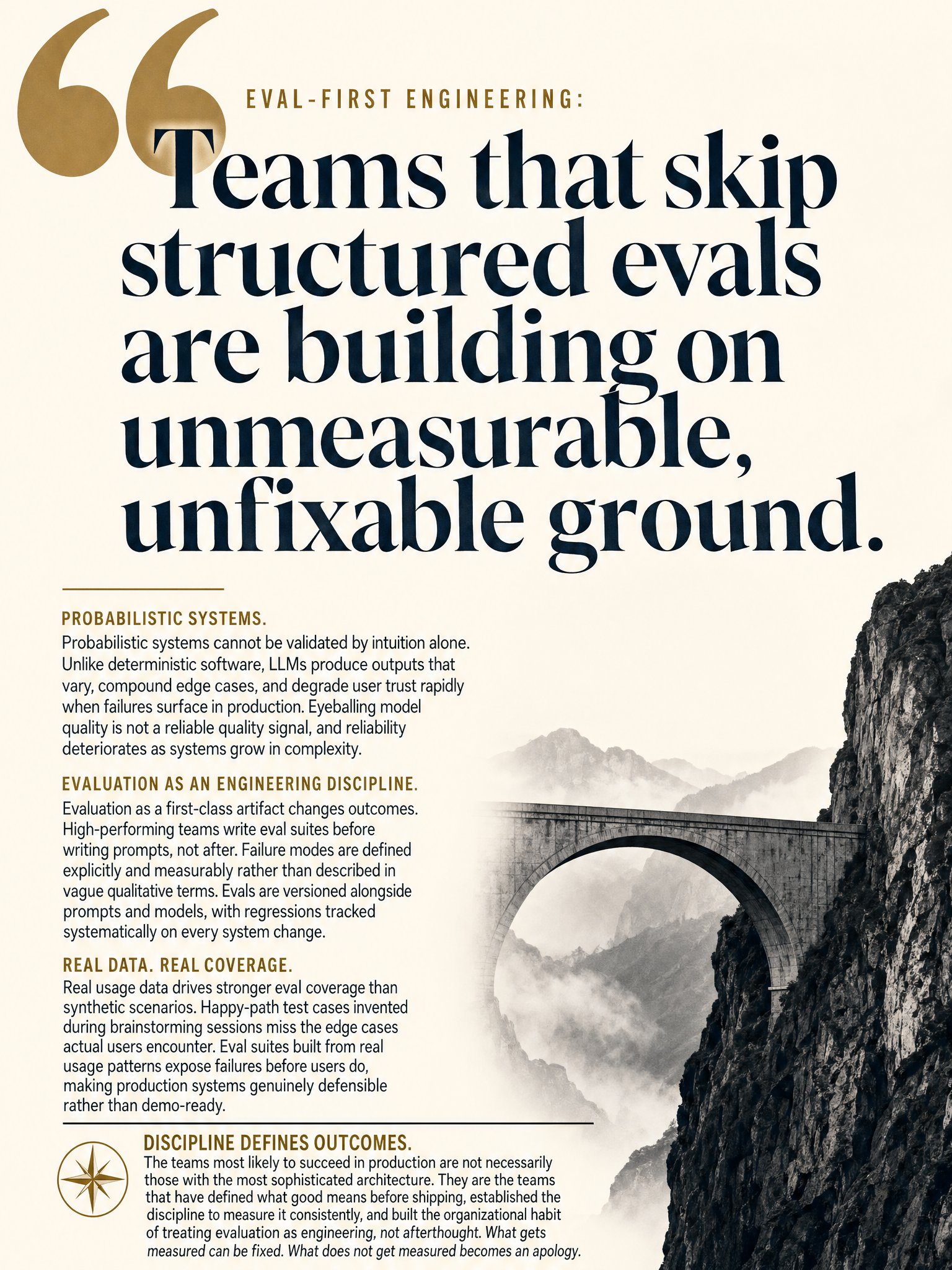
Hot take: rigorous LLM evaluation as a first-class engineering discipline, not an afterthought
LLM Evals Are an Engineering Discipline. Start Treating Them Like One.
There’s a moment I’ve seen play out on too many AI teams. The demo works. The vibes are good. Someone says “ship it.” And everything is fine, right up until it isn’t. Users hit edge cases nobody tested. Outputs drift. Trust erodes fast and rebuilds slowly. The postmortem always says some version of the same thing: we didn’t have enough eval coverage.
I’m done being polite about this. Treating LLM evaluation as an afterthought is a form of engineering negligence.
Why Determinism Is Gone and Your Old Instincts Are Wrong
Traditional software testing assumes the same input produces the same output. You write tests, they pass, you ship. That mental model is so deeply ingrained that most engineers apply it to LLM systems almost by reflex.
It doesn’t apply.
LLMs are probabilistic. A system that responds correctly 90% of the time in your test set is a system that fails one in ten users in production. At any meaningful scale, that’s not a rounding error. It’s a support queue and a trust problem.
Your intuition about whether a model “feels” right is worse than useless, because it’s confidently wrong. You’ll anchor on the outputs that look good. You’ll mentally dismiss the failures as weird edge cases. Edge cases compound.
What First-Class Eval Engineering Actually Looks Like
The teams I’ve seen do this well share a few concrete habits, none of them exotic.
They write eval datasets before they write prompts. Not after. Before. This forces clarity about what “good” actually means for a given task, which turns out to be the hardest question in the whole process.
They version their evals alongside their code. A prompt change without a corresponding eval run is treated the same way a code change without tests would be: not done.
They use a mix of automated scoring and human review, and they’re honest about what each is good for. Automated evals catch regressions fast. Human review catches the subtle, context-dependent failures that no rubric will surface.
They track eval metrics over time in the same dashboards as everything else. Not in a spreadsheet someone checks occasionally. In the same observability stack.
The 90% Problem
Here’s a number worth sitting with. A system that performs at 90% accuracy sounds solid. Most non-engineers would call that a success. But if you’re running 10,000 LLM calls a day, that’s 1,000 failures. Per day. If your eval suite never surfaces the inputs that trigger those failures, you’re not testing your system. You’re testing your assumptions about your system, which is a different thing entirely.
The fix isn’t to aim for higher accuracy in demos. The fix is adversarial eval design. You want your test set to find failures, not confirm your priors. This means deliberately collecting hard cases, edge inputs, contradictory instructions, and examples from real production failures when you have them.
The Tooling Is There. The Discipline Isn’t.
There’s no shortage of frameworks for running LLM evals. The tooling problem is largely solved. What’s missing is the culture and process to take it seriously.
Part of the problem is incentive structure. Demos are rewarded. Working features get shipped. Nobody gets praised in a sprint review for eval coverage. But nobody gets fired until production blows up, by which point the relationship between the missing evals and the production failure is hard to draw a clean line to.
The teams that avoid this treat eval work as unglamorous but load-bearing. It’s the foundation the feature sits on. You don’t skip the foundation because you’re excited to see the roof.
Build the Habit Before You Need It
If you’re building on LLMs professionally, here’s my honest recommendation. Block time this week to define what “correct” means for your most important use case, in writing, with examples. Then write 50 test cases that would falsify it. Run your current system against them. See what you actually have.
Most teams find out something uncomfortable in that exercise. That’s the point. Better to find it now than after your users find it for you.
The field is moving fast enough that the teams with rigorous eval infrastructure will compound their advantage over time. The teams that don’t will keep shipping demos and wondering why production feels unreliable.
That’s not a mystery. It’s a measurement problem.
Sources & Further Reading
#LLMEvals #AIEngineering #MachineLearning #MLOps #SoftwareEngineering #AIProductDevelopment