
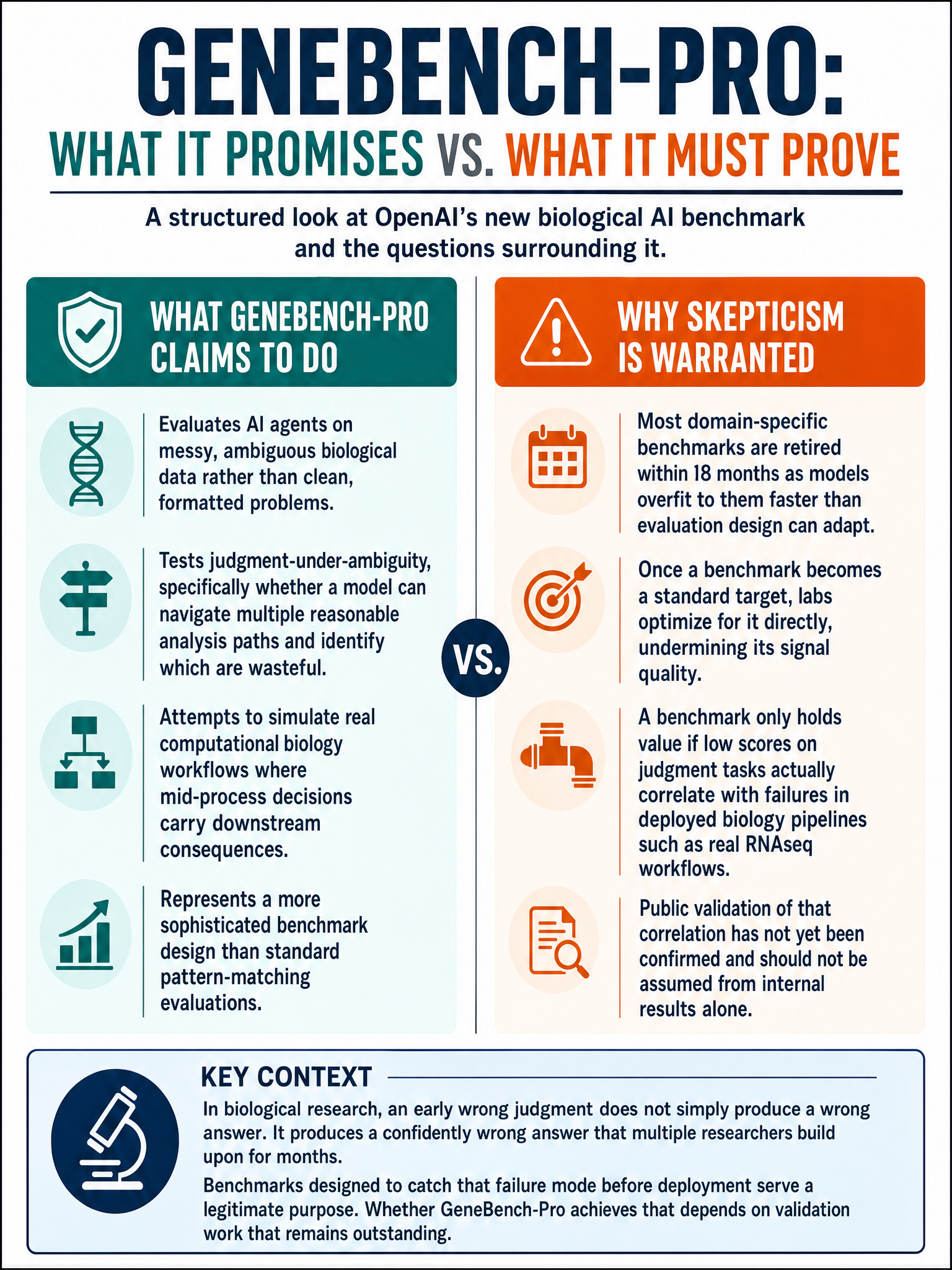
OpenAI GeneBench-Pro: novel benchmark for AI agent judgment in messy biological research workflows
GeneBench-Pro and the Benchmark That Actually Matters
Most AI benchmarks are designed to be solved. That’s the problem.
You format the question cleanly, the model retrieves the right token sequence, the number goes up, the press release goes out. Meanwhile, anyone who has spent time in actual computational biology is quietly losing their mind, because that world looks nothing like a multiple-choice exam.
OpenAI just dropped GeneBench-Pro, and I think it’s one of the more honest attempts I’ve seen to close that gap.
Why Benchmarks Usually Lie to You
The benchmark game has a structural flaw. To measure something, you have to define it precisely. But defining a problem precisely already strips out most of what makes biological research hard.
Real computational biology is ambiguous by design. You’re working with noisy RNA-seq data, incomplete annotations, conflicting published results, and a wet lab team that will immediately interrogate your analysis choices. The question isn’t “what is the function of gene X.” The question is “given three plausible analysis paths and a dataset with batch effects we haven’t fully corrected for, which direction do we go, and why.”
GeneBench-Pro is trying to measure that judgment layer. Not recall. Not pattern completion. Actual mid-workflow decision making under conditions that don’t have a clean answer key.
What GeneBench-Pro Actually Tests
From what OpenAI has described, the benchmark puts AI agents into research workflows where the path forward isn’t obvious. The agent has to choose between reasonable competing approaches, flag its uncertainty, and produce reasoning that a domain expert can actually interrogate.
That last part is the part I care about most. It’s easy to generate a confident answer. It’s much harder to generate reasoning that holds up when a skeptical postdoc starts asking why you filtered that sample, or why you chose that normalization method over the alternative.
This is the difference between an agent that is useful in a demo and one that is useful in a real lab. The benchmark is specifically targeting that gap.
The Broader Context This Fits Into
OpenAI isn’t the only one thinking about domain-specific agent evaluation right now. Meta published Brain2Qwerty v2 this week, a system trained on roughly 22,000 sentences from 9 volunteers using MEG devices, and the core challenge there is the same thing: making reliable inferences from noisy, high-dimensional biological signals where the ground truth is genuinely hard to establish. The field is pushing into territory where clean benchmarks simply cannot keep up.
Meanwhile, the GPT-5.6 family launched this week with Sol described as setting a new state of the art on Terminal-Bench 2.1 for complex command-line workflows. That’s a narrower capability claim. GeneBench-Pro is trying to do something harder, which is evaluate judgment, not just execution.
My Take
I’m genuinely glad someone is building this. The biological sciences are one of the places where AI agents have the most to contribute and also the most damage they can do if they’re confidently wrong. A model that hallucinates a gene interaction with high confidence in a clinical research workflow isn’t just wrong, it’s expensive and potentially dangerous.
The benchmark doesn’t solve that problem. But it at least asks the right question. Can the agent navigate ambiguity, pick a defensible path, and communicate its reasoning in a way that a human expert can evaluate and push back on?
That’s the standard that matters. I hope other labs pick this up and build against it, because right now the benchmarks driving most model development are still measuring the wrong thing.
We’re building increasingly capable systems for a world full of messy, real problems. It’s about time the tests started looking like those problems.
#AIResearch #ComputationalBiology #MachineLearning #OpenAI #BioAI