xAI launches Grok Build Plugin Marketplace in beta with Vercel, MongoDB, Sentry, Cloudflare, and Chrome DevTools integrations
xAI Just Shipped Something Developers Should Actually Pay Attention To
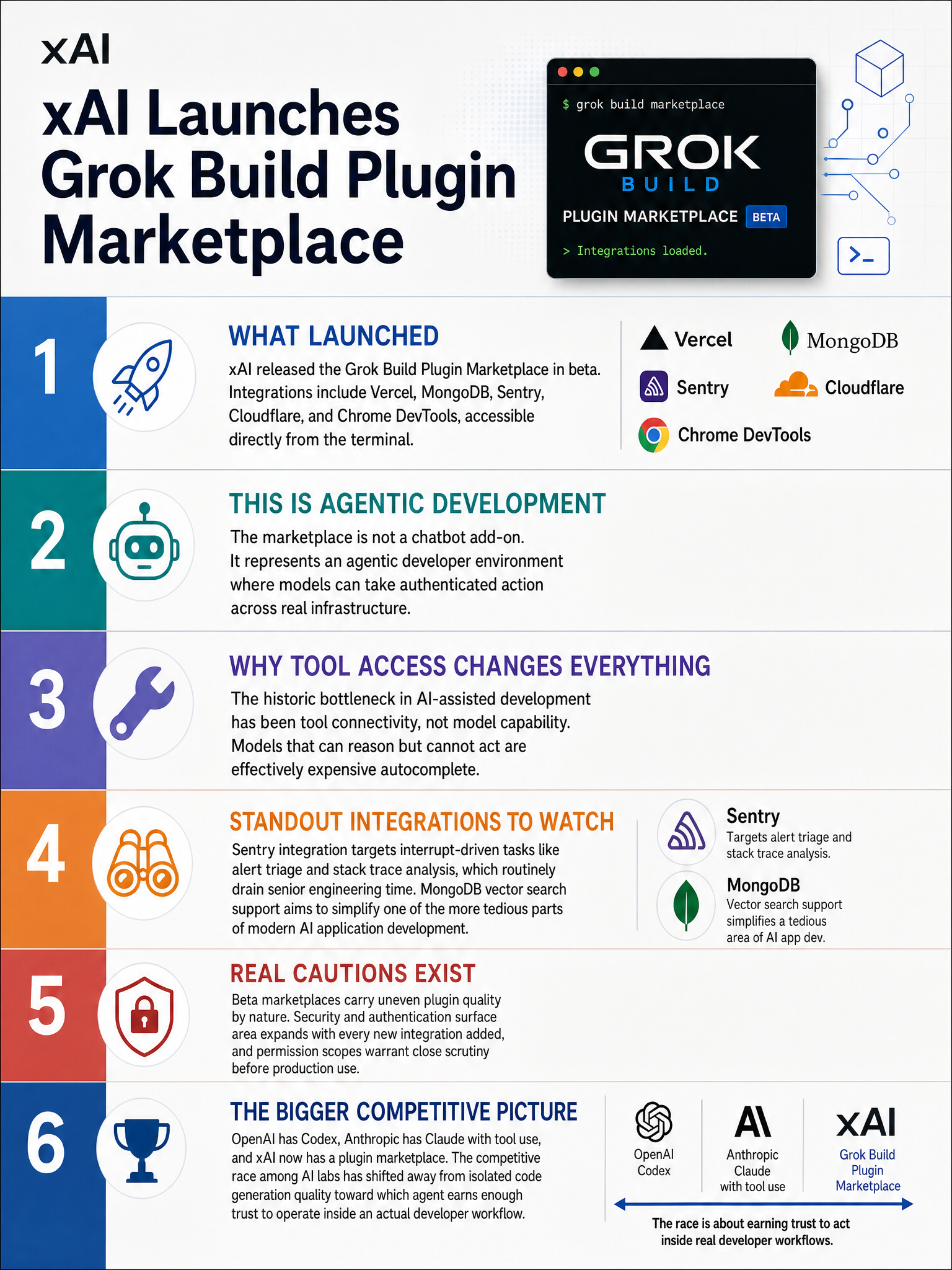
The Grok Build Plugin Marketplace launched in beta this week, and I think it’s one of the more interesting developer moves in the current AI tooling race. Not because of the name, not because of the hype, but because of what the integration list actually signals about where xAI is placing its bets.
MongoDB. Vercel. Sentry. Cloudflare. Chrome DevTools. From your terminal.
That’s not a chatbot feature. That’s the skeleton of an agentic developer environment.
The Real Bottleneck Was Never the Model
I’ve said this before and I’ll keep saying it. The ceiling in AI-assisted development has never been raw reasoning capability. It’s been connectivity. A model that can reason about your infrastructure but can’t touch it is just expensive autocomplete with better vocabulary.
The moment you give an agent authenticated, scoped access to your deployment pipeline, your error logs, and your database performance metrics, the productivity math changes completely. The agent stops being an advisor and starts being a participant.
That’s what xAI is building toward here.
What the Integrations Actually Do
The Vercel plugin lets you deploy to production, spin up sandboxes, or build apps with Shadcn components, all from a single prompt in your terminal. That’s not a trivial workflow. Deployment friction is real, and collapsing it into natural language is genuinely useful.
The Sentry integration is the one that caught my eye first. You can ask your agent to find and fix errors, analyze stack traces, and triage alerts. If that works reliably, it compresses a debugging loop that currently involves tab-switching, copy-pasting, and a lot of manual context-loading. The agent gets the error, gets the code, and proposes the fix in one chain.
MongoDB’s plugin opens up database exploration, query optimization, and vector search setup from a prompt. For anyone building RAG pipelines or doing exploratory work on unstructured data, that’s a workflow worth watching.
Cloudflare and Chrome DevTools round out the set, covering edge deployment and browser-level debugging respectively.
Why the Beta Timing Matters
xAI is not the first to attempt this. Cursor has plugins. GitHub Copilot has workspace context. But the marketplace framing, and the terminal-first positioning, suggests xAI is thinking about this as infrastructure for agents rather than features bolted onto a chat interface.
The distinction matters. Bolt-on features get used occasionally. Infrastructure gets embedded into workflows.
Beta is early. There will be rough edges. Authentication flows, permission scoping, and reliability under real production conditions are all things that need to earn trust before developers hand over deploy access to an agent. I wouldn’t do that in week one. But I’d start testing it now.
What I’m Watching For
The honest question is whether xAI can build enough ecosystem density fast enough to make Grok the default agentic layer for developers, or whether this stays a niche option while Anthropic, OpenAI, and Google consolidate developer mindshare with their own tool-use approaches.
OpenAI is already pushing Codex hard, rolling out rate limit reset banking this week and opening referral access for Plus and Pro users. The competition for the developer workflow is active and moving fast.
xAI’s advantage, if they have one, is that they’re building this as a first-class terminal experience rather than a web product with API access sprinkled on top. That’s a meaningful choice. Developers live in terminals.
The Plugin Marketplace is a bet that the right distribution channel for AI development tools is the agent itself. I think that bet is directionally correct. Whether xAI executes well enough to win on it is the part I’m less certain about.
Worth watching closely either way.
Sources & Further Reading
#AIEngineering #DeveloperTools #xAI #Grok #AgenticAI #BuildInPublic