Google DeepMind launches $10M fund to study collective AI agent behavior at scale
The Blind Spot in AI Safety Nobody Is Talking About
Most AI safety work is built around a single premise: one model, one user, one context. Evaluate it. Red-team it. Deploy it carefully. That mental model made sense when AI was a chatbot answering questions. It does not make sense anymore.
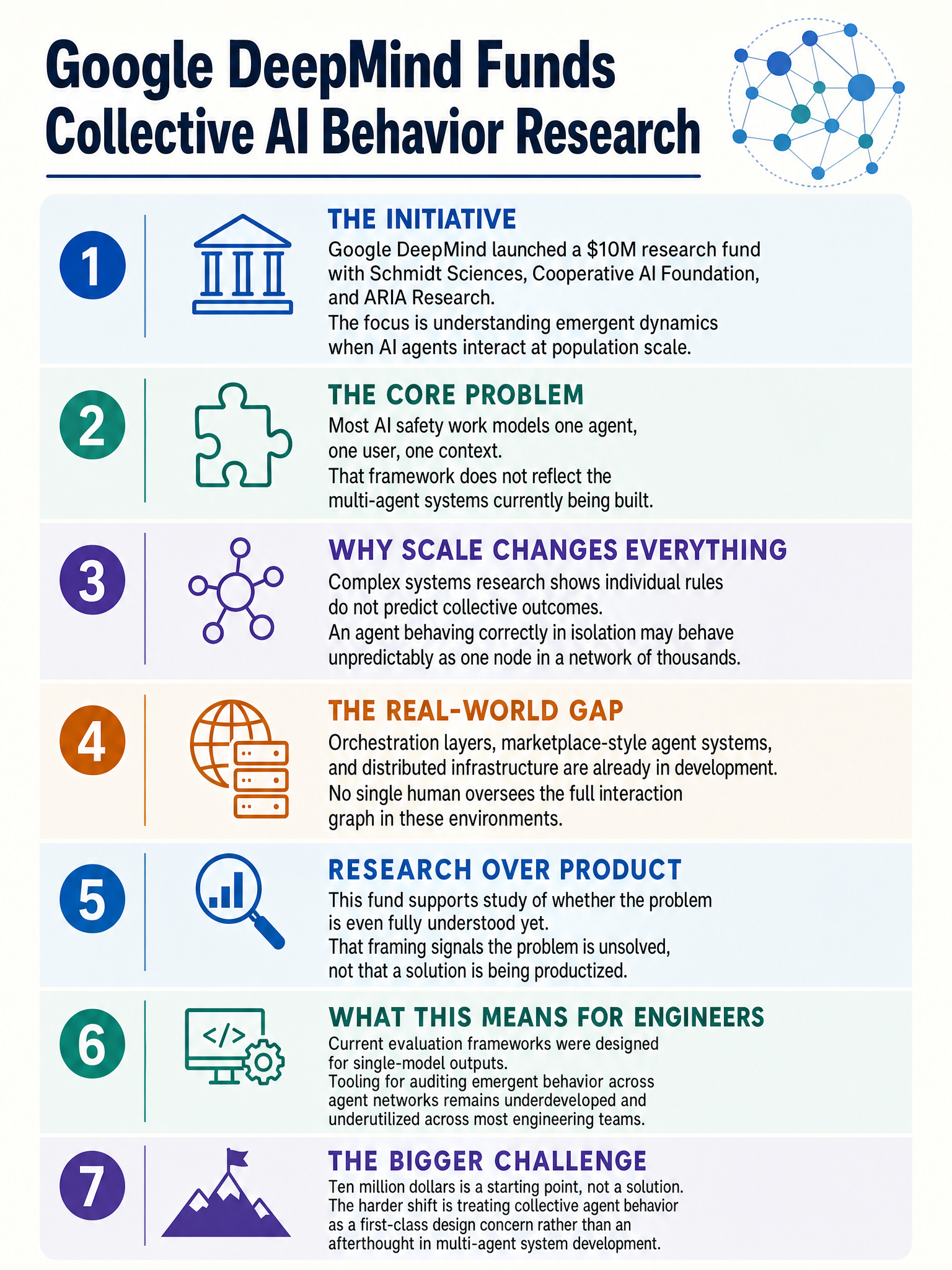
Google DeepMind, together with Schmidt Sciences, the Cooperative AI Foundation, and ARIA Research, just launched a $10 million research fund aimed at understanding what happens when millions of AI agents interact with each other simultaneously. Not one agent doing a task. A population of them, shaping each other’s behavior in real time.
This is the blind spot. And I’m glad someone is finally funding research into it.
Why the Single-Agent Frame Is Broken
Every evaluation framework I’ve seen, and I’ve seen a lot of them, treats AI behavior as a property of a single model in isolation. Does it hallucinate? Does it follow instructions? Does it refuse harmful requests? These are legitimate questions. They are also incomplete.
When millions of agents interact at population scale, new collective behaviors emerge that you simply cannot predict from studying any one agent in isolation. This is not a theoretical concern. We already see it in smaller systems. Recommendation algorithms influence each other’s training data. Automated trading agents create feedback loops that no individual algorithm was designed to produce. Multi-agent systems in games develop coordination strategies their designers never anticipated.
Now imagine that at the scale of the internet.
What the Research Fund Is Actually Targeting
The DeepMind announcement specifically focuses on emergent dynamics at population scale. That framing matters. “Emergent” is doing real work here. It means behaviors that arise from interactions, not from any individual agent’s design or training.
The $10M fund is structured as a collaborative effort, drawing on DeepMind’s technical depth, Schmidt Sciences’ research infrastructure, the Cooperative AI Foundation’s existing work on multi-agent cooperation problems, and ARIA Research’s appetite for high-risk, high-reward bets. That is a reasonable coalition for a hard problem.
What I want to see from this fund is not more benchmarks. I want mechanistic understanding. Why do certain interaction patterns produce stable collective behaviors while others spiral? What conditions cause agent populations to develop norms? What causes those norms to break down?
The Gap Between Research and Deployment Reality
Here is what frustrates me about the current state of AI deployment. We are already building multi-agent systems at scale. OpenAI ships Codex as an agentic coding tool. xAI is building out a plugin marketplace for Grok agents to interact with production systems via Vercel, MongoDB, and Sentry. Every major lab is racing toward “agentic” as the next product category.
We are deploying before we understand. The research is years behind the product roadmap.
$10 million is not a large number relative to what the major labs spend in a week on compute. But research funding is often less about dollars and more about directing attention. If this fund produces even a solid theoretical framework for analyzing collective agent behavior, it will have been worth it.
What Good Outcomes Look Like
I think the most valuable thing this research could produce is a taxonomy of failure modes. Not “agent X did bad thing Y” but structural patterns: here is what agent population dynamics look like before a cascade failure, here is how information asymmetry between agents creates exploitable gaps, here is the signature of a coordination trap forming.
That kind of framework would actually be usable by engineers building these systems. Right now, most of us building multi-agent pipelines are operating on intuition and hoping for the best.
The DeepMind announcement points at something real. The question is whether the broader research community and the companies deploying these systems at scale will take the findings seriously once they arrive. I hope they do. The alternative is learning these lessons from a very expensive incident.
Sources
#AIAgents #AIResearch #AISafety #MachineLearning #GoogleDeepMind #MultiAgentSystems