Hot take: Meta Muse Spark 1.1 launch and the compounding advantage of labs that build with their own models
Meta Muse Spark 1.1 and the Compounding Advantage Nobody Is Talking About
Today everyone’s eyes are on GPT-5.6. Reasonably so. An 80.0 on the Artificial Analysis Coding Agent Index, a 53.6 on Agents’ Last Exam (13.1 points above Claude Fable 5 adaptive), ultra mode spinning up parallel agents, ChatGPT Work handling entire workflows from a single prompt. Sam Altman called it “obviously the best model we have ever produced.” The numbers back that up.
But while that story was dominating the feed, Meta quietly dropped something I think deserves more attention.
🔍 What Muse Spark 1.1 Actually Is
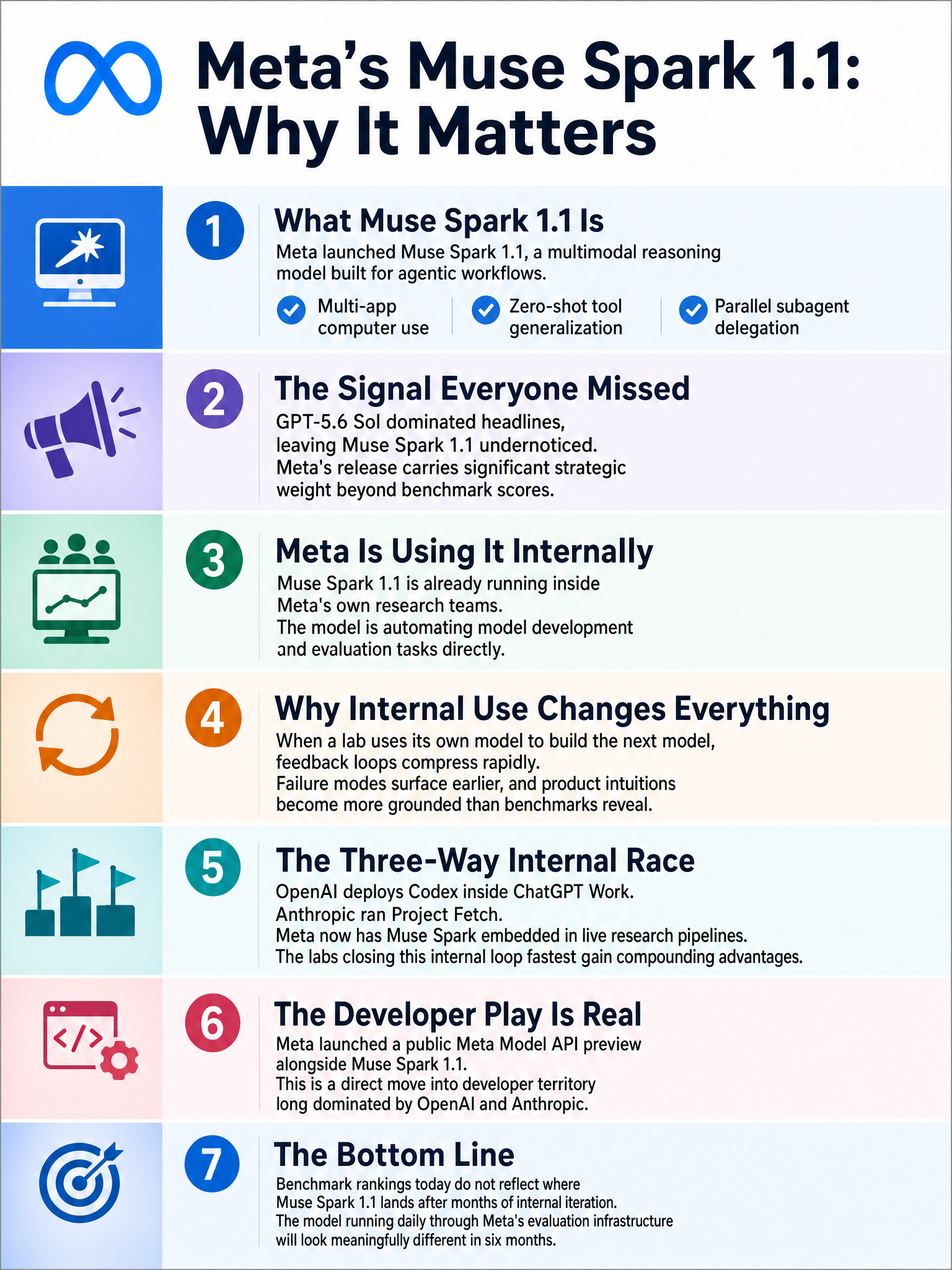
Muse Spark 1.1 is a multimodal reasoning model built specifically for agentic workflows. That framing matters. This is not a general-purpose chat model that someone bolted an agent wrapper onto. Meta trained it to orchestrate multi-agent systems from the ground up. It zero-shot generalizes to new tools and services, delegates work to parallel subagents, maintains context across extended sessions, and can navigate unfamiliar interfaces with minimal human guidance.
The multimodal capabilities are real too. It handles visual and audio inputs, preserves detail across long workflows, and shows specific strength in visual-to-code generation. Meta says it delivers substantial performance gains over the first Muse Spark on complex feature implementation and end-to-end development tasks.
The Model API is now in public preview. Developers can access it today.
The Part That Actually Matters
Here is the line buried in the Meta announcement that caught my attention: “Our researchers are now automating model development and evaluation tasks by leveraging Muse Spark 1.1 in their workflows.”
Read that again.
Meta is using Muse Spark 1.1 to help build the next version of Meta’s models. The model is eating its own feedback loop.
This is the compounding advantage. When a lab deploys its own model on the actual work of model development, training pipelines, evaluation harnesses, research automation, the iteration cycle compresses. You do not just get a better model on the next release. You get a shorter path to that better model, which itself gets deployed back into the research workflow, which shortens the path again.
🔁 Why This Is Different From Benchmarks
Benchmark scores tell you how a model performs on a fixed test. Deployment inside the lab tells you how a model performs on unconstrained, messy, real engineering work. Those are very different signals.
When Meta says Muse Spark 1.1 is scoring competitively with leading models on their internal coding benchmark, and simultaneously using it to automate model development tasks, they are making a claim about reliability under production load in one of the most technically demanding environments possible. That is a harder bar than any public leaderboard.
OpenAI has done versions of this with Codex and its own internal tooling. Google has leaned on Gemini internally for years. The labs that sustain long-term momentum are almost always the ones that treat internal deployment as a forcing function, not a side project.
What This Means for the Rest of 2025
Meta has the infrastructure to move fast here. Billions of users across its platforms, internal research teams that can stress-test agentic models at scale, and now a public API to pull in external developer feedback. The gap between “research model” and “production model” at Meta is smaller than it looks from the outside.
GPT-5.6 is the headline today, and it earned that. But the most interesting story might be which lab is building the most efficient internal feedback loop right now. Meta just gave us a data point on where they stand.
The labs that figure out how to use their own models to build better models faster are not just competing on capability. They are competing on the rate of capability growth. That is a different race, and Muse Spark 1.1 is a visible signal that Meta is running it seriously.
Sources
#AIEngineering #MachineLearning #MetaAI #OpenAI #AgenticAI #LLMs #AIStrategy