Google DeepMind Predicting the Past: Gemini-powered tool lets historians query ancient Greek and Latin inscriptions in plain English via Antigravity skill system
The Ancient World Just Got a New Interface
There’s a category of AI application that doesn’t get enough attention. Not chatbots. Not code assistants. The ones that take a domain with deep specialist knowledge, decades of accumulated tooling that only experts can use, and quietly remove the barrier between the question and the answer. Google DeepMind just built one of those.
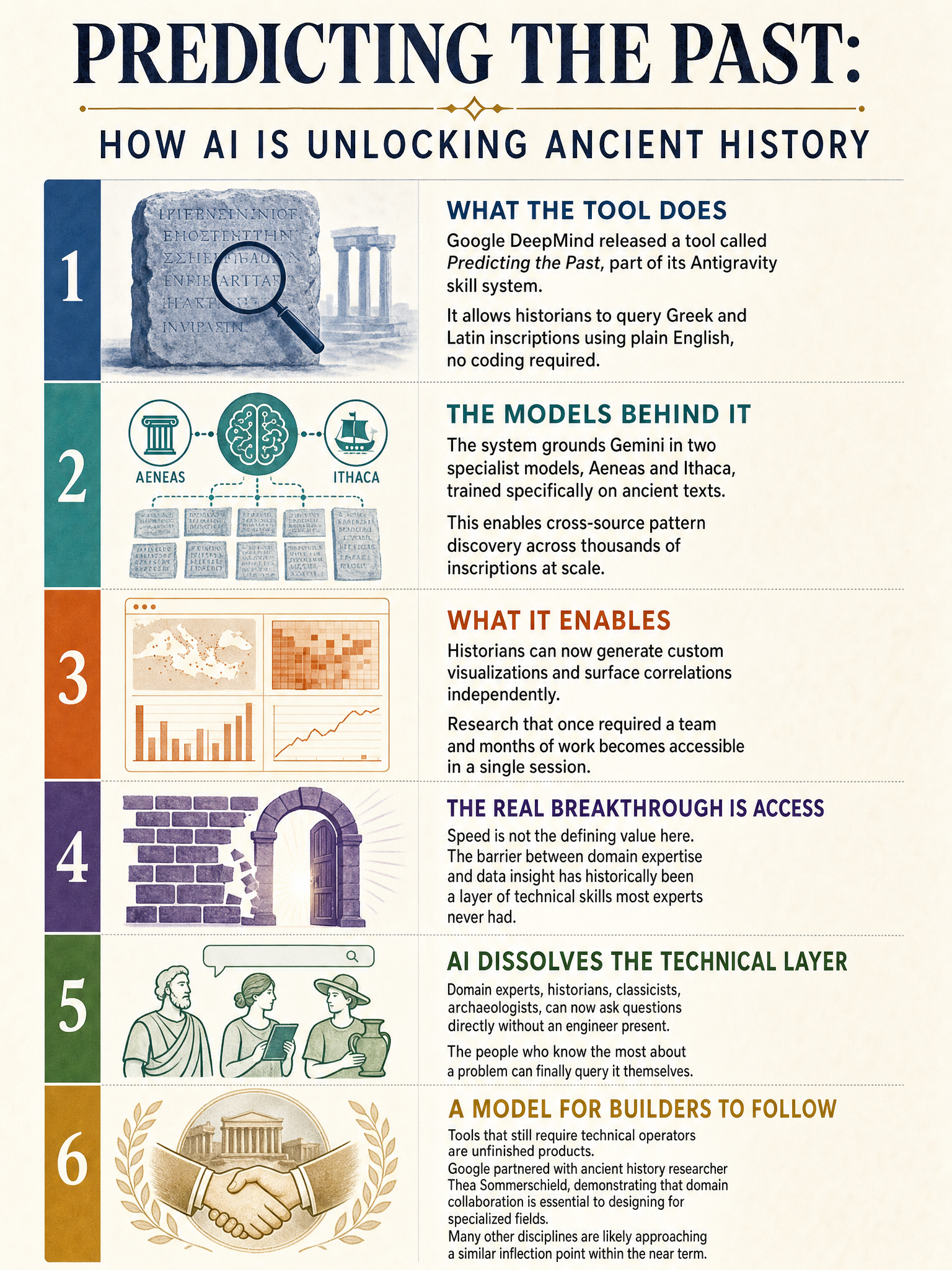
They released something called Predicting the Past, a skill inside their Antigravity system, that lets historians query ancient Greek and Latin inscriptions in plain English. No SQL. No specialized tooling. No years learning epigraphy workflows. You ask a question, you get an answer grounded in actual expert models.
I think this is getting far less coverage than it deserves.
How It Actually Works
The architecture here is what makes this interesting. Gemini isn’t hallucinating answers about ancient Rome from its training data. It’s grounded directly in two specialist models, Aeneas and Ithaca, that were trained specifically on ancient inscriptions. Gemini handles the interface layer, the natural language, the reasoning, the visualization generation. The domain models handle the actual epigraphy.
DeepMind framed three specific problems this system addresses: generating custom analysis and visualizations per inscription, doing cross-source mapping to find large-scale patterns across thousands of texts, and making advanced AI tools accessible to researchers with no coding background. All three of those were real blockers before this.
The research team ran three case studies in collaboration with Thea Sommerschield to demonstrate this. That’s not a demo. That’s domain experts actually stress-testing the tool on real historical questions.
Why the Skill Architecture Matters
The Antigravity skill system is worth paying attention to as a pattern. What DeepMind is doing here is modular. You don’t retrain a giant model every time you want deep domain expertise. You build a skill that grounds a capable general model in a specialist system. The general model handles the reasoning and the interface. The specialist handles the truth.
This is a smarter architecture than trying to cram everything into one model’s weights. It’s also more auditable. If Predicting the Past gives a historian a wrong answer about a third-century inscription from Attica, you can trace where the error came from. That matters in research contexts.
The Real Shift Here
For years the conversation about AI in research has been about productivity. Write your literature review faster. Summarize papers. Generate a first draft. That framing is fine but it’s small. The actual ceiling is much higher.
What Predicting the Past does is different. It lets a historian ask a cross-source question that would have required a team of researchers, months of manual correlation work, and probably a database engineer. Now one person with domain knowledge but no coding background can ask that question on a Tuesday afternoon and get a visualization back.
That changes what questions get asked. Not just how fast they get answered.
The access question is also real. Ancient inscription databases like the Packard Humanities Institute corpus contain tens of thousands of entries. The scholars who could extract large-scale patterns from those databases were limited to people who could also write code or knew someone who could. That’s a small subset of the people with the actual historical expertise to interpret the results.
My Take
I’ve spent enough time building ML systems to have a fairly calibrated view of what AI tools actually change versus what they just speed up. This one changes something. When you lower the barrier to a question that was previously inaccessible, you don’t just get faster versions of old research. You get new research. Different hypotheses. Questions that weren’t worth asking before because the cost was too high.
The ancient world has a fixed evidence base. No new inscriptions are being carved. But the questions we can ask of the existing evidence, and who gets to ask them, just expanded. That’s a real result.
The pattern DeepMind is establishing with Antigravity, grounding a general model in narrow expert systems rather than hoping general training covers the domain, is one I expect to see replicated across fields where the expert knowledge is structured but inaccessible. Legal history. Archival medicine. Comparative linguistics. The template is there now.
Sources
#AI #GoogleDeepMind #MachineLearning #DigitalHumanities #Gemini #AncientHistory #AIResearch