OpenAI GPT-5.5 Instant health parity and new RL-based beneficial traits research with cross-domain transfer findings
GPT-5.5 Instant and the RL Alignment Paper That Deserves More Attention
OpenAI dropped two things this week that most coverage is treating as separate announcements. They are not. GPT-5.5 Instant reaching parity with frontier Thinking models on health questions is the product headline. The reinforcement learning research on beneficial traits is the reason to actually pay attention. Put them together and you have a clearer picture of where OpenAI thinks alignment work needs to go.
Let me walk through both, because the research paper in particular has a finding that I think is being undersold.
The Health Parity Number
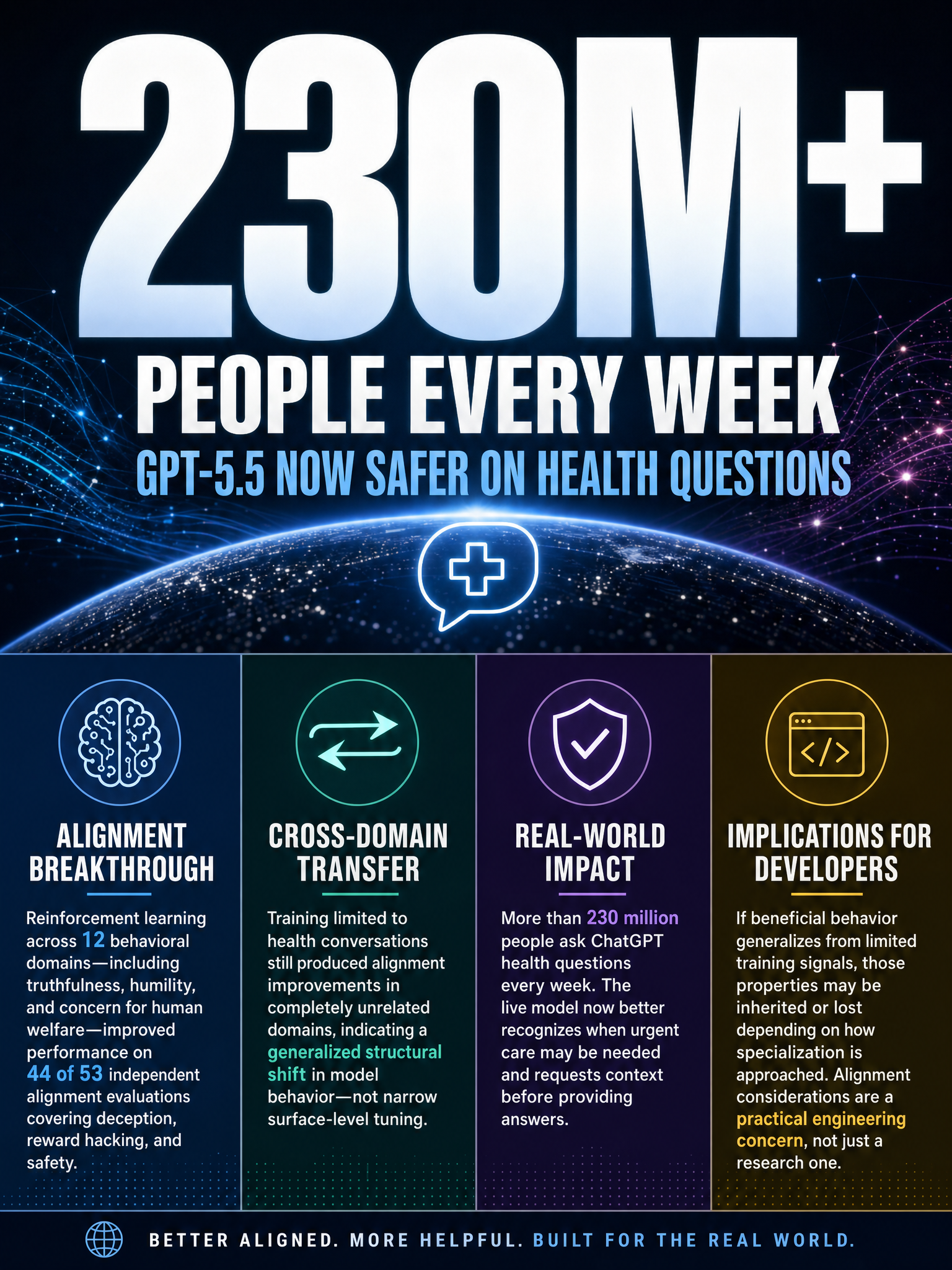
230 million people per week turn to ChatGPT with health and wellness questions. That number from OpenAI stopped me. That is not a niche use case anymore. That is a primary care adjacency at scale.
GPT-5.5 Instant is now on par with their frontier Thinking models for health-related questions. It is better at recognizing when urgent care may be needed, and OpenAI built this with input from a global network of hundreds of physicians across 60 countries, 49 languages, and 26 specialties. That physician feedback loop matters. It is not just benchmark chasing. It is actually trying to get the model to flag context it might otherwise miss, reduce overconfidence, and give people clearer next steps.
This does not make GPT-5.5 Instant a doctor. But it does make the gap between “AI health response” and “competent triage guidance” meaningfully smaller.
The RL Paper Is the Real Story
OpenAI trained models using reinforcement learning on realistic conversations to reinforce traits like truthfulness, humility under uncertainty, openness to correction, fairness, and concern for human welfare. They did this across 12 domains including health, science, and education.
The result: trained on a relatively small amount of data, the model improved on 44 of 53 independent evaluations of alignment and beneficial behavior. Those evaluations spanned deception, reward hacking, safety, health, and mental health scenarios.
44 of 53. From a small training dataset. That is a strong signal.
The model was also harder to steer toward harmful behavior with adversarial prompts, while remaining responsive to helpful instructions. OpenAI also saw preliminary evidence of greater resistance to harmful fine-tuning. That last point matters a lot for open-weight and fine-tunable models where alignment can get stripped out downstream.
The Cross-Domain Transfer Finding
This is the part I keep coming back to.
When OpenAI limited the beneficial behavior training to health conversations only, the model still improved on non-health evaluations of misalignment, deception, and reward hacking. Tasks that looked structurally very different from the training data.
That is cross-domain transfer of alignment properties. The model did not just learn “be careful about health advice.” It internalized something more general about how to behave under uncertainty, and that generalized.
If this holds up at scale, it changes the economics of alignment work significantly. You do not necessarily need to cover every domain exhaustively. You find the right training signal in one domain and the behavior propagates. That is a qualitatively different picture than the “whack-a-mole per capability” approach that alignment work has sometimes felt like.
I want to be careful not to overread one paper. But the directional finding here is worth taking seriously.
What This Means for AI in High-Stakes Domains
The NEJM AI study OpenAI published with Boston Children’s Hospital and Harvard adds another data point worth noting. Using o3 Deep Research, researchers reanalyzed 376 de-identified cases that had already gone through genetic testing and expert review. They identified 18 diagnoses across neurodevelopmental disorders, rare neuromuscular disease, sudden unexpected death in pediatrics, and early-onset psychosis. Many of those cases had evaded years of expert analysis.
18 diagnoses from 376 previously reviewed cases is not a small number. That is a real hit rate in one of medicine’s hardest problems.
The throughline across all of this is that OpenAI is building a consistent story: better base capability plus alignment that transfers plus real-world validation in health contexts. Whether the execution matches the story is a different question. But the research direction is coherent.
Where I Land
The cross-domain transfer finding from the RL paper is the most interesting technical result OpenAI has published this month. The health parity announcement will get the headlines. The alignment research deserves the attention.
What I want to see next is whether these findings replicate at larger model scales and whether the resistance to harmful fine-tuning holds in practice when people are actively trying to break it. Those are the tests that matter.
The work here is early, as OpenAI themselves say. But “early” and “unimportant” are not the same thing.
🔬
Sources & Further Reading
#AIAlignment #MachineLearning #OpenAI #HealthAI #LLMs #ReinforcementLearning