Jensen Huang breaks from Trump trade delegation to eat noodles in Beijing hutong, reflecting NVIDIA’s complex position in US-China AI chip tensions
Jensen Huang Ate Noodles While the Trade War Raged. He Was Right To.
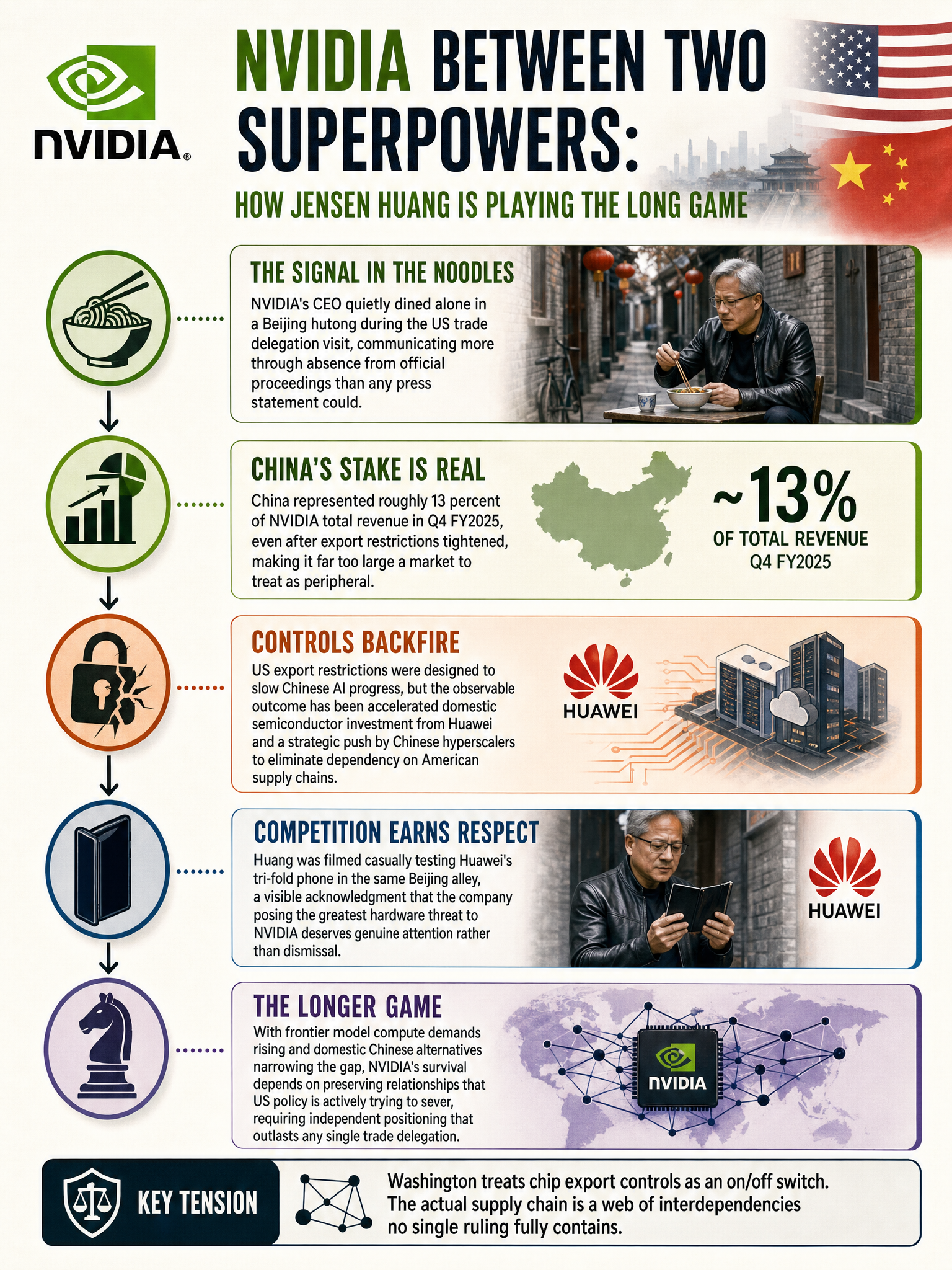
There’s a photo circulating from Beijing this week. Jensen Huang, CEO of the world’s most valuable chip company, sitting in a hutong alleyway eating zhajiangmian from a place called Fangzhuan workshop. Not in a conference room. Not on a delegation panel. Not shaking hands with officials for a photo that would run on Reuters.
Just noodles in a Beijing side street.
I find this deeply funny. I also think it’s the most honest thing anyone did during the entire Trump trade visit.
The Real Center of Gravity
Let me be direct about what that image communicates.
NVIDIA is not a bystander in US-China AI tensions. It is the central node. When policymakers talk about restricting China’s AI development, they are, at the operational level, mostly talking about what Jensen Huang’s company can and cannot sell.
The H20 chip, NVIDIA’s downgraded export-compliant GPU specifically engineered to stay within US Commerce Department restrictions, is still moving into China. Chinese labs are buying it. Chinese researchers are training on it. DeepSeek’s R1 model, which shook a lot of assumptions early in 2025, was built on hardware that included H20s. The restrictions created a floor, not a ceiling.
Meanwhile, Jensen also tried out Huawei’s tri-fold phone during the Beijing visit, according to video that circulated on X from Johannes Maria (@luo_yuehan). That detail matters. He’s not pretending Huawei doesn’t exist. He’s not performing ignorance about the competitive stack that China is building as an alternative.
What Export Controls Actually Do
I’ve spent enough time watching this policy space to have a firm opinion here. Export controls on AI chips are not a strategy. They are a delay mechanism, and an expensive one.
When you restrict chip access, you don’t stop the research. You push it toward domestic alternatives. Huawei’s Ascend line exists precisely because the restrictions created the incentive to build it. SMIC is pushing advanced node processes harder than it would have otherwise. The US policy has, in a real sense, funded the competition it was trying to prevent.
The BIS restrictions tightened further in late 2024, cutting off the H100 and A100 entirely for China. The H20 was the engineered workaround. But even that path is under political pressure now. Every turn of the restriction screw produces a corresponding turn in Chinese domestic development.
Jensen knows this. That’s probably part of why he ordered the noodles instead of sitting through another round of geopolitical theater.
The Uncomfortable Business Reality
NVIDIA’s China revenue was roughly 17 percent of total revenue in fiscal year 2024, down from over 20 percent the prior year, directly because of the export restrictions. That is a material number. For any other company, losing 17 percent of revenue to regulatory action would be a crisis.
For NVIDIA right now, it’s a manageable wound, because the US and Gulf markets are on fire. The H100 and B200 demand from hyperscalers is so extreme that supply still hasn’t fully caught up with orders. Jensen can absorb the China hit.
But “can absorb it” and “doesn’t care about it” are different things. China is a real market with real customers who want to build real AI systems. Acting like that market doesn’t exist, or shouldn’t exist, is a political position dressed up as a security strategy.
What the Noodle Bowl Signals
I don’t think Jensen Huang eating zhajiangmian in a Beijing hutong is a statement. I think it’s just a person who genuinely likes China, has spent decades doing business there, and took an hour to do something human in the middle of a circus.
But it reads as a statement, and that reading is worth sitting with.
The trade delegation is performing a version of reality where the US and China are cleanly separable in the AI supply chain. Jensen’s entire existence at that event demonstrates why that version is fiction. The most important semiconductor company in the world cannot be neatly placed on one side of a geopolitical ledger. Its technology is already in China. Its competitors are in China. Its customers’ customers are in China.
You can’t export-control your way out of that. You can only choose how honestly you deal with it.
Jensen chose noodles. Honestly, that’s the right move.
Sources
#NVIDIA #AIPolicy #Semiconductors #JensenHuang #USChinaTech #AIChips