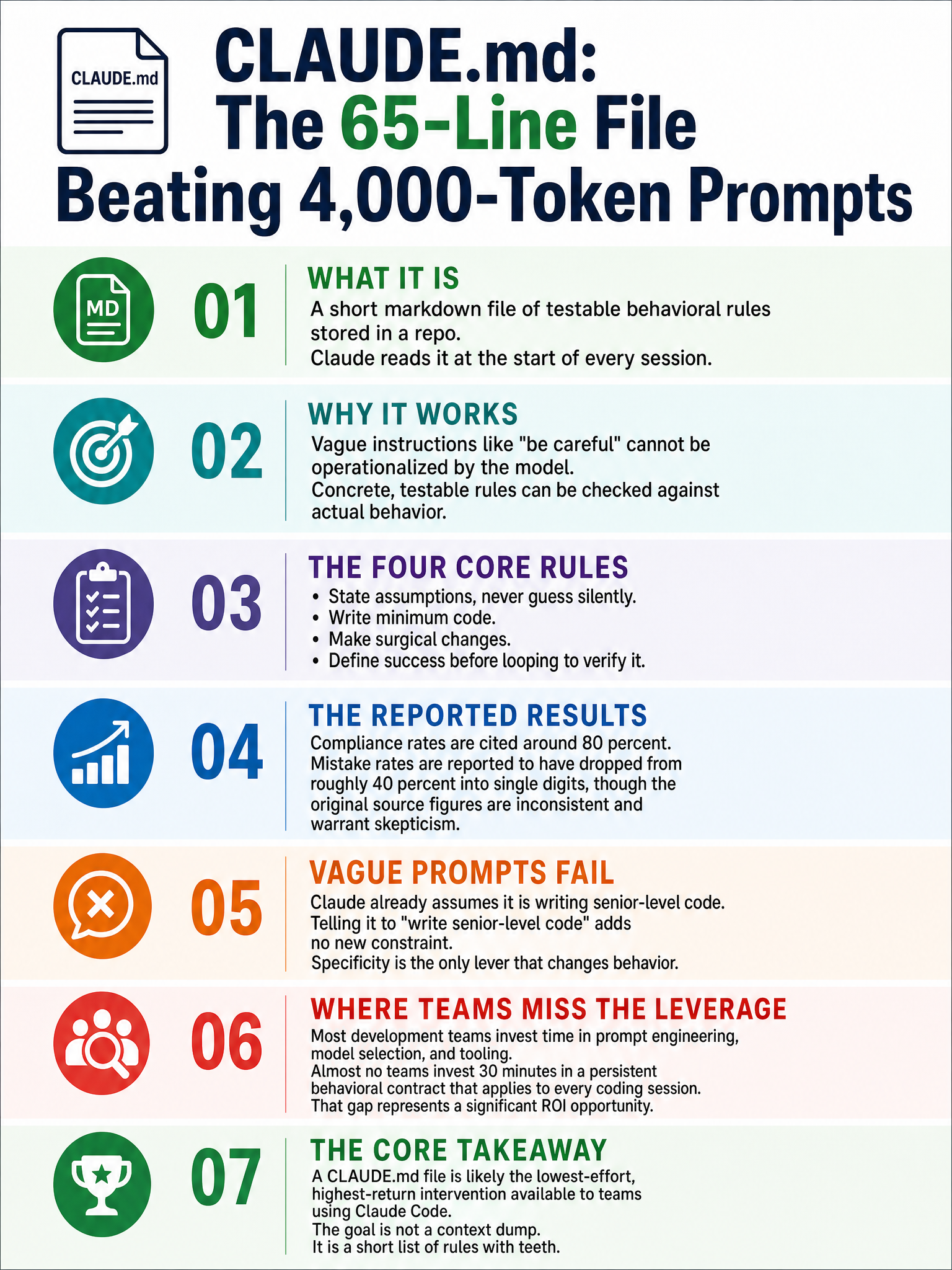
CLAUDE.md behavioral rules file for Claude Code reducing AI coding mistakes
CLAUDE.md Is the Most Underrated File in Your Codebase
I’ve spent a lot of time tuning prompts. System prompts, user prompts, few-shot examples, all of it. And I’ll tell you what most of that work produces: marginally better output that degrades the moment the conversation gets long or the task gets complicated. So when something genuinely changes the behavior of a coding assistant in a repeatable, measurable way, I pay attention.
CLAUDE.md is that thing right now. A 65-line markdown file sitting at the root of your repo, read by Claude Code at the start of every session, with 120,000 GitHub stars as of this writing. That’s not a niche experiment. That’s a signal.
Why Prompts Fail and Rules Work
Here’s the core problem with dumping your preferences into a system prompt: Claude doesn’t treat it as law. It treats it as context. Vague context. “Be careful” doesn’t mean anything to a model that already believes it is being careful. “Act like a senior engineer” doesn’t work either, because Claude already thinks it is one.
What works is testable imperatives. Rules that are either followed or visibly broken, with no ambiguous middle ground.
This is the insight behind CLAUDE.md. You’re not asking for a personality. You’re installing behavioral constraints that survive across sessions because they live in the repo, not in your head.
The Four Rules Getting the Most Traction
The original article, written by @Mnilax on X, is framed around rules attributed to Andrej Karpathy’s workflow. The four that show up most in practice:
State assumptions explicitly instead of guessing silently. This one alone cuts a huge category of bug. When Claude assumes a function signature, an API response shape, or a database schema, and doesn’t tell you, you get code that looks right and fails at runtime.
Write minimum code. Nothing speculative. No “while I’m here” additions. No future-proofing you didn’t ask for. Just the thing you asked for.
Make surgical changes. Don’t touch adjacent code. This is the one I see violated most often without CLAUDE.md in place. You ask for a one-line fix and get a refactored module.
Define success criteria before writing code, then loop until verified. This is basically test-driven development encoded as a behavioral rule. Claude writes the verification step first, then writes to pass it.
The Numbers, With a Caveat
The original article claims mistake rates dropped from 41% to 11% across 30 codebases over 6 weeks. That’s the headline number. The body of the article says 3%. As @dunik_7 on X pointed out, nobody seemed to catch the contradiction, and nobody had to, because both numbers represent a real and significant improvement over a ~40% baseline error rate.
I’ll be honest about the methodology here: “30 codebases” with no description of how mistakes were measured, no control group, and contradicting figures in the same article is not rigorous research. But the directional claim holds up. Compliance with the rules runs around 80%, and anecdotally, anyone who has used Claude Code on a non-trivial project without behavioral constraints has watched it rewrite things it wasn’t supposed to touch.
The 40% waste estimate, where roughly 40 cents of every dollar in tokens goes toward code you’ll discard or rewrite, is the more credible framing. That number feels right from my own usage.
Why This Works at the Architecture Level
A CLAUDE.md file is read into the context window at session start. It’s not a system prompt you forget to update. It lives next to your code, gets versioned with your code, and can be reviewed in a PR like everything else. You can diff it. You can enforce it in onboarding.
This is the thing I think most people miss. CLAUDE.md isn’t a prompt trick. It’s a team convention, the same way a linter config or a commit message format is a team convention. The behavioral rules become part of the repo’s culture in a concrete, inspectable way.
What I’d Actually Add
The original 65 lines are a solid foundation. I’d add a few things for any production codebase: explicit rules about which files are off-limits, a rule requiring Claude to ask before creating new abstractions, and a constraint against installing new dependencies without flagging them. Those three additions cover most of the damage I’ve seen in real projects.
The honest conclusion here is that the tooling for AI-assisted coding is still young, and most teams are leaving a lot on the table by treating their AI tools as magic boxes instead of systems with configurable behavior. CLAUDE.md is one of the cheapest interventions available, and 120,000 stars suggests the rest of the industry is figuring that out too.
Sources & Further Reading
#ClaudeCode #AIEngineering #DeveloperTools #LLMs #SoftwareEngineering