Why most second-brain knowledge systems fail engineers, and what actually works
Why Your Second Brain Is a Graveyard (And How to Fix It)
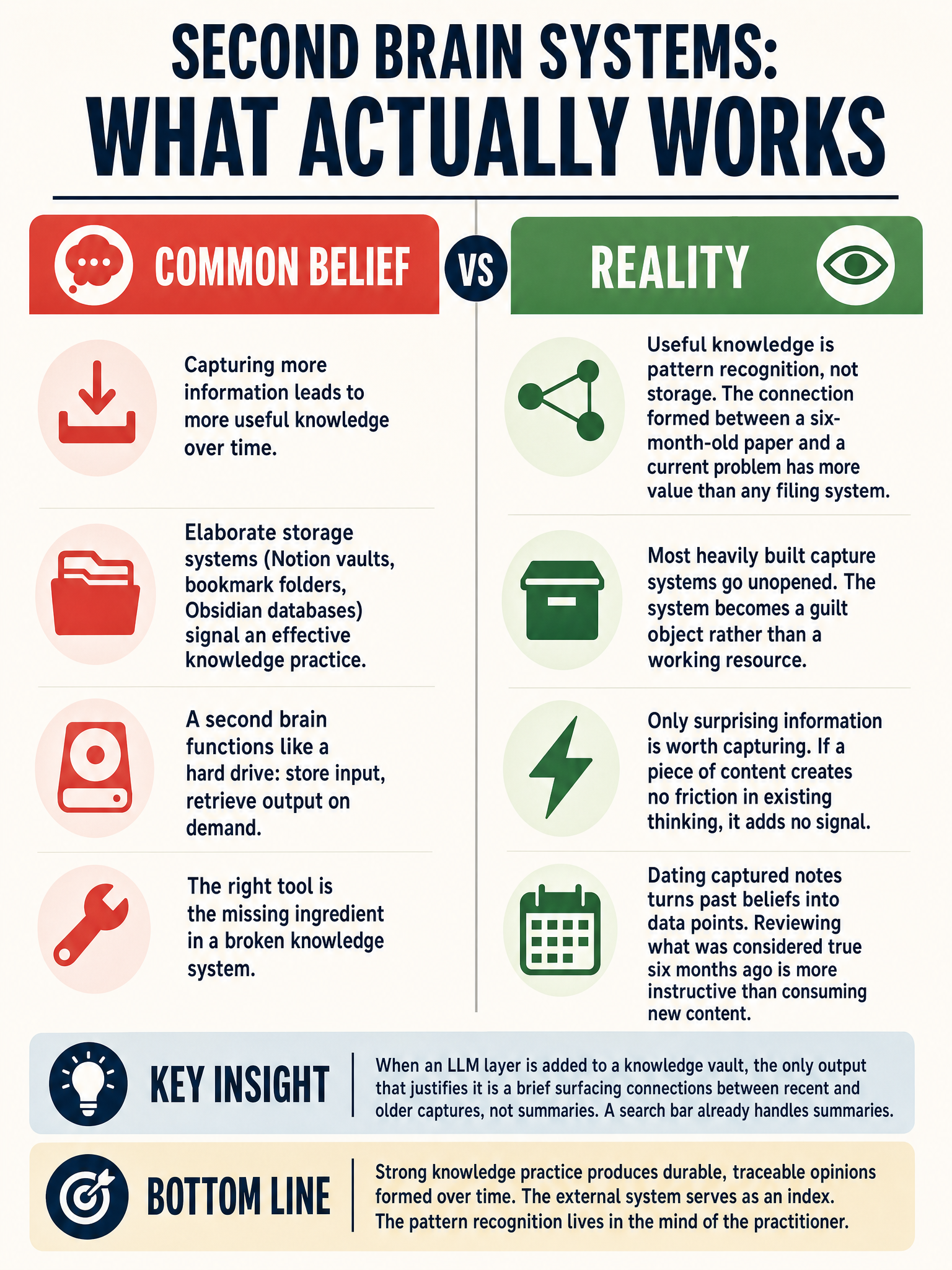
Most engineers I know have built at least one elaborate knowledge system. Notion workspace with nested databases. An Obsidian vault with backlinks going nowhere. A bookmark folder containing 400 links they will never read again. They spent a weekend setting it up, felt extremely productive doing it, and then quietly stopped opening it two weeks later.
The system became a guilt object. A monument to good intentions.
I’ve done this myself. The problem is not the tool. The problem is the assumption underneath the tool.
The Hard Drive Fallacy
We treat personal knowledge management like we’re building a hard drive. Write it down. Store it. Retrieve it later. That model works fine for passwords and meeting notes. It fails completely for engineering knowledge, because useful engineering knowledge is not retrieval. It’s pattern recognition.
The moment that actually matters is when you’re staring at a bug at 2am and your brain quietly connects it to a distributed systems paper you skimmed six months ago. That connection cannot live in a folder. A folder is inert. It waits to be opened. Your best thinking does not happen when you decide to open a folder.
What most second-brain setups get completely backward is the direction of information flow. You put things in. The system does nothing. You come back and hope to find something useful. That hope is almost always disappointed.
The Direction Has to Flip
Rohit, writing on the current state of Obsidian setups, put it well: “it should brief you every morning with the connections you missed. Instead it captures everything and surfaces nothing.” That is the exact problem. Capture is not the hard part. Surfacing is.
The fix is not a better folder structure. The fix is making the system push information at you instead of waiting for you to pull it. A daily brief. Automated connection-finding. Something that says “you saved this paper last Tuesday and you’ve been working on a latency problem, here’s why they might be related.”
That requires something that can reason over your notes, not just index them. A plain Obsidian vault cannot do that. An Obsidian vault with Claude running over it might. The setup Rohit describes, combining Obsidian with Claude Code and an automated capture pipeline, is closer to the right model. Not because it’s sophisticated, but because it changes the direction of flow.
What Actually Works in Practice
I’ve found three things that make a knowledge system actually useful for engineering work.
First, friction at capture has to be nearly zero. If saving something takes more than ten seconds, you will stop doing it. The capture step has to be automatic or close to it.
Second, the system has to do something with what you give it. Not just store it. Connect it, summarize it, flag it when it becomes relevant. This is where LLM integration stops being a gimmick and starts being genuinely useful. You are offloading the synthesis step to something that can actually do synthesis.
Third, you need a regular push mechanism. A morning brief. A weekly digest. Something that puts relevant connections in front of you without requiring you to go looking. Most engineers will not go looking. I don’t. The systems that have actually helped me are the ones that showed up in my workflow without being summoned.
The Karpathy Standard
There’s a reason people reference Andrej Karpathy when talking about deep technical understanding. His free 3-hour LLM course covers the full training stack, tokenization, RLHF, and why these systems behave the way they do. Not how to use the tools. How the entire system was built from the ground up.
The engineers who understand that material build things the ones who only use the tools cannot conceive of. The same principle applies to knowledge systems. Understanding why your current setup fails is more useful than downloading a prettier template.
The failure mode is not laziness. It’s a wrong mental model. Fix the model first.
🧠
The real second brain is not a storage system. It is a system that reads what you feed it and talks back. Build it that way from the start, or save yourself the weekend and don’t build it at all.
Sources & Further Reading
#secondbrain #engineering #PKM #LLM #AItools #devtools #softwareengineering