OpenAI o3 Deep Research study in NEJM AI finds 18 diagnoses in previously unsolved rare pediatric disease cases with Boston Children’s Hospital
The Number That Stopped Me Cold
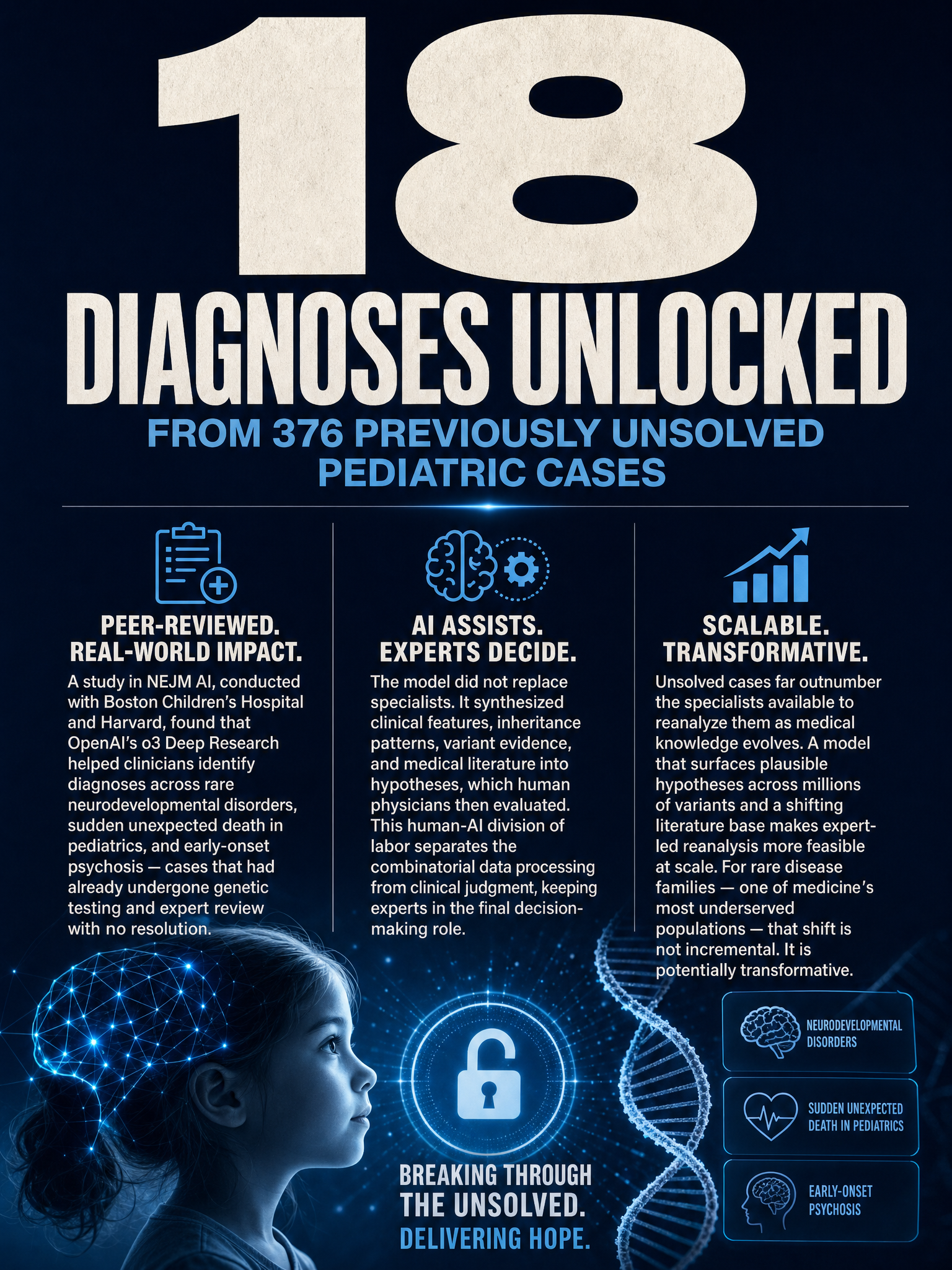
I’ve read a lot of AI research papers. Most of them report marginal gains on benchmarks nobody outside the lab cares about. Then I read the OpenAI and Boston Children’s Hospital study published in NEJM AI, and one number made me stop: 18.
Eighteen diagnoses. From 376 cases that had already been through genetic testing, expert review, and years of clinical evaluation. Cases that had been, for all practical purposes, closed. Families who had been told, in so many words, that medicine didn’t have an answer for them.
That is not a benchmark. That is a child getting a diagnosis their parents spent a decade waiting for.
What the Study Actually Did
The setup matters here, because it’s easy to misread this as “AI beats doctors.” That’s not what happened.
The research team, working across OpenAI, Boston Children’s Hospital, and Harvard, took 376 de-identified pediatric cases that had already gone through standard clinical and genetic workups. These weren’t fresh referrals. They were unsolved cases spanning rare neurodevelopmental disorders, rare neuromuscular disease, sudden unexpected death in pediatrics, and early-onset psychosis.
The problem with rare disease diagnosis is scale. Genetic sequencing surfaces millions of variants, and the medical literature connecting those variants to clinical presentations evolves constantly. What wasn’t published three years ago might be the missing piece today. No human specialist can hold all of it in memory and reason across it simultaneously for every patient.
o3 Deep Research was used to help clinicians connect clinical features, inheritance patterns, variant evidence, and current scientific literature into hypotheses, which specialists then evaluated. The model wasn’t making final calls. It was doing the kind of systematic, exhaustive literature synthesis that takes a researcher weeks, and doing it fast enough to be practically useful across hundreds of cold cases.
Why the Mechanism Matters
I want to be specific about what o3 was doing here, because the framing of “AI helps diagnose rare diseases” can mean very different things.
This wasn’t a pattern-matching exercise on lab values. The model was reasoning across heterogeneous evidence types: genetic variants, clinical phenotypes, inheritance logic, and a constantly expanding body of published research. The output was hypotheses for specialists to evaluate, not automated diagnoses.
That distinction is important for two reasons. First, it’s honest about what the technology is doing. Second, it points toward where AI is genuinely useful in medicine right now. The bottleneck in rare disease diagnosis often isn’t clinical judgment. It’s the sheer volume of information that needs to be synthesized before good judgment can even be applied. That’s a tractable problem for a large reasoning model.
OpenAI noted that this kind of AI-assisted periodic reanalysis could make it scalable to revisit old cases as medical knowledge advances. That’s the real opportunity. Not replacing specialists, but making it economically and logistically feasible to go back through the archive.
The Honest Caveats
I’m not going to pretend this study answers every question about AI in clinical settings.
18 diagnoses from 376 cases is roughly a 5% hit rate. That’s meaningful, but it also means the model generated leads that didn’t pan out the vast majority of the time. The paper doesn’t tell us much yet about false positive rate or downstream clinical burden from chasing unproductive hypotheses. Those details matter a lot before this becomes a standard workflow.
The study is also, by nature, a proof-of-concept collaboration between OpenAI and institutions that have strong incentives to publish positive results. I don’t think that invalidates the findings, but independent replication across different hospital systems and case types will be required before this changes clinical practice.
And the cases here were already curated, de-identified, and structured for analysis. Real clinical data is messier than that.
What This Points Toward
OpenAI is clearly building a thesis around health as a flagship application for their frontier models. GPT-5.5 Instant is now described as on par with their frontier thinking models for health-related questions, and more than 230 million people per week use ChatGPT for health and wellness questions. They’ve built a network of hundreds of physicians across 60 countries and 49 languages to improve model quality.
The NEJM AI study fits into that thesis, but it’s different in kind from consumer health Q&A. This is a peer-reviewed study in a serious journal, involving real unsolved cases and genuine clinical stakes. That’s a different bar, and they cleared it.
For the families behind those 18 cases, the abstract debate about AI in medicine is already over. They got an answer.
That’s where I think the conversation needs to stay grounded. Not in whether AI will transform healthcare (it probably will, in some form), but in whether specific applications are making real clinical differences for real people. This one did.
Sources & Further Reading
#AIinMedicine #RareDisease #OpenAI #MachineLearning #ClinicalAI #HealthTech #PediatricMedicine