OpenAI ChatGPT Work launch: agentic workflows powered by GPT-5.6 Sol, ultra mode, and the shift from cost-per-token to cost-per-task framing
ChatGPT Work Is Not a Better Chatbot. It’s a Different Tool Entirely.
OpenAI dropped a lot of things at once this week. A new model family, a new desktop app, hosted sites, and something called ChatGPT Work. Most of the coverage I’ve seen is focused on the benchmark numbers. That’s the wrong thing to look at first.
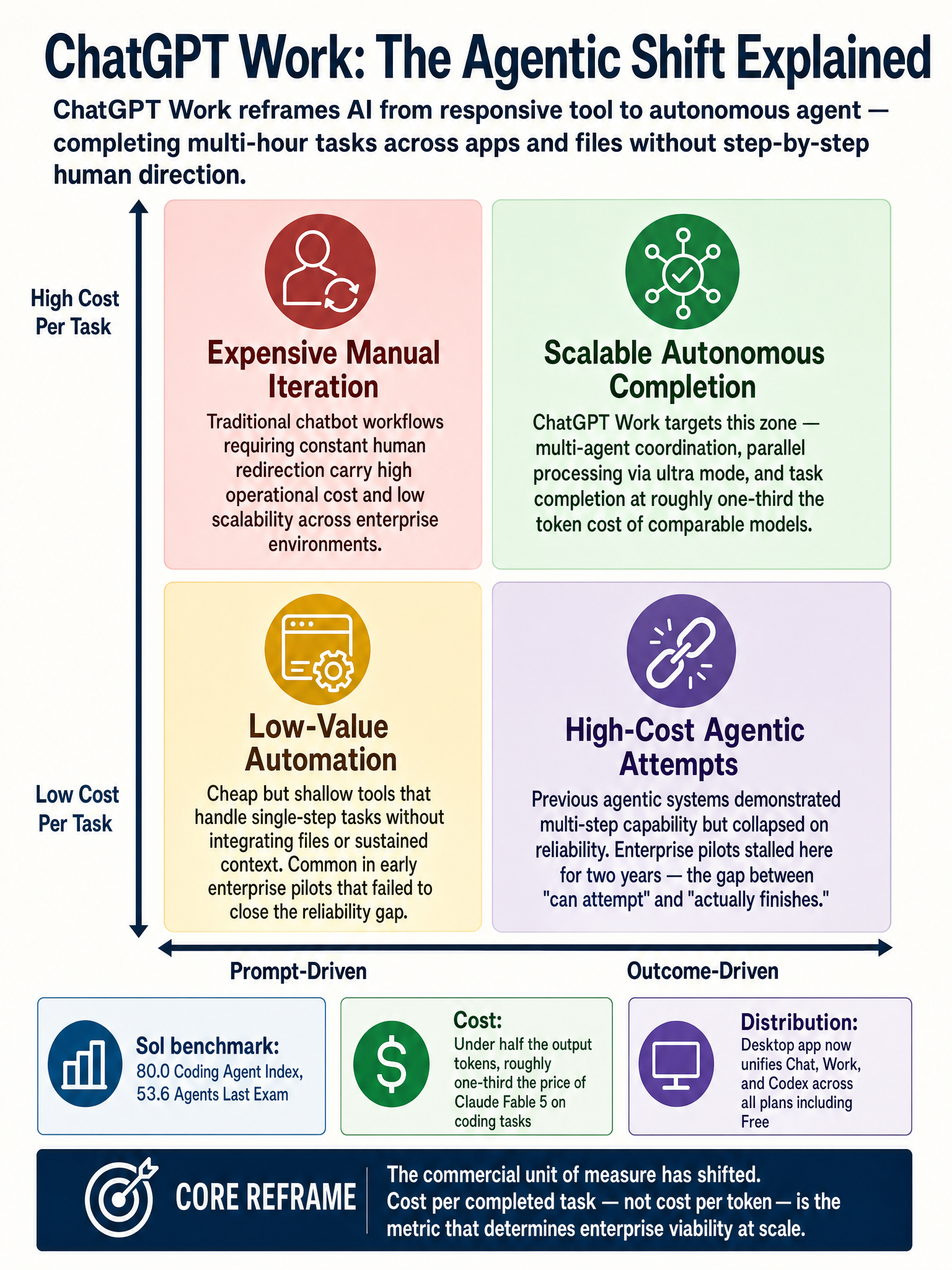
The benchmark numbers are real. GPT-5.6 Sol scores 80.0 on the Artificial Analysis Coding Agent Index, 2.8 points above Claude Fable 5, using less than half the output tokens and costing about one-third less. On Agents’ Last Exam it hits 53.6, beating Fable 5 by 13.1 points. Those are significant leads. But benchmarks are table stakes now. The more interesting question is what the product is actually trying to do.
The Actual Shift
ChatGPT Work is an agent. Not a chatbot with agentic features bolted on. The framing OpenAI is using is “describe the outcome you want, without having to spell out every step.” It can take action across your apps and files, stay with a project for hours, and hand you finished work at the end.
That is a genuinely different loop than what we’ve been doing. For years the interaction pattern was: you prompt, it responds, you refine, repeat. You were the orchestrator. The model was fast, but it was waiting on you at every step. ChatGPT Work is supposed to invert that. You set the goal, it figures out the path.
I’m skeptical of the marketing version of this, but I’m not skeptical of the direction. Agentic workflows that actually persist across sessions and pull context from real files and apps, without you babysitting every handoff, that’s a meaningful step if it works in practice.
Ultra Mode and What It Actually Is
GPT-5.6 launches with ultra mode, which OpenAI describes as coordinating multiple agents working in parallel. It trades higher token use for better and faster results on demanding tasks. This is the part that connects directly to Sam Altman’s comment this week: “we have heard enterprises on their concerns about AI costs, and 5.6 sol is a huge step forward for dollars-per-task, as are terra and luna.”
That framing matters. Cost-per-token is how the infrastructure conversation has been happening. Cost-per-task is how buyers actually think. If your finance team wants a competitive analysis done, they don’t care how many tokens it took. They care what it cost to get the output they needed. Sol’s efficiency gains make that math much more favorable, and ultra mode is the premium tier for when you want to throw more parallelism at something and still get it done faster.
The Model Family Design
The Sol, Terra, and Luna naming is worth paying attention to. OpenAI is explicitly tiering intelligence against cost, and the spread is significant. On Agents’ Last Exam, GPT-5.6 Terra and Luna outperform Fable 5 at around one-sixteenth the estimated cost of Sol. That’s not a footnote. That means enterprises can route routine tasks to cheaper tiers and reserve Sol for the genuinely hard problems. This is infrastructure thinking, not just product thinking.
What I’m Actually Watching
The Codex integration is what ties this together. Altman said explicitly that “Codex is the core of our new work product.” ChatGPT Work is rolling out now for Pro, Enterprise, and Edu plans on web and mobile, with Plus and Business following in the next few days. The desktop app brings Chat, Work, and Codex together on every plan including Free.
The real test is whether the agentic loop holds up on messy real-world tasks, not controlled demos. Hours-long autonomous work across live apps is a hard problem. Context drift, error propagation, and knowing when to stop and ask rather than barrel through. Those are the failure modes that will determine whether this is genuinely useful or impressive for 20 minutes.
The dollars-per-task framing is the right one. If OpenAI can make that case stick with verifiable results in enterprise workflows, this is a real wedge against the rest of the market.
🔗
Sources
#ChatGPT #OpenAI #AIAgents #GPT5 #EnterpriseAI #LLM #MachineLearning