Insight on Mira Murati’s multi-AI worldview and what pluralistic AI infrastructure means for builders routing global traffic through single frontier models
The Monoculture Problem Nobody Wants to Talk About
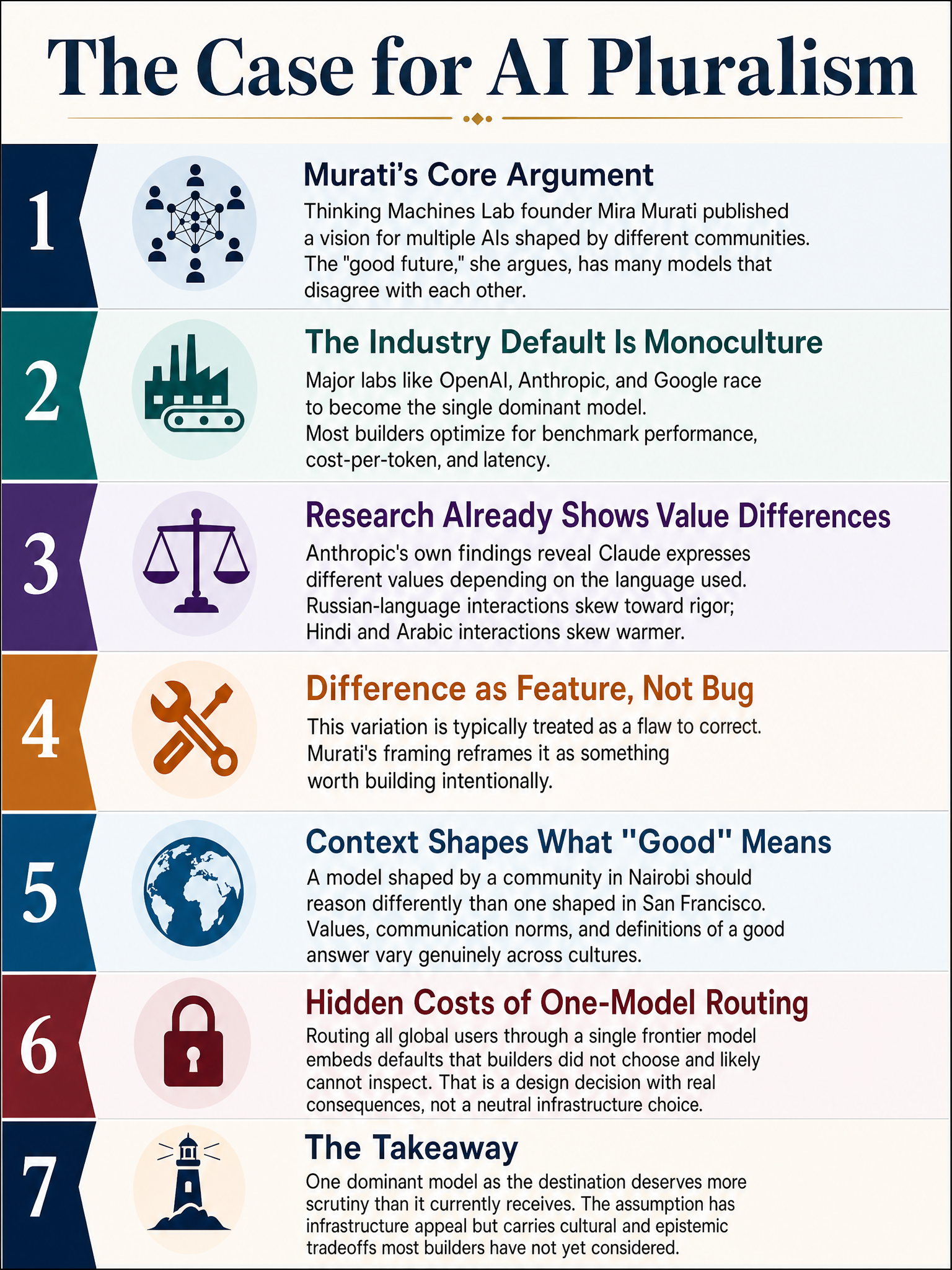
One line from Mira Murati’s new worldview document stopped me cold this week. “The good future has many AIs, raised in different places, shaped by the people they serve, disagreeing with each other the way we do.”
That is not a platitude. That is a direct challenge to how almost every production AI system is built right now.
🌐
The Default Is Dangerous
The standard architectural decision in 2025 goes like this: benchmark the top models, pick the winner, route all traffic there, optimize cost-per-token. Every major cloud vendor has a preferred frontier model. Every startup with a tight runway is collapsing its AI infrastructure to a single provider.
I get the economics. I’ve made the same tradeoff. But when Anthropic published research this week analyzing 300,000 anonymized Claude conversations, what they found should make every builder uncomfortable about that single-model default.
Claude expresses over 3,000 distinct values. Those values shift depending on which language you’re speaking. In Russian, Claude leans toward rigor and asks users for supporting evidence. In Hindi and Arabic, it leans warmer. Model versions land at different points too: Sonnet 4.6 runs more playful and affirming, while Opus 4.7 is more likely to give you a candid critique. Anthropic’s own researchers admitted they don’t yet understand why these variations occur, or whether they’re desirable.
Think about that. The company that built the model doesn’t fully know why it values things differently depending on how you talk to it.
Why This Should Terrify Builders
If you’re routing global user traffic through a single model, you are not serving a single consistent intelligence. You’re serving a system whose expressed values drift with language, prompt framing, and model version. Your Russian-speaking users are getting a different epistemic experience than your Arabic-speaking users. You probably don’t know this. Your product spec didn’t account for it.
This isn’t a Claude problem specifically. It’s a monoculture problem. When you centralize all cognition through one system, you inherit all of its biases, blind spots, and invisible value shifts at scale. And you have no reference point to even detect the drift.
Murati’s framing is the right one. Pluralistic AI infrastructure is not idealism. It’s a practical hedge against epistemic monoculture.
🔧
What Pluralistic Infrastructure Actually Looks Like
I want to be concrete here because “many AIs” can sound vague. In practice, pluralistic AI infrastructure means a few things for builders.
First, it means routing by context, not just cost. A legal research tool used globally should not default every query to the same model in the same configuration. Route by language, domain, and stakes.
Second, it means treating model disagreement as a signal, not a failure. If you run two models on the same query and they diverge, that divergence contains information. It might tell you the question is genuinely ambiguous. It might tell you one model has a cultural blind spot on the topic.
Third, it means watching the open-weights ecosystem seriously. Murati’s Tinker product lets anyone train their own open-weights models, which is exactly the right direction. Open-weights models trained on local corpora, by local teams, for local needs will capture things that a model trained primarily on English-language web data simply cannot.
Sam Altman has gestured at this too, writing this week that he sees open-source harnesses as a reason to favor that architectural approach. He’s thinking about it at the infrastructure layer, which is where this conversation needs to live.
The Benchmark Trap
The benchmark race everyone is running right now actively works against pluralism. When OpenAI publishes that GPT-5.6 Sol is half the price and roughly twice as token-efficient as previous versions, the rational short-term response is to consolidate onto that model. I understand the pull.
But benchmarks measure narrow task performance under controlled conditions. They don’t measure value consistency across languages. They don’t measure what happens when your product scales to users whose cultural context the training data underrepresented. They optimize for the wrong thing when your goal is serving genuinely diverse users.
Murati is building against that logic. Human values don’t average out, she writes. Local knowledge can’t be centralized. These aren’t philosophical observations. They’re architectural constraints.
The builders who figure out how to route intelligently across a pluralistic model ecosystem, how to detect value drift, how to use model disagreement productively, those builders will have systems that are more robust and more honest than anything a single-model architecture can produce.
Anthropic’s admission that they analyzed 300,000 conversations and still can’t fully explain their own model’s value variation is the most important data point I read this week. Build accordingly.
Sources
#AIEngineering #MachineLearning #AIInfrastructure #LLMs #BuildingWithAI