DeepSeek V4 Flash coding model approaching Claude Opus 4.8 performance at 99% lower cost, and what it means for frontier lab pricing strategy and builder architecture decisions
DeepSeek V4 Flash and the Death of Frontier Pricing
The number that broke my brain this week was not a benchmark score. It was a percentage.
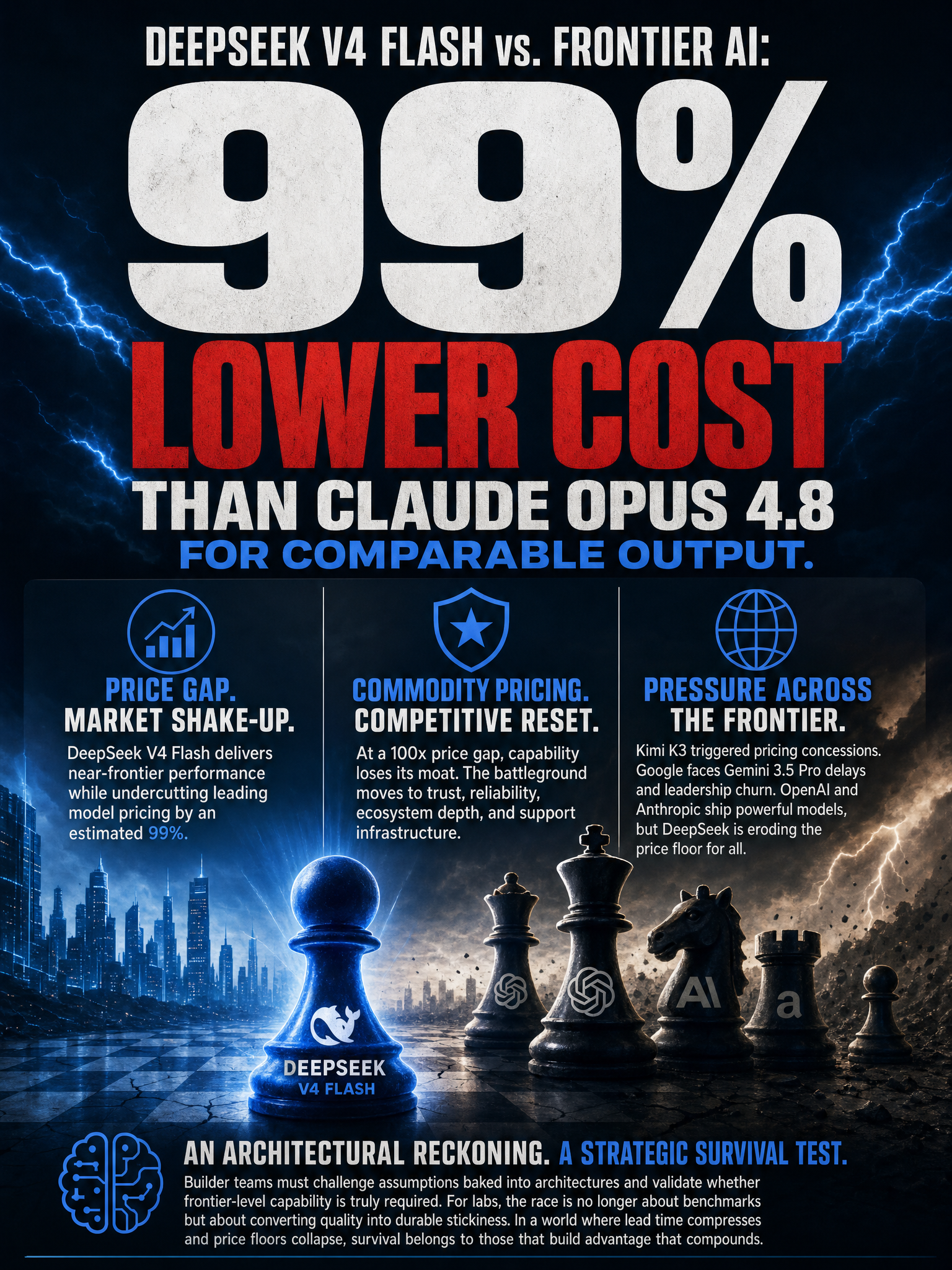
DeepSeek V4 Flash, a coding model, is approaching the performance of Anthropic’s Claude Opus 4.8 at roughly 99% lower cost for comparable output. Not 10x cheaper. Not even 50x. Ninety-nine percent. If that figure holds up under real workloads, it does not just change the math for individual teams. It breaks the entire pricing logic that most AI product companies have been building around for the last two years.
I have been watching the open-weight price war accelerate since early 2025, but this feels like a different gear entirely. Kimi K3 forced OpenAI’s hand on pricing just weeks ago. Now DeepSeek is targeting the top of the Anthropic stack with a specialized coding model at what amounts to commodity rates. This is not iteration. This is compression.
Why Capability Scarcity Was Always the Business Model
The frontier labs, Anthropic and OpenAI especially, have been selling on capability. That story works as long as capability is scarce. When a model you can call cheaply gets within striking distance of the most expensive option on the market, the scarcity argument collapses.
Claude Opus 4.8 is a genuinely impressive model. I use Anthropic’s APIs regularly and I have a lot of respect for their engineering. But “impressive” and “worth 100x the price” are two very different claims. Builders are rational. When the performance gap shrinks and the cost gap stays enormous, budget allocation changes fast.
This is also happening while Google is dealing with real turbulence. Demis Hassabis stepped down as Google DeepMind CEO this week, moving to a chairman and chief scientist role, with Gemini 3.5 Pro still months behind schedule according to reporting from Axios and Reuters. Three major labs, three very different problems at the same time.
What This Means for How You Build
If you are architecting an AI product right now, the DeepSeek V4 Flash release changes a few concrete decisions.
First, the “use the best model for everything” approach is becoming harder to justify in code review, documentation generation, and routine completion tasks. Those are exactly the workloads where coding-specialized models at 99% lower cost start looking like the obvious call.
Second, routing logic matters more than it did six months ago. Sending every query to a frontier model is now a product decision, not just a default. You need to be deliberate about where premium inference actually earns its price.
Third, vendor lock-in risk is higher than most teams realize. If you have tightly coupled your product to one provider’s API conventions, switching costs will slow your ability to respond when pricing or performance shifts underneath you.
The Frontier Labs Are Not Standing Still
I want to be clear that I do not think Anthropic or OpenAI are in existential trouble. Both are releasing capable new models and both have enterprise relationships that are stickier than raw API pricing suggests. But the competitive pressure from DeepSeek is real and it is accelerating on a timeline that would have seemed implausible eighteen months ago.
The pricing umbrella that frontier labs rely on, the gap between what top models cost and what the market will bear, is shrinking from below. That forces a response. Either you compete on price, which destroys margins, or you compete on something that cannot be commoditized: trust, reliability, compliance posture, fine-tuning pipelines, or genuinely differentiated capability in domains where the gap has not yet closed.
Coding is one of the highest-volume, most price-sensitive use cases in the market. DeepSeek chose it deliberately.
Where This Goes
The builders who win the next eighteen months will be the ones who treat model selection as a dynamic engineering decision rather than a vendor commitment. The infrastructure question is not which model is best. It is which model is best for this task at this cost given this latency requirement.
That framing used to be premature. It is not anymore.
The frontier pricing era is not over, but it is under real pressure for the first time. DeepSeek V4 Flash is a signal worth taking seriously, and the teams that respond to it with updated architecture thinking will have a meaningful edge over the ones that wait for the pricing logic to fully collapse before reacting.
Sources
#AIEngineering #DeepSeek #LLMPricing #BuildingWithAI #MachineLearning