Grok 4.6 matches GPT-5.6 Sol Max on benchmarks as SpaceX and Meta emerge as serious frontier AI contenders, reshaping model evaluation for builders
SpaceX is now a serious AI lab. Sit with that for a second.
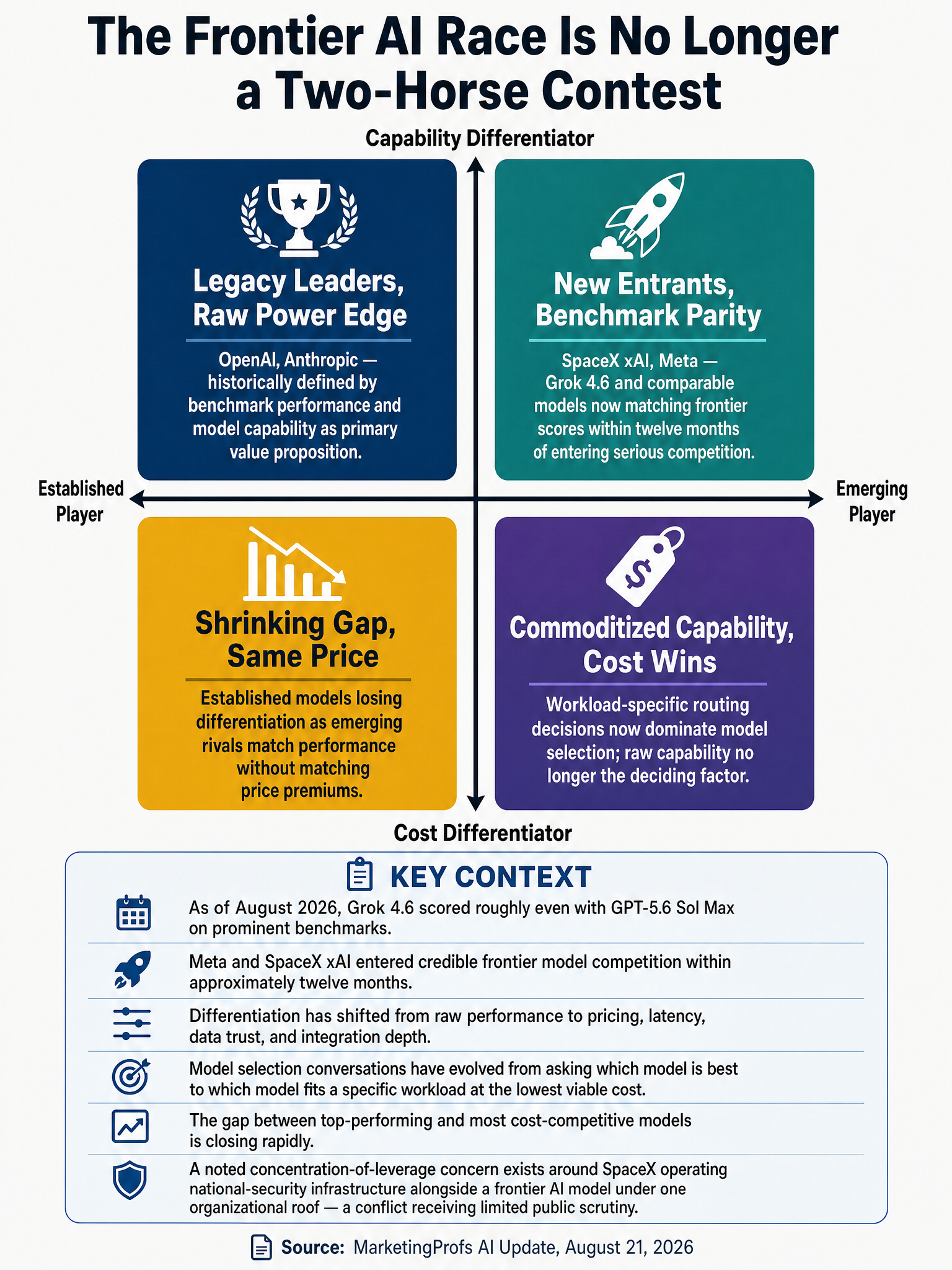
Not a hobby. Not a side project. A frontier model contender matching OpenAI on benchmarks. According to MarketingProfs’ August 21 roundup of the past two weeks in AI, Grok 4.6 scored roughly even with GPT-5.6 Sol Max on a prominent benchmark. Meta is in the same conversation. Two companies that weren’t on most builders’ shortlists twelve months ago are now trading blows with the incumbents, often at lower cost.
This changes the calculus for anyone making architecture decisions right now.
The Benchmark Picture
Grok 4.6 and GPT-5.6 Sol Max landing at roughly the same benchmark score is not a rounding error. GPT-5.6 (Terra) launched July 9, 2026 with a 1,050,000-token context window and 128,000 max output tokens. These are not small models playing catch-up. They are frontier-class systems, and SpaceX’s entry is matching them.
Claude Sonnet 5 launched June 30 with a million-token context window. Gemini 3.7 Flash followed August 13 from Google DeepMind. The pace of releases has gotten genuinely hard to track, and that pace matters because each release resets the baseline builders are comparing against.
When performance converges, what actually differentiates models?
What Builders Should Actually Care About
When Grok 4.6 and GPT-5.6 Sol Max score roughly even, raw capability stops being the selection criterion. The decision shifts to pricing, latency, rate limits, API reliability, fine-tuning access, and ecosystem tooling.
SpaceX and Meta entering with aggressive pricing changes leverage for everyone. If you’re currently locked into OpenAI or Anthropic pricing without renegotiating, now is the time to renegotiate. The competitive pressure is real.
I’ve watched too many teams pick a base model based on a benchmark chart and then get surprised six months later when their actual production costs or latency profiles don’t match the chart. The benchmark gets you in the door. Everything else determines whether the integration survives.
The Evaluation Problem Nobody Wants to Talk About
Here’s the part that keeps me up at night. As the number of credible frontier models grows, benchmark comparisons become less reliable guides for production decisions. Most standard benchmarks don’t test for the things that break in real systems: multi-step reasoning chains that drift, tool-use reliability under partial data, latency variance under load, or behavior consistency across paraphrased prompts.
The Grounded Reasoning Cup is an attempt to evaluate AI agents live, which is the right instinct. Static benchmarks measuring frontier models that are all within noise of each other tell you almost nothing useful for routing decisions.
Builders need internal evals tailored to their actual tasks. That’s not a new idea, but with five or more credible frontier options now on the table, skipping that step is genuinely expensive.
The Competitive Map Is Redrawn
Twelve months ago, the practical question for most teams was “Anthropic or OpenAI.” Google was in the conversation but trailing. Everyone else was a rounding error.
That mental model is obsolete. SpaceX, Meta, Google, OpenAI, and Anthropic are all now credible at the frontier tier. Nvidia’s Nemotron 3.5 Lightning is also in the open-model tier competing for workloads that don’t need the absolute top of the range. The options are multiplying faster than most teams can evaluate them.
The teams that will make good decisions here are the ones who build systematic evaluation infrastructure before they need it, not after a vendor relationship goes sideways.
The frontier is crowded now. That’s good for builders who are paying attention, and brutal for anyone coasting on a model choice they made in 2025.
Sources
#AIEngineering #FrontierAI #MachineLearning #LLMs #BuildersTake