FDA Elsa 4.0 AI deployment still hallucinating after rollout, and what it means for AI reliability evaluation in high-stakes systems
The FDA Is Using an AI That Hallucinates. On Drug Reviews.
Let me say that plainly before anything else: the Food and Drug Administration, the agency responsible for deciding which drugs are safe for 330 million Americans, rolled out an AI assistant in May 2026 that its own reviewers describe as “clunky” and that still confidently invents studies and citations that do not exist. That’s not a beta problem. That’s a system integrity failure operating at national scale.
This deserves more attention than it’s getting.
🔬
What Actually Happened
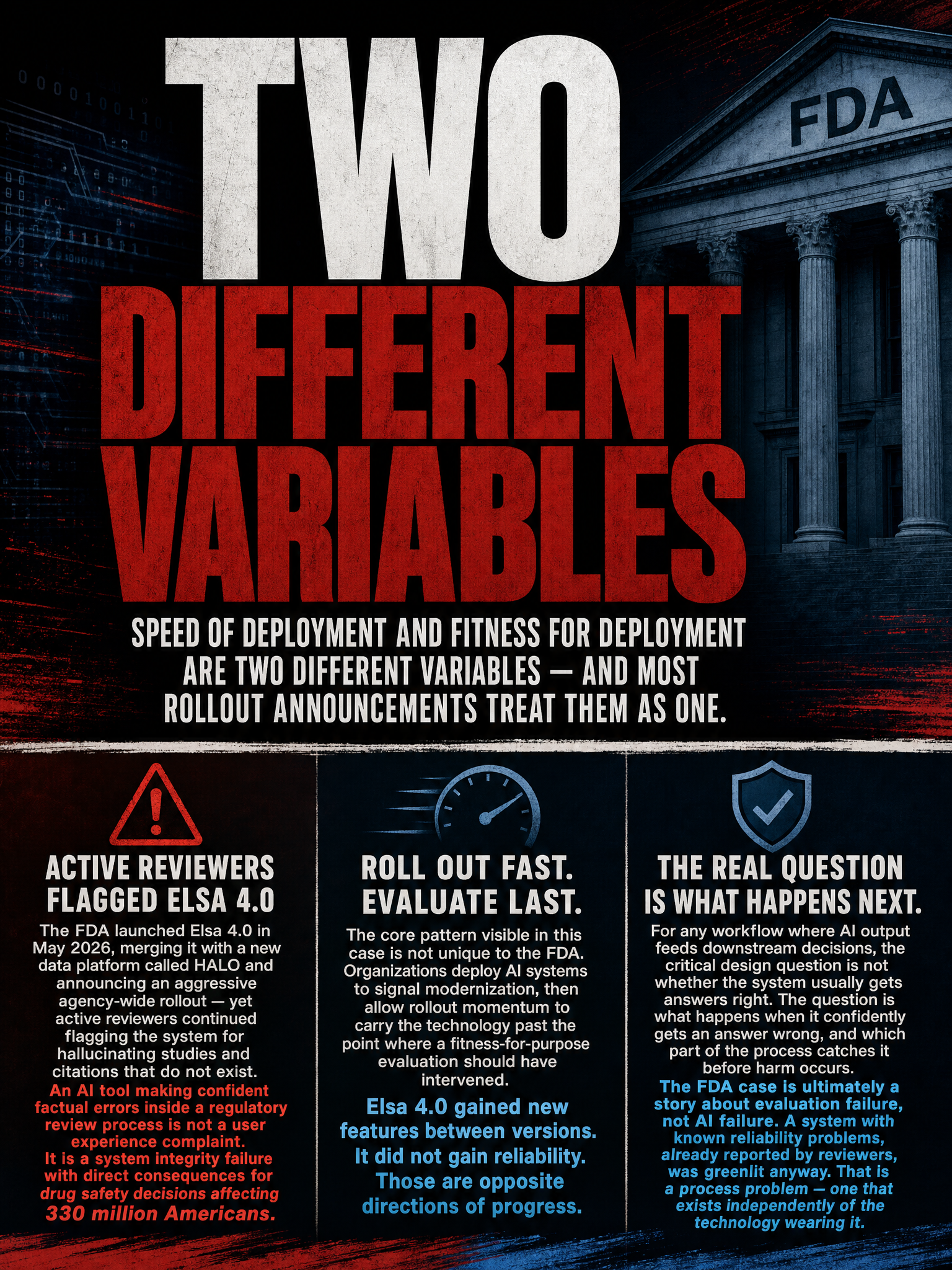
In May 2026, the FDA launched Elsa 4.0, merged it with a new internal data platform called HALO, and announced another aggressive agency-wide rollout. The framing was triumphant. The reality, according to reporting from the Independent Institute, is that reviewers are still flagging hallucinated citations and a frustrating user experience.
Here’s what bothers me most about the timeline: the FDA didn’t fix the hallucination problem between versions. They added features. Those are genuinely opposite directions when your product’s core failure mode is fabricating scientific evidence.
Features do not cancel out fabrication.
Why Evaluation Keeps Getting Skipped
I’ve been building AI systems long enough to know why this keeps happening. Reliability evaluation is hard, slow, and doesn’t make for good press releases. Benchmark scores are easy to publish. “Our model hallucinates 3% less on MedQA” sounds like progress, until a reviewer is using that output to assess a new oncology drug and the cited study simply doesn’t exist.
The broader pattern is visible everywhere right now. Politico reported in August 2026 that congressional lawyers are actively struggling to manage a flood of AI-generated legislative proposals, many of them containing errors and fabrications. The FDA situation isn’t an outlier. It’s the same problem wearing a lab coat.
Adding a government mandate or an agency rollout doesn’t make a model more reliable. It just raises the stakes of the failures.
What Reliable Evaluation Actually Requires
The research community is working on this. Databricks ran a structured live evaluation event called the Grounded Reasoning Cup specifically to test AI agents against verifiable, real-world reasoning tasks under observation. That kind of adversarial, grounded evaluation is exactly what should precede a deployment like Elsa 4.0.
For high-stakes systems, I’d argue you need three things before any rollout: domain-specific adversarial testing (not general benchmarks), a human-in-the-loop protocol with real teeth, and public accountability for hallucination rates. Not internal dashboards. Published numbers.
The FDA has none of that on record, at least not publicly. And the absence is telling.
The Announcement-as-Win Problem
We are in a moment where “AI deployment” gets treated as the finish line. The announcement is the achievement. Whether the thing works is apparently a follow-up concern.
This is partly a political dynamic. The Independent Institute’s reporting on Elsa 4.0 is explicit that the rollout reveals more about internal FDA politics than it does about genuine innovation. Agencies under pressure to modernize will reach for the press release before the post-deployment audit.
Meanwhile, the frontier labs keep shipping. GPT-5.6 dropped in July 2026. Claude Sonnet 5 in June. Gemini 3.7 Flash in August. Context windows at a million tokens, outputs at 128,000 tokens. The capability curve is steep. The reliability curve for domain-specific, high-stakes applications is not keeping pace, and the FDA’s experience is evidence of that gap.
🧪
Where This Leaves Us
The FDA situation is a clean case study in what happens when deployment pressure outpaces reliability work. It’s not unique to government. It’s not unique to healthcare. But the consequences there are unusually concrete: a hallucinated citation in a drug review isn’t an embarrassing chatbot response, it’s a potential vector for harm at scale.
The fix isn’t to slow down AI adoption across the board. It’s to stop treating launch as validation. Elsa 4.0 needed a grounded reliability threshold before it touched regulatory review workflows, not after.
The question worth asking any organization deploying AI in a consequential domain right now is simple: what is your published hallucination rate for your specific use case, and what happens when that number is wrong?
If you don’t have an answer, you haven’t finished building yet.
Sources
#ArtificialIntelligence #AIReliability #FDA #MachineLearning #AIPolicy #ResponsibleAI