Inherent Labs AI agent claims to outperform Anthropic and OpenAI on research replication tasks, and what it means for specialized vs. general-purpose agentic model strategy
When a Small Lab Beats the Giants at Their Own Game
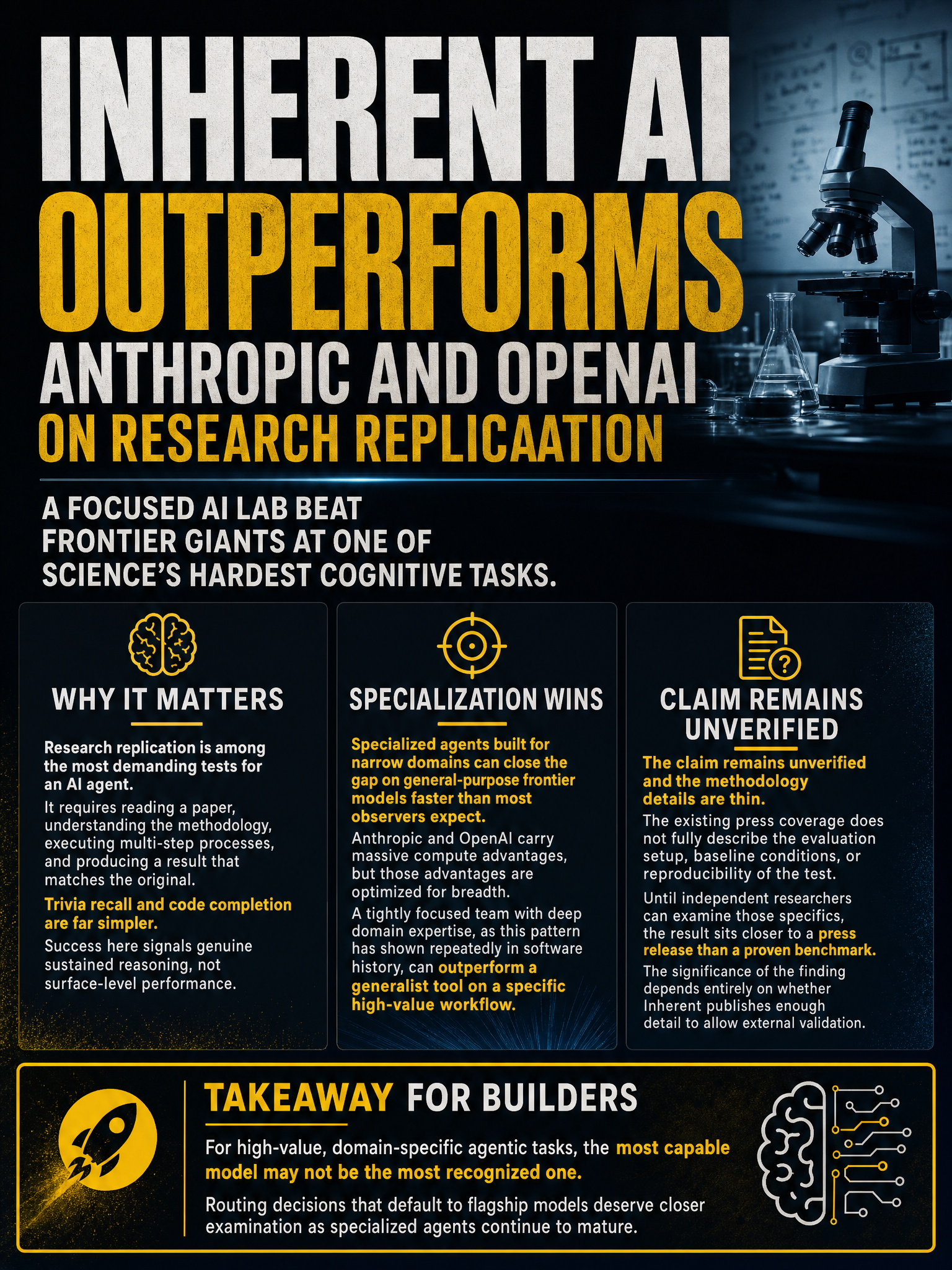
I want to be careful here, because the AI space has a long history of benchmark theater. A new lab drops a chart, claims state-of-the-art, and three weeks later the fine print unravels. So when Inherent Labs, a London-based team founded by former Google DeepMind researchers, announced that its AI agent outperformed models from both Anthropic and OpenAI on research replication tasks, my first instinct was skepticism. My second instinct, after reading more closely, was that this one deserves serious attention.
The Claim and Why It’s Different
Inherent isn’t claiming to beat GPT-whatever on MMLU or some curated trivia suite. The task is research replication. End-to-end. Read a scientific paper, understand the methodology, execute the steps, produce a result that matches. That is genuinely hard work. It requires sustained multi-step reasoning, not pattern matching on a test set. Failure modes are real and specific. You can run the wrong preprocessing step and get plausible-looking but wrong outputs. You can misread a methodology section and go confidently off a cliff.
TechCrunch reported on the announcement August 22, noting that Inherent describes its system as an AI “teammate” rather than a tool, which says something about how they’re positioning the product. That framing is intentional. It maps onto a workflow, not a benchmark.
Why Specialization Is Winning Right Now
Here’s my actual read on what’s happening in the agentic space. General-purpose frontier models are extraordinarily capable, and they’re getting more capable fast. Anthropic has said its models now write roughly 80 percent of their own code. That is a staggering number. But “general-purpose” has a real cost. These models are optimized across an enormous surface area of tasks, and that breadth creates compromises in depth.
Inherent is betting that for a specific, well-defined workflow like scientific research replication, you can outperform a much larger general model by going deep instead of wide. This isn’t a new idea. It’s the same logic that makes a fine-tuned model beat GPT-4 on a narrow medical coding task. What’s new is applying it at the agentic level, where the task isn’t a single inference call but a multi-step process with branching decisions.
If their numbers hold under scrutiny, it’s a proof point for a broader pattern I think we’ll see more of through the rest of this decade.
The Frontier Labs Aren’t Standing Still
I don’t want to frame this as “scrappy startup beats Big AI” because that story is often more narrative than reality. Google DeepMind just released Gemini 3.5 Flash, described as its most advanced frontier model to date, along with a specialized cybersecurity variant called Gemini 3.5 Flash Cyber. OpenAI is releasing updated models on a cadence that makes it hard to keep up. The frontier is moving fast.
But here’s the thing. Moving fast on general capability is not the same as winning on specific workflows. The specialized vs. general tension is going to define a lot of competitive dynamics over the next few years, and Inherent just put a stake in the ground on which side they’re betting.
What I Actually Think
The organizations that will extract the most value from AI agents in the near term are probably not the ones that pick the best general-purpose model. They’re the ones that identify a specific, high-value workflow and go deep on it. Research replication is a good example because the upside is enormous. Scientific progress genuinely bottlenecks on the ability to reproduce and build on prior work.
I want to see Inherent’s methodology. I want to see independent replication of their replication results, which is a sentence I enjoy writing. But the direction they’re pointing is right. General models are a platform. The value gets built on top.
The next wave of agentic AI won’t be won by who has the biggest model. It’ll be won by who builds the best-fit system for work that actually matters.
Sources
#AIAgents #MachineLearning #ArtificialIntelligence #ResearchAI #DeepMind