Question: as AI generates full interactive worlds from prompts, what is the actual skill of a software engineer going forward?
The Question Nobody in Engineering Wants to Answer
Karpathy posted something last week that I haven’t been able to shake. He was watching Claude Fable 5 generate real-time ThreeJS environments from prompts, full 3D scenes with physics, lighting, interactive objects, and he wrote: “I didn’t appreciate that models would be able to create these awesome, rich, playable worlds that fuse knowledge and code.”
That phrase. Fuse knowledge and code.
That is not what we usually mean when we talk about AI coding tools. We talk about autocomplete, boilerplate generation, context-aware suggestions. We talk about spending less time on the boring parts. But when a model generates a bear that catches a salmon at the 43-minute mark of a procedurally created river environment, that is not boilerplate. That is coherent world-building from a domain blend that includes physics simulation, 3D rendering, animal behavior logic, and visual composition.
So the question I’m sitting with: what is left for the software engineer?
🎮
What “Fusing Knowledge and Code” Actually Means
Most programmers have spent their careers separating concerns. You write the logic, designers handle the visuals, domain experts provide the rules. Specialization was the whole game.
What Karpathy is pointing at is a model that doesn’t respect those separations. It draws on rendering knowledge, physics intuition, biological plausibility (bears do catch salmon), and ThreeJS API fluency simultaneously. The output isn’t a code snippet. It’s a working artifact with cross-domain coherence baked in.
That changes the nature of the skill gap. You can’t just “stay ahead” by knowing more syntax. The model already knows more syntax than you. You can’t win on API recall. The model beats you there too.
The question becomes: what can you bring that a prompt cannot?
The Engineer as System Thinker
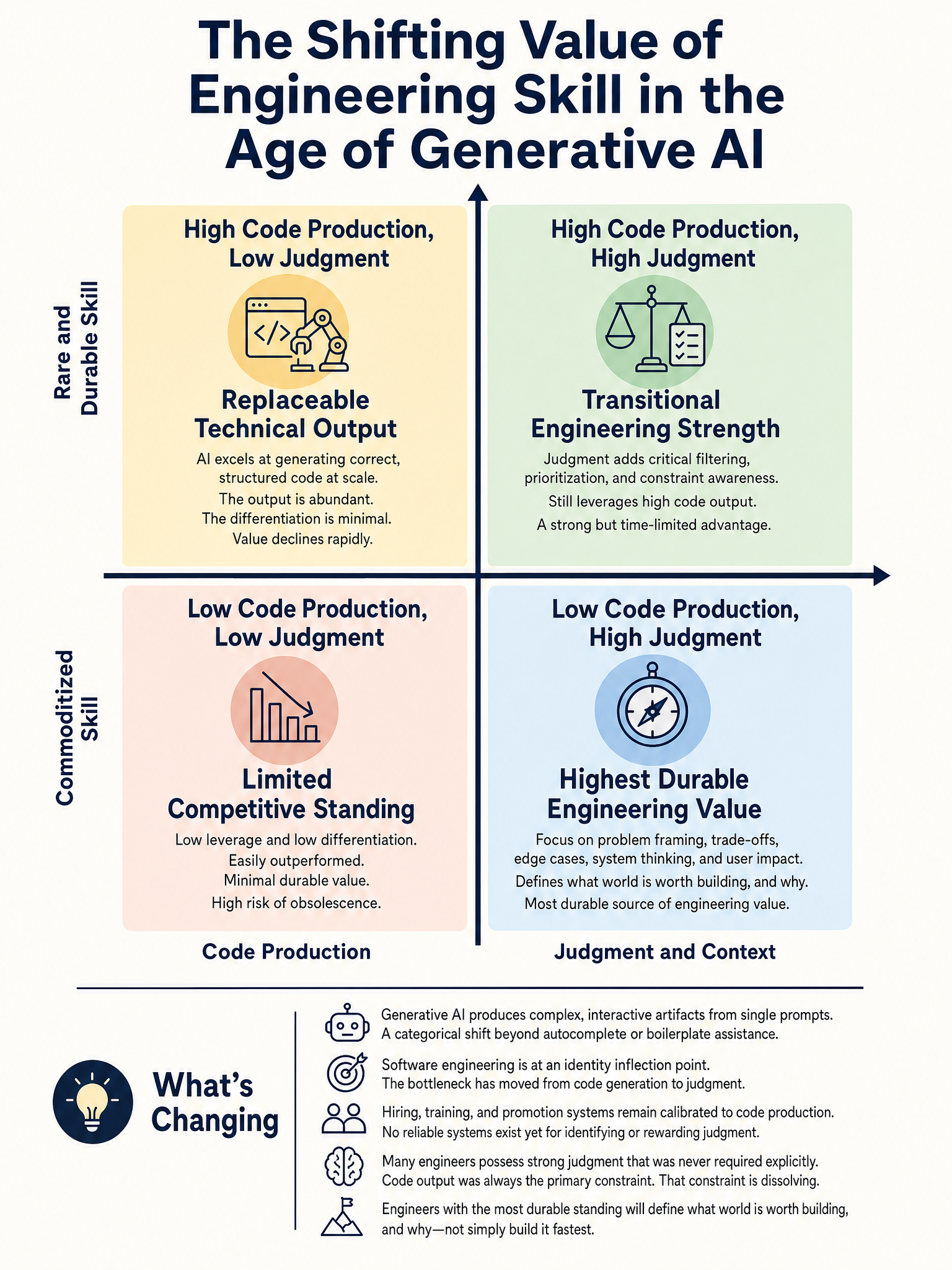
Here’s my actual take. The skill that survives is not writing code. It is knowing what the code is supposed to do, why, and whether it’s doing it correctly.
When a model generates a playable world, it needs a human to answer questions the model can’t ask itself. Is this the right abstraction? Does this system hold when it scales to 10,000 concurrent users? What breaks when the physics parameters drift outside the training distribution? Does this design create technical debt that will cost six months to unwind in two years?
Those are not generation problems. They are judgment problems. And judgment requires context that lives outside any prompt.
Bridgewater’s work with Tinker API is a good parallel here. They didn’t hand the model their entire analytical process and walk away. They used domain experts to fine-tune the model specifically for financial analysis tasks, with those experts still in the loop on what mattered. Experts improving AI that empowers experts, as the announcement put it. The expertise didn’t disappear. It moved upstream.
🧠
What Gets Harder, Not Easier
I want to push back on the comfortable narrative that engineers just “move up the stack.” That framing implies a clean escalator. It’s not.
Moving up the stack means you need broader context, faster. If a model can generate a working game environment in minutes, the engineer who adds value is the one who can look at that environment and immediately see the edge cases, the architectural debt, the missing failure modes. That requires deep knowledge of how systems break. Which means you still need to understand the generated code, even if you didn’t write it.
Reading comprehension of generated systems is a skill we are dramatically underinvesting in right now.
The other thing that gets harder is verification. OpenAI just released GeneBench-Pro specifically to evaluate how well AI agents navigate messy biological data and make judgment calls. The benchmark exists because generation is getting cheap and verification is getting hard. That pattern will repeat across every domain.
Where This Actually Lands
The software engineer who thrives in the next decade is not the one who resists AI generation. It’s the one who has strong enough mental models of systems to act as a good critic, architect, and failure analyst for generated code.
Write less. Understand more. The job is shifting from author to editor to reviewer to architect, and the timeline on that shift is faster than most hiring pipelines are built to handle.
The bear catching the salmon was impressive. What I want to know is who designed the river.
Sources
#SoftwareEngineering #AIEngineering #FutureOfWork #MachineLearning #Karpathy