Anthropic’s Model Hardware Standard (MHS) as a physical-world AI agent protocol and what it means for builders working at the hardware-software interface
Anthropic Just Claimed a $30 Trillion Market. The Part You Missed Is the Protocol.
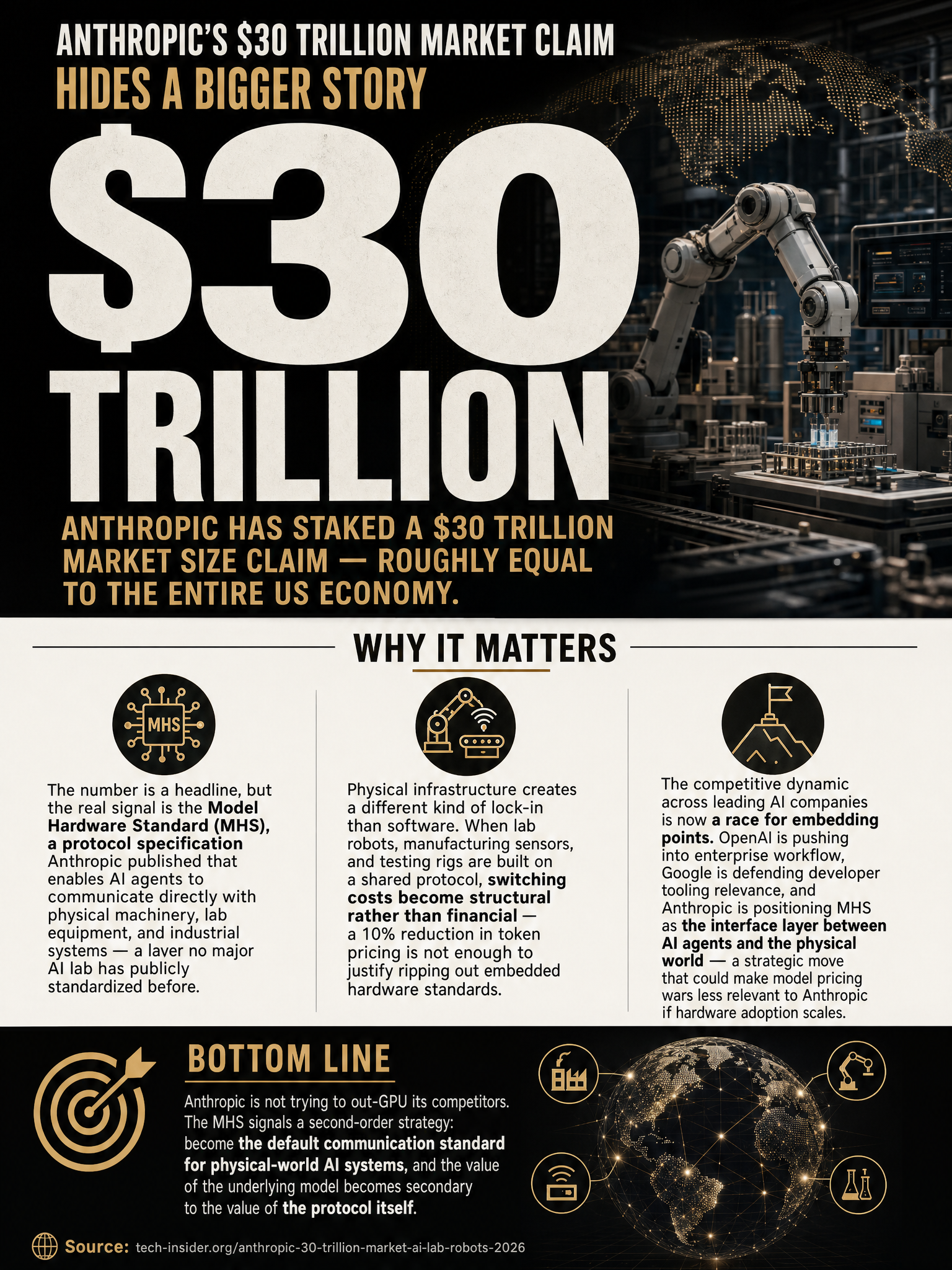
$30 trillion. That number landed last week and most of the coverage treated it like an audacious fundraising talking point. Fair, honestly. It’s a number so large it stops meaning anything if you sit with it too long. For reference, that’s roughly the entire output of the US economy in a year.
But here’s what I actually care about, and what most people glossed over in the headline grab: the Model Hardware Standard.
What MHS Actually Is
The Model Hardware Standard, or MHS, is not a new Claude model. It is not a benchmark score or a price cut. It is a shared interface specification that lets AI agents communicate directly with physical machinery, robots, lab equipment, and industrial systems. Anthropic described it in their August 27 announcement (per CNBC’s coverage) as a way to make it dramatically simpler for agents to operate hardware.
That’s a protocol play. That’s infrastructure. That’s a different category of move entirely.
When you publish a protocol and the industry adopts it, you don’t have to win every model benchmark race. You become the connective tissue. That’s a position that compounds over time in a way that model releases don’t.
Why Builders at the Hardware-Software Interface Should Pay Attention 🔧
If you’re working on robotics, lab automation, or anything where software needs to talk to physical systems, the MHS is worth reading carefully. Right now, every team building in this space is solving the same plumbing problems independently. Custom APIs, proprietary control interfaces, brittle middleware that breaks every time the hardware vendor pushes a firmware update.
A shared standard doesn’t eliminate that complexity. But it gives the community a common vocabulary. And if Anthropic’s agents are natively fluent in MHS while your competitors are still building one-off integrations, that’s a real gap.
The race, as I read it, is for embedding points. Not model performance in the abstract, but where an AI system becomes load-bearing inside a physical workflow. Lab automation is a strong candidate. The $30 trillion number Anthropic is citing almost certainly includes industrial and scientific infrastructure, not just software licenses.
The Competitive Picture
While Anthropic is making this infrastructure move, the rest of the field is running hard in different directions. Google employees are already testing Gemini 3.8 Flash internally, weeks after shipping the last version. SpaceXAI dropped Grok 4.6 in August with a focus on long-running agents. Chinese open-source models are starting to replace Claude in document-review workflows at some US companies, according to Fortune’s reporting from August 27.
Claude Opus 5 is listed at $500 per million tokens on current pricing tables. That’s a premium tier product. Anthropic is clearly not trying to win on price. The MHS is part of a bet that the right kind of integration beats the cheapest API.
That might be correct. Or it might be the kind of strategic repositioning you do when the cost curve on models is moving against you. I genuinely don’t know yet, and anyone who tells you they do is guessing.
My Actual Take
Publishing a hardware interface standard is one of the more interesting things a frontier AI lab has done in a while. Not because it’s guaranteed to work, but because it reveals what Anthropic thinks the next five years are actually about. They’re not betting purely on model capability. They’re betting on physical-world deployment at scale, and they want to control the handshake between the agent and the machine.
For builders working at this interface, the practical move right now is simple: read the MHS spec, understand what assumptions it makes about agent architecture, and figure out whether those assumptions match your system. Don’t wait for the ecosystem to mature before forming an opinion on the design choices.
The $30 trillion number is marketing. The protocol is the thing worth watching.
Sources
#AIAgents #Robotics #LabAutomation #Anthropic #HardwareSoftware #AIProtocol #MachineLearning
Sources & Further Reading
- Anthropic Claims $30T Market as AI Runs Lab Robots [2026]
- Chinese open-source AI is starting to win over U.S. businesses
- Google Employees Are Already Testing the Next Gemini Flash AI Model
- AI Updates Today (August 2026) – Latest AI Model Releases
- Elon Musk: The 100 Most Influential People in AI 2026