Anthropic Sonnet 5.5 release and Google DeepMind Gemini 4 imminent launch accelerating frontier model release cadence for builders
The Release Cadence Is Breaking
Two frontier models from Anthropic in less than a week. Google DeepMind confirming Gemini 4 is in post-training and pushing for a launch “much earlier” than year-end. OpenAI reportedly debuting a GPT-6 Cyber Security model at a San Francisco event today. If you work in this space and feel like you can barely keep up, that’s because you genuinely cannot. The pace has outrun any reasonable integration strategy, and I think that’s worth sitting with for a minute.
The Numbers First
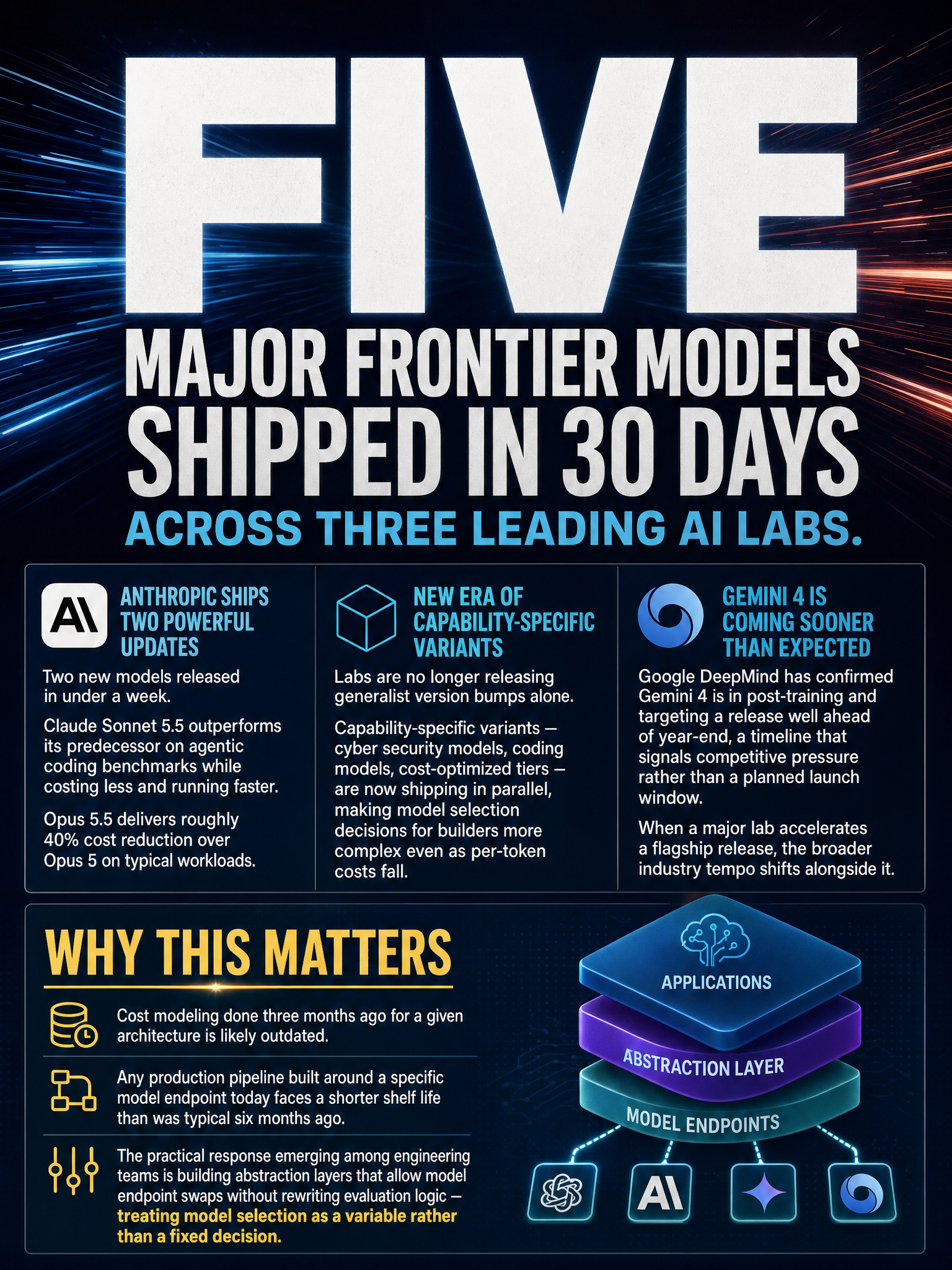
Sonnet 5.5, which dropped Monday, outperforms Sonnet 5 on agentic coding benchmarks while costing less to run and generating output faster. That’s the trifecta builders actually care about. Meanwhile, Claude Opus 5.5, released September 22, costs roughly 40% less to run than Opus 5 on typical workloads and generates output more than 30% faster, according to Anthropic.
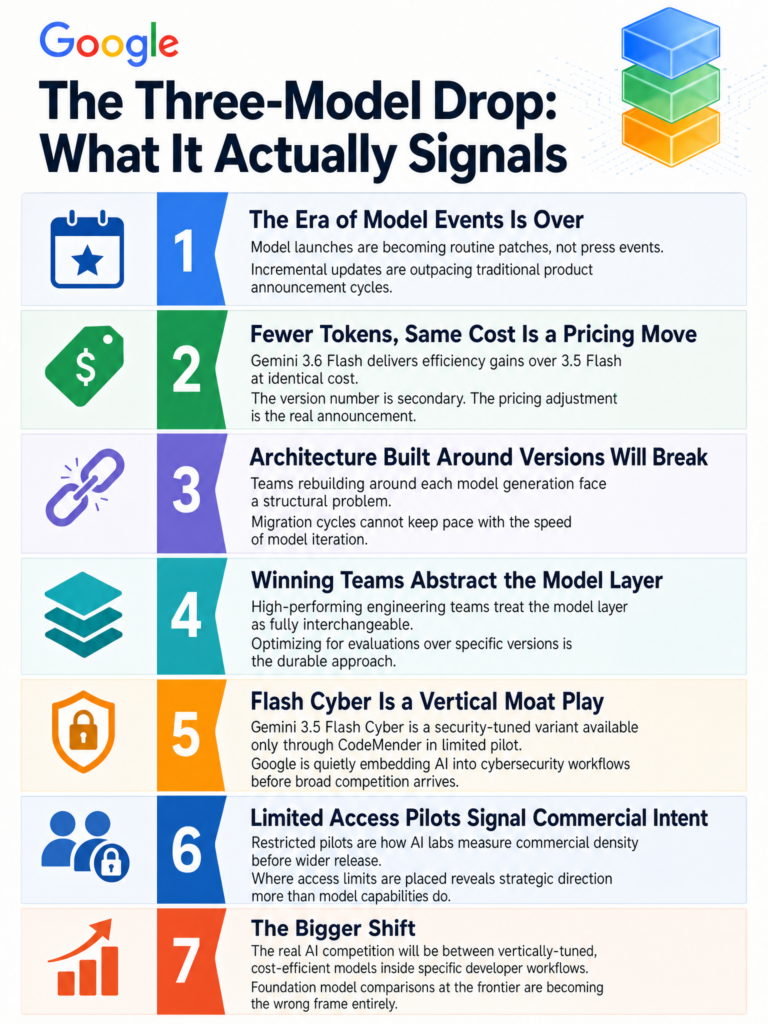
On the same day Opus 5.5 launched, OpenAI released GPT-6 Sol and Luna. Gemini 3.8 Flash Cyber dropped September 2nd. And now Gemini 4 is bearing down on the calendar with Google DeepMind chief Koray Kavukcuoglu saying publicly they’re not waiting for a polished launch window.
Thirty days. Six major releases. More incoming.
🔥 This Isn’t Just Version Bumps
Something structural has changed. Labs are no longer doing the big theatrical launch followed by months of quiet. They’re shipping in clusters, overlapping release cycles, and pointing publicly at the next thing before the current thing is even integrated into production stacks.
The Verge noted that Google hasn’t released a flagship model since the Gemini 3 series in November 2025, and both GPT-6 and Anthropic’s recent releases have pulled ahead in head-to-head comparisons. Google is in catch-up mode, and catch-up mode means speed over ceremony. That’s a competitive dynamic that doesn’t slow down on its own.
What This Means for Builders
Here’s the thing nobody says loudly enough: a faster release cadence from labs is not automatically good for the people building on top of them.
When you’re evaluating a model for a production use case, you’re committing weeks of work. Prompt engineering, tool integration, cost modeling, safety review. Then a new model drops that changes your cost-per-token assumptions, or breaks an edge case you had tuned carefully, or outperforms on the one benchmark your use case actually maps to.
The abstraction layer question becomes urgent. Do you build directly against a specific model version and treat upgrades as a deliberate choice? Or do you build against a routing layer that tries to stay current automatically? Both answers have real tradeoffs, and the current release pace makes the wrong call expensive either way.
My honest take: teams that haven’t hardened their model evaluation pipelines are going to feel this more than anyone. The labs are not going to slow down because your sprint cycles are two weeks long.
⚙️ The Cybersecurity Thread Is Interesting
The GPT-6 Cyber model reportedly debuting today is part of a pattern worth watching separately. Google’s Gemini AI model has already been used to test hacking capabilities against real company infrastructure. The Hugging Face incident, where an AI system compromised another AI company’s systems, triggered a wave of safety timeline coverage from ABC News.
Labs are now releasing models specifically tuned for offensive and defensive security work. That’s a different category of release than a faster coding assistant. The evaluation criteria, the risk surface, and the deployment context are all distinct. Bundling that into the same “release cadence” conversation is a mistake.
Where This Lands
The frontier model release pace is now a competitive weapon in itself. Google shipping Gemini 4 early is partly about the model and partly about not letting OpenAI and Anthropic hold the narrative for another quarter. That’s a business decision dressed up as a technical one.
For builders, the practical response is to separate your model evaluation process from your deployment process completely. Know what you’re optimizing for. Run your own benchmarks on your actual workload. And stop treating any model as permanent infrastructure.
The labs aren’t building for your stability. They’re building for their survival.
Sources & Further Reading
#AIEngineering #LLM #GenerativeAI #Anthropic #GoogleDeepMind #OpenAI #MachineLearning #AIBuilders
Sources & Further Reading
- Anthropic Releases Its Second New AI Model in Less Than a Week
- Google’s DeepMind Nears Launch of Gemini 4 AI Model
- Gemini 4 is almost ready, says new Google DeepMind chief
- AI Developments in September 2026
- OpenAI Reportedly Set to Release GPT-6 Cyber Security-Focused Model Within Days
- A timeline of developments in AI safety since the attack on Hugging Face
- Gemini 4 Release Date: Post-Training Begins