Google Gemini 3.7 Flash launch for coding and business automation vs. OpenAI GPT-5.6 Sol Ultrafast invite-only access, and what it means for builders evaluating fast models for agentic workloads
Availability Is a Feature: What Gemini 3.7 Flash vs. GPT-5.6 Sol Ultrafast Tells Builders Right Now
The model race has a new wrinkle, and it isn’t about benchmark scores.
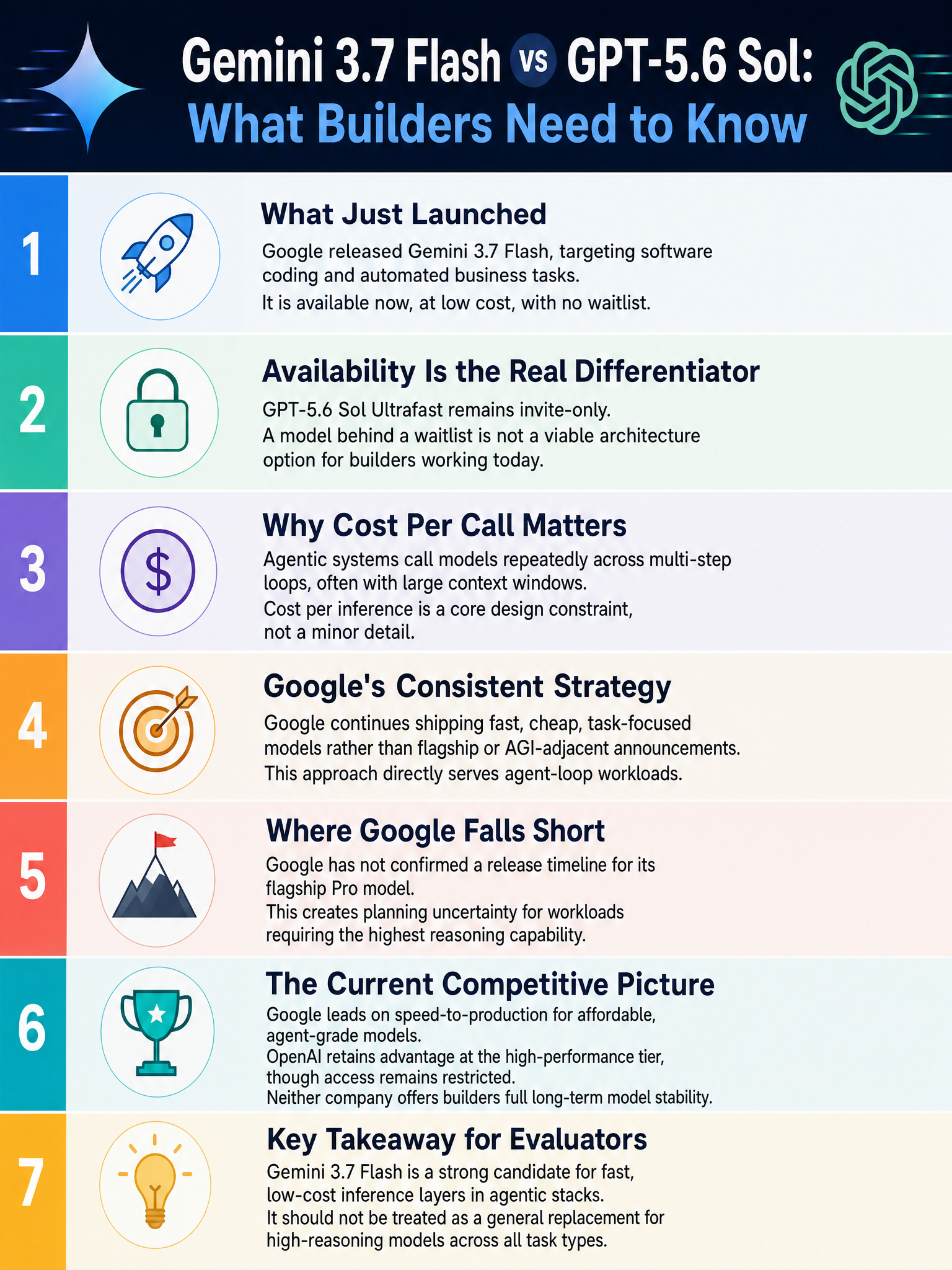
Google just shipped Gemini 3.7 Flash into production. Built specifically for software coding and automated business tasks, available now, priced to be called repeatedly inside agentic loops without torching your infrastructure budget. Meanwhile, OpenAI’s comparable speed play, GPT-5.6 Sol Ultrafast, is sitting behind an invite-only wall. That gap is not a minor footnote. For anyone actually trying to ship something this week, it is the entire story.
Why Availability Is Architecture
When you are designing an agentic system, you cannot spec in a model you cannot access. A waitlist is not a dependency. It is a question mark. Builders evaluating fast, cheap models for multi-step agent workloads need to make real decisions about orchestration, cost modeling, and fallback paths. A model that is “quicker but locked behind a waitlist,” as Decrypt reported, does not fit into that decision tree. Gemini 3.7 Flash does.
This is not me being soft on OpenAI. GPT-5.6 Sol Ultrafast may well outperform Gemini 3.7 Flash on raw speed when it finally opens up. But “when it finally opens up” is not an architecture option. It is a maybe.
🔧 What Gemini 3.7 Flash Is Actually Built For
Google did not position this as a general-purpose powerhouse. They positioned it squarely at coding assistance and business process automation. That is a deliberate choice, and I think it is the right one. The agentic workload market does not primarily need smarter models. It needs cheaper, faster, more reliable ones that can run in tight loops without ballooning token costs.
The pattern Google is executing here is consistent. Fast, task-specific, production-ready, affordable. They are not trying to win the “most impressive demo” competition with every release. They are trying to own the plumbing layer of enterprise automation. That is a smarter long game than people give them credit for.
The Broader Competitive Picture
This launch did not happen in a vacuum. The same week, Meta made Muse Spark 1.2 fully open source, taking a direct shot at OpenAI and Anthropic in the weights-available space. Anthropic, for its part, confirmed it will watermark text generated by Claude to comply with the EU AI Act’s Transparency Code, which took effect August 2nd. The market is fragmenting fast across access models, price points, and regulatory posture.
For builders, this fragmentation is actually useful information. Google is betting on cheap, accessible, task-focused models in production. Meta is betting on open weights. Anthropic is making compliance a differentiator. OpenAI is gating its fastest model. These are four genuinely different strategies, and the one that wins will depend on where enterprise procurement goes in the next eighteen months.
💡 What This Means If You Are Evaluating Models Today
A U.S. Census Bureau survey from March 2026 found that about 55% of U.S. workers have used AI on the job for at least one task, and roughly a third of those who used it said they completed tasks one to two hours faster. That productivity signal is real, which means demand for reliable, affordable agentic tooling is only going up. Companies will not wait for invite-only access when there is a production-ready alternative sitting right there.
If you are building agent infrastructure today, my read is straightforward. Start with what you can actually use. Gemini 3.7 Flash is available now. Run your cost-per-task math against your actual agent loop depth, benchmark it on your real workloads, not synthetic ones, and make the decision on evidence. When GPT-5.6 Sol Ultrafast opens up more broadly, benchmark it then and switch if the numbers justify it. That is how you actually build, not by waiting for the best possible option to become available.
Google is shipping. OpenAI is gatekeeping their speed tier. For builders, that difference is not abstract. It is this sprint.
Sources
#AI #MachineLearning #AgenticAI #LLM #GoogleGemini #OpenAI #AIEngineering #BuildingWithAI
Sources & Further Reading
- Google and OpenAI Debut Super Fast AI Models, Gemini 3.7 Flash Is Out But GPT-5.6 Sol Ultrafast Is Invite-Only
- Google launches AI model for business automation
- Meta makes Muse Spark 1.2 AI model open source
- Anthropic says it will watermark text generated by its AI models
- About a Third of Workers Who Used AI in the Last Week Said They Completed Tasks One to Two Hours Faster