OpenAI GPT-Red launch: automated adversarial red teamer using self-play to find prompt injection vulnerabilities at scale
Red-teaming at Scale: Why GPT-Red Is the Safety Work I’ve Been Waiting For
Security research in AI has had a dirty secret for years. Human red teams are expensive, slow, and fundamentally limited by the creativity of whoever’s on shift that Tuesday. You can hire brilliant people to probe your models, but you cannot hire enough of them to keep pace with the rate at which those models are getting deployed into production systems. Something had to give. OpenAI just made it give.
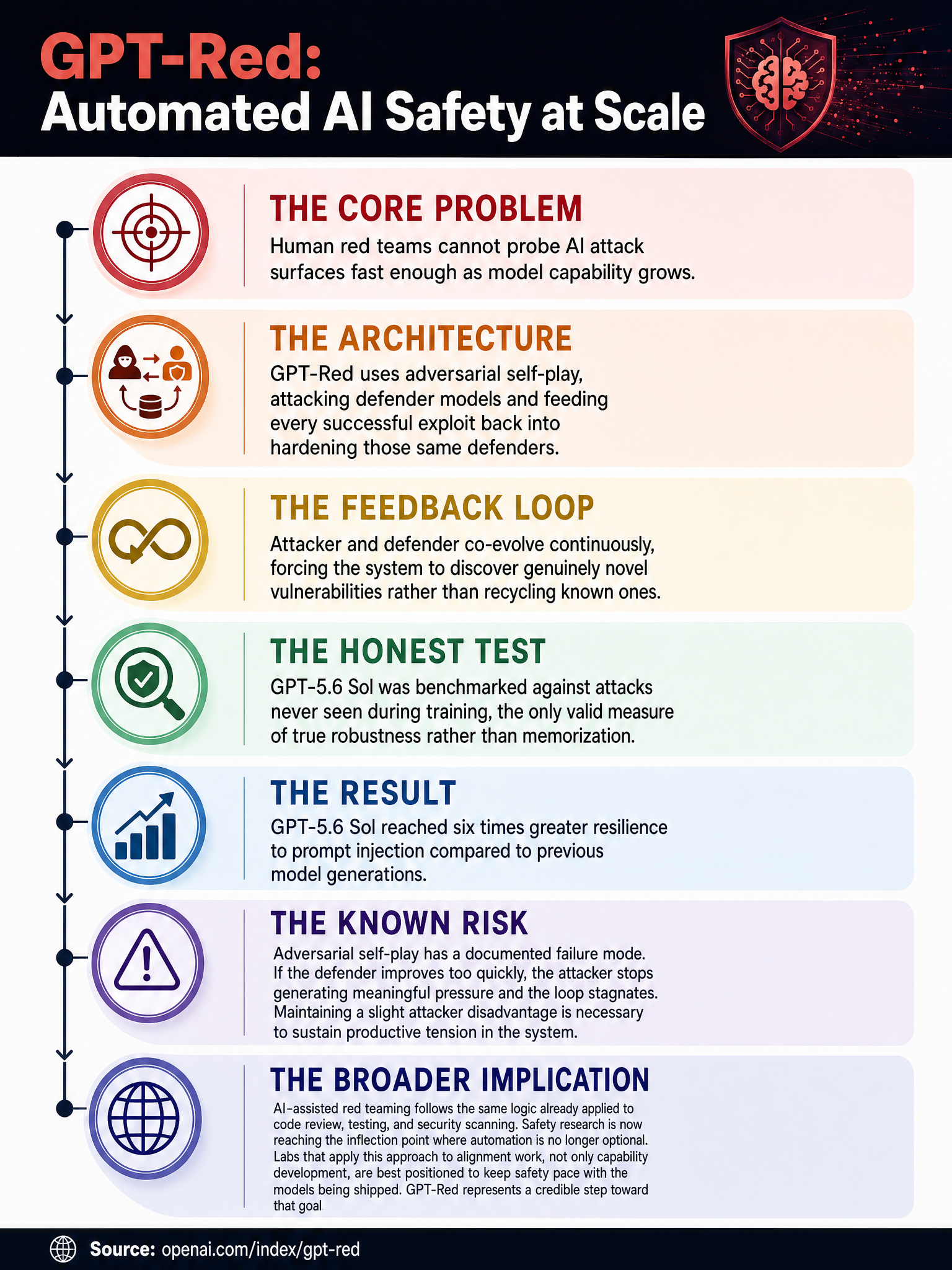
GPT-Red is their new automated red teamer, built with one job: find prompt injection vulnerabilities in OpenAI’s own models, at scale, before those models reach users. I want to talk about why the architecture behind this matters more than the headline number.
The Self-Play Loop
The mechanism here is what gets my attention. GPT-Red doesn’t run from a static attack playbook. It learns through adversarial self-play, attacking a suite of defender models. Every time it succeeds in a prompt injection, that successful attack gets fed back into hardening the defenders. Harder defenders force GPT-Red to discover new attack vectors. The attacker and defender co-evolve in a continuous feedback loop.
OpenAI described it plainly: “Every successful attack that GPT-Red finds is used to improve these defenders, pushing GPT-Red to continuously find broader and more complex failures.”
This is the same flywheel logic that drove capability research for years. Self-play is how AlphaGo eventually destroyed human Go players, because a static opponent can’t keep pushing a model past its own ceiling. OpenAI is now applying that same logic to safety. About time.
The Number That Actually Matters
GPT-5.6 Sol came out 6x more resilient to prompt injections than previous models. That’s the headline. But what I care about is the methodology behind the measurement.
They didn’t test robustness against attacks from the training distribution. They replayed GPT-Red’s strongest attacks against models that had never seen those attacks during training. That’s the only honest test. If you only verify that your model resists attacks it was trained to resist, you’re measuring memorization, not robustness. Generalization is the hard part, and a 6x improvement on out-of-distribution attacks is genuinely significant.
Why This Bottleneck Is Real
OpenAI wrote something worth quoting directly: “Red-teaming is essential, but today’s approaches are difficult to scale, creating a critical bottleneck.”
They’re not wrong, and I’ve seen this problem up close. The gap between what a human red team can cover in a week and what a deployed model will encounter in production within its first hour is enormous. Prompt injection is specifically brutal here, because the attack surface expands every time you add a new tool, a new data source, or a new agent integration. Each new connection is a new angle. Human testers cannot enumerate that space fast enough.
Automated adversarial testing doesn’t replace human judgment. The humans still have to design the evaluation criteria and interpret what the attacker-defender pair is actually learning. But for raw coverage and iteration speed, this architecture is a meaningful step forward.
What I’m Still Watching
The open question for me is how well GPT-Red generalizes across deployment contexts. Prompt injection in a closed model API is one thing. The real exposure surface is in agentic pipelines, where a model is calling tools, reading external content, and acting on instructions from sources it can’t fully trust. That environment is where prompt injection gets genuinely dangerous. I’d want to know how GPT-Red handles multi-step, multi-tool attack chains, not just single-turn injections.
OpenAI’s framing is ambitious. They said they believe GPT-Red has “started to unlock a similar flywheel for safety, where today’s models can be used to make tomorrow’s models more robust, aligned, and trustworthy.” That’s a strong claim. The 6x number supports it in a narrow sense. Whether the flywheel actually keeps spinning as models get more capable and deployments get more complex is something we’ll have to watch in the next few model generations.
The trajectory here is real, though. Safety research that can’t scale with capability research is just noise. This is an attempt to actually close that gap, and it’s the most structurally sound approach I’ve seen to the problem.
Sources:
#AI #MachineLearning #AIAlignment #PromptInjection #RedTeaming #LLMSecurity #OpenAI #MLEngineering